Dalit Man Lynched in Odisha Over Suspected Cattle Slaughter
Source:The Hindu ↗
Why It Matters
The incident underscores the continuing threat of mob lynching and cow vigilantism in India, which often disproportionately impacts Dalits and minorities. It raises critical concerns regarding the rule of law, the protection of vulnerable sections, and the challenges of maintaining social harmony against vigilante justice.
Summary
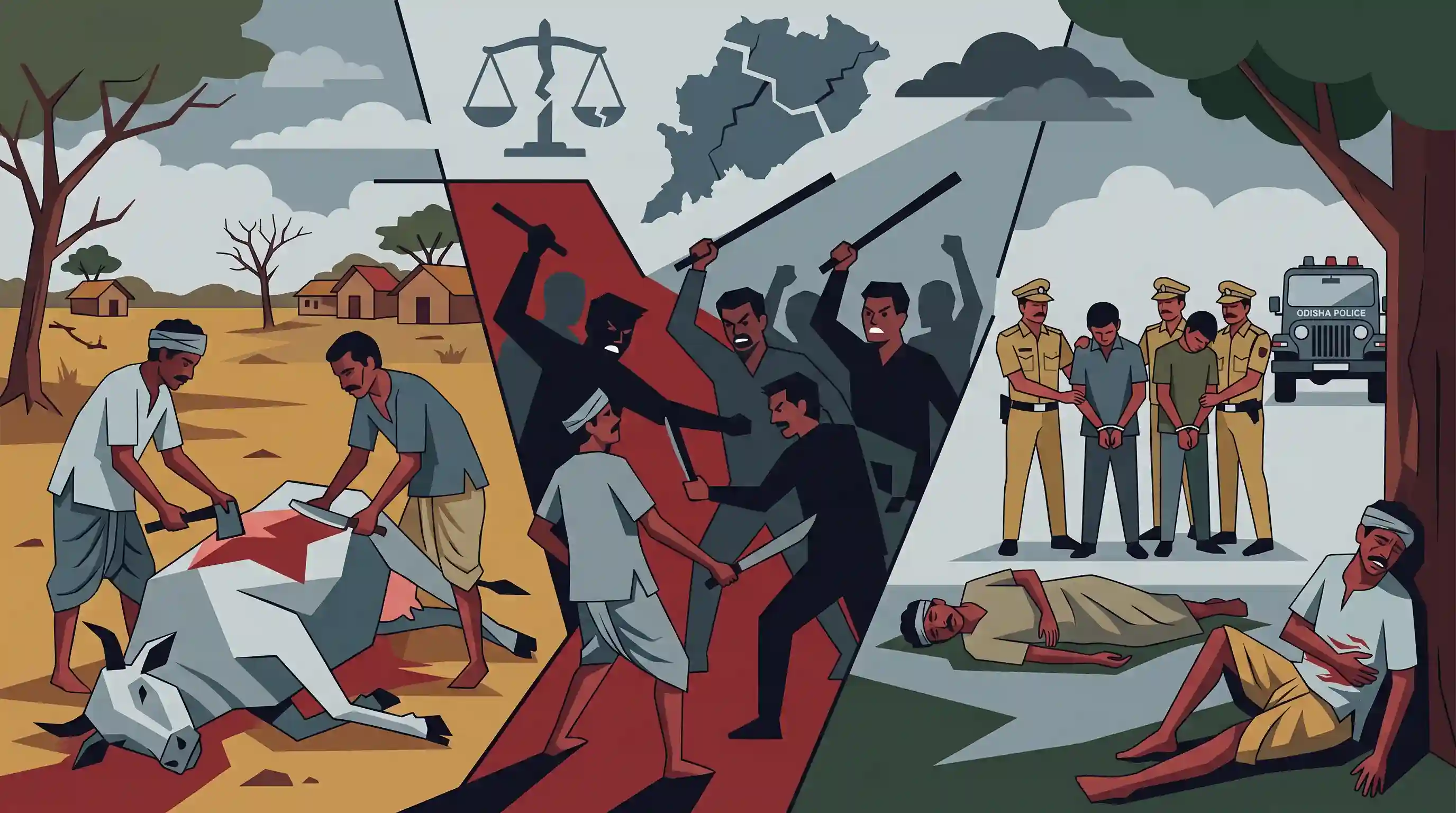
A Dalit man was lynched and his associate severely injured by a mob in Odisha's Deogarh district on suspicion of killing a cow. The victims, who belonged to a marginalized community and worked as traditional cattle skinners, were processing a cow that had died of natural causes when they were attacked. The Odisha Police have arrested six people in connection with the incident, which highlights the persisting issues of cow vigilantism and mob violence against vulnerable sections.
Key Points
- A 35-year-old Dalit man was lynched to death and his associate was critically injured by a mob in Odisha's Deogarh district over suspicions of cow slaughter.
- The victims, who traditionally worked as cattle skinners, were processing a cow that had already died of natural causes when they were attacked.
- Police have arrested six individuals from a neighboring village and registered cases of murder and attempt to murder.
- The incident reflects ongoing challenges with cow vigilantism and violence targeting marginalized communities reliant on traditional occupations.
Important Terms
Mob Lynching

A form of collective extrajudicial violence where a mob unlawfully punishes individuals based on perceived wrongdoing, bypassing legal procedures. It often targets marginalized communities based on rumors or biases.
UPSC context
GS Paper 2 (Polity/Constitution) and GS Paper 3 (Internal Security); tests understanding of law and order challenges and constitutional violations.
Cow Vigilantism
Acts of violence or intimidation carried out by self-appointed groups for 'protecting' cows. These often target cattle traders, skinners, or minorities on suspicion of cattle slaughter or smuggling.
UPSC context
GS Paper 1 (Secularism/Communalism) and GS Paper 3 (Internal Security); explores threats to social harmony and the secular fabric.
SC/ST (Prevention of Atrocities) Act, 1989
Special legislation protecting SC/ST communities from caste-based violence, humiliation, and discrimination. It defines specific 'atrocities,' establishes special courts, and bars anticipatory bail for accused individuals.
UPSC context
GS Paper 2 (Social Justice/Vulnerable Sections); crucial for questions on legal safeguards and empowerment of marginalized groups.
Tehseen Poonawalla Case (2018)
A landmark 2018 Supreme Court judgment that described lynching as a 'horrendous act of mobocracy' and mandated preventive, remedial, and punitive guidelines for state and central governments.
UPSC context
GS Paper 2 (Judiciary/Governance); provides the standard legal framework for addressing mob violence and state accountability.
Bharatiya Nyaya Sanhita (BNS)
The primary criminal code of India, replacing the IPC. Section 103(2) specifically penalizes mob lynching as murder committed by five or more persons based on race, caste, or community.
UPSC context
GS Paper 2 (Governance/Criminal Justice Reform); essential for current affairs questions regarding changes in India’s legal statutes.
Odisha Police
The state law enforcement agency responsible for maintaining order in Odisha. In this context, it is responsible for arresting culprits and enforcing the SC/ST Act in Deogarh.
UPSC context
GS Paper 3 (Police Reforms/Internal Security); represents the primary state apparatus for implementing law and order and protecting civil rights.
Rule of Law
A fundamental constitutional principle that no one is above the law and that judicial processes must occur in courts, not through 'mob justice' or extrajudicial killings.
UPSC context
GS Paper 2 (Polity/Governance); a core pillar of the Constitution, frequently tested in relation to democratic stability and justice.
Prelims Trap
"Mob lynching is not explicitly codified as a distinct offense under the Bharatiya Nyaya Sanhita (BNS)."
Section 103(2) of the BNS 2023 explicitly codifies murder by a mob of five or more persons on grounds of race, caste, or community as a distinct offense.
Static Concepts Connected
What are the key investigative and judicial safeguards under the SC/ST (PoA) Act?
- Anticipatory Bail Bar: Section 18 generally bars anticipatory bail, though the Supreme Court ruled it can be granted in exceptional cases if no prima facie case is established.
- Investigating Officer Rank: Investigations under the Act must be carried out by a police officer not below the rank of Deputy Superintendent of Police (DSP).
- Exclusive Special Courts: State governments must establish Exclusive Special Courts and appoint Special Public Prosecutors to ensure speedy, unhindered trials of atrocities.
What preventive measures against mob lynching were mandated in the Tehseen Poonawalla judgment?
- District Nodal Officers: States must appoint a senior police officer, not below the rank of Superintendent of Police (SP), as a Nodal Officer in every district to curb mob violence.
- Intelligence Task Forces: Police must constitute special task forces to gather intelligence about individuals likely to commit such crimes, spread hate speech, or incite mobs.
- Fast-Track Trials: State governments shall designate special fast-track courts in each district to hold day-to-day trials for lynching cases, concluding within six months.
Cross-Topic Patterns
Fundamental Rights vs. Vigilantism
State failure to prevent mob lynching directly violates Article 21 (Right to Life). The Supreme Court continually emphasizes the State's monopoly on legitimate violence to prevent "mobocracy."
Caste-Occupational Vulnerability
This incident exposes the economic vulnerability of Dalits engaged in traditional caste-based occupations like cattle skinning, trapping them at the intersection of rural poverty and majoritarian violence.

A multi-statement Prelims question comparing BNS Sec 103(2) mob lynching provisions with the SC/ST Act safeguards is highly probable.
Linked PYQs · 3
Linked PYQs · 3
- 2017MainsGS3
Mob violence is emerging as a serious law and order problem in India. By giving suitable examples, analyze the causes and consequences of such violence.
- 2024MainsGS1
Despite comprehensive policies for equity and social justice, underprivileged sections are not yet getting the full benefits of affirmative action envisaged by the Constitution. Comment.
- 2018MainsGS4
What do each of the following quotations mean to you in the present context? "Anger and intolerance are the enemies of correct understanding." Mahatma Gandhi
