Caste Prejudices and Honour Killing Incidents in Rural Madhya Pradesh
Source:Indian Express ↗
Why It Matters
This incident serves as a critical, real-world case study for UPSC Mains GS1 (features of Indian society, caste system) and GS2 (protection of vulnerable sections). It illustrates that despite constitutional protections like Article 17 and laws like the SC/ST Act, caste rigidities and "honour"-based violence remain formidable challenges, often superseding the Right to Life and Personal Liberty (Article 21).
Summary
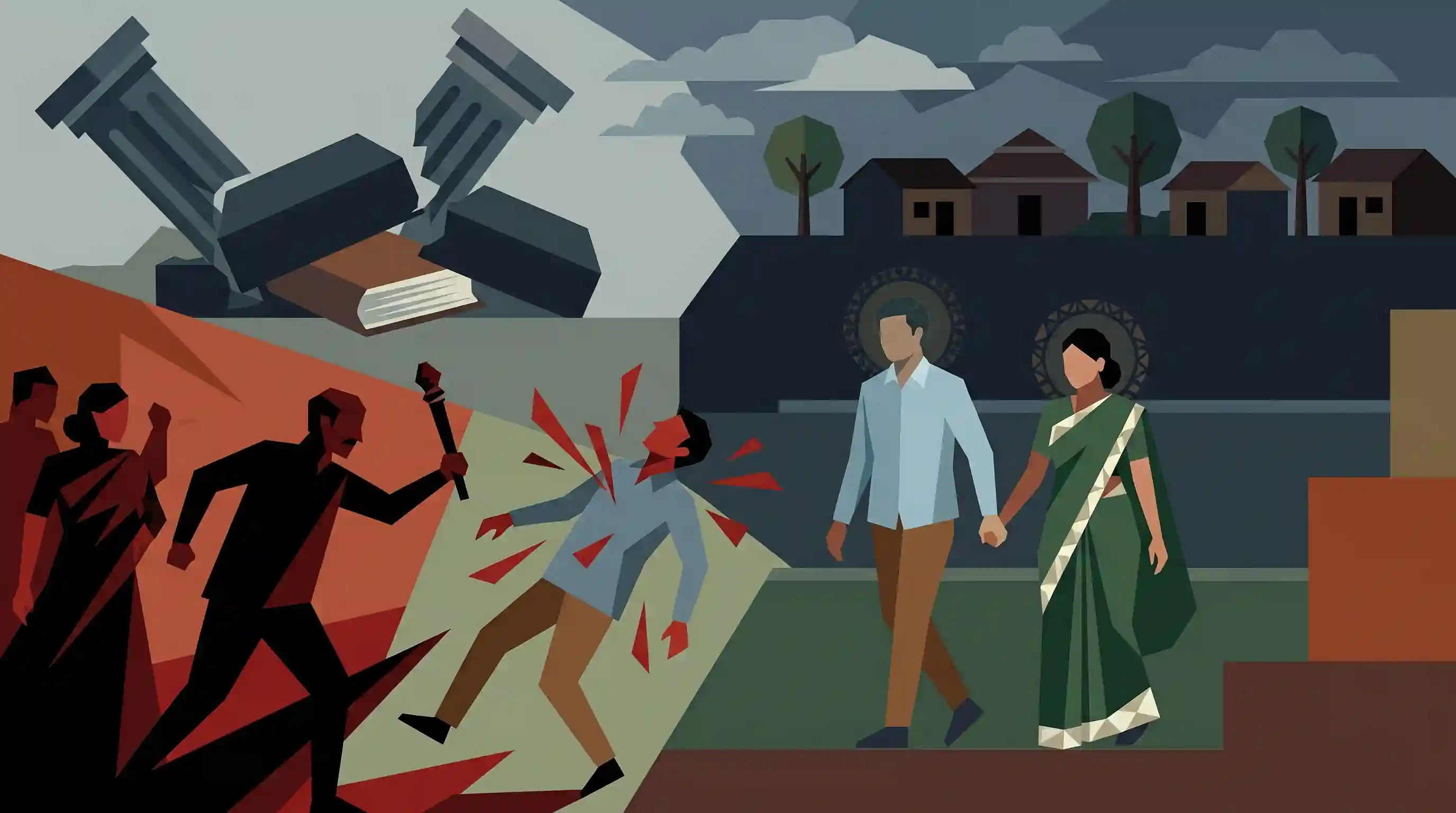
A Dalit man was allegedly murdered by his upper-caste wife's family upon returning to his village in Madhya Pradesh, months after their inter-caste marriage. The tragic incident highlights the persistent issue of caste-based violence and "honour killings" stemming from deep-rooted societal prejudices against inter-caste alliances. It exposes the acute vulnerabilities of marginalized communities and demonstrates how entrenched social dogmas continue to challenge constitutional morality and legal safeguards designed to protect vulnerable sections.
Key Points
- A Dalit man was brutally killed by his upper-caste wife's family upon their return to a village in Madhya Pradesh, months after their inter-caste marriage.
- The incident is a classic manifestation of an 'honour killing', driven by deep-rooted caste prejudice and societal resistance to marriages that transcend rigid caste boundaries.
- It highlights the acute vulnerability of marginalized communities and the often inadequate on-ground protection provided to inter-caste couples by local authorities.
- The event underscores a stark contrast between Constitutional guarantees (such as the Right to Equality and the Right to Life/Choose a partner) and prevailing social realities in rural India.
Important Terms
SC/ST (Prevention of Atrocities) Act

A 1989 law designed to prevent crimes, discrimination, and 'atrocities' against Scheduled Castes and Scheduled Tribes. It mandates special courts and denies anticipatory bail to accused persons to ensure deterrent punishment.
UPSC context
GS Paper 2: Mechanisms, laws, institutions, and Bodies constituted for the protection and betterment of vulnerable sections.
Honour Killings
Violence or murder committed by family or community members against individuals (mostly couples) perceived to have brought 'dishonour' to the group by defying caste, religious, or clan norms in marriage.
UPSC context
GS Paper 1: Social empowerment; GS Paper 2: Social justice and challenges to the rule of law.
Constitutional Morality
The principle of adhering to the core values of the Constitution—equality, liberty, and dignity—over traditional social morality or majoritarian dogmas when they conflict with individual fundamental rights.
UPSC context
GS Paper 2 & 4: Indian Constitution; Ethics and Human Interface (Social morality vs. Constitutional values).
Special Marriage Act, 1954
A civil law providing a legal framework for inter-caste and inter-religious marriages in India without requiring religious conversion, emphasizing the individual's right to choice in matrimonial alliances.
UPSC context
GS Paper 2: Statutory provisions related to marriage and personal liberty.
Caste Endogamy
The social custom of marrying only within a specific social group, caste, or ethnic group. It is considered the core mechanism through which the caste hierarchy and 'purity' are maintained.
UPSC context
GS Paper 1: Salient features of Indian Society; Diversity of India.
Article 21 (Right to Life)
A fundamental right guaranteeing that no person shall be deprived of their life or personal liberty except according to procedure established by law; includes the 'right to marry' by choice.
UPSC context
GS Paper 2: Fundamental Rights and judicial interpretations protecting individual autonomy.
Prelims Trap
Anticipatory bail is absolutely barred under the SC/ST (Prevention of Atrocities) Act without any exceptions.
While Section 18 of the SC/ST Act bars it, the Supreme Court ruled that anticipatory bail can be granted if no prima facie case is made out.
Static Concepts Connected
How is the right to choose a marriage partner protected under the Indian Constitution?
- Article 21: The Supreme Court (Lata Singh, Hadiya cases) ruled that an adult's right to choose a partner is a fundamental right.
- State Obligation: The state is bound to protect inter-caste and inter-faith couples from societal violence or harassment.
- Constitutional Morality: Violent opposition to a consenting adult's choice of partner violates the core tenets of constitutional morality.
What are the key directives of the Shakti Vahini v. Union of India (2018) judgment?
- Illegal Practice: The Supreme Court declared honour killings a barbaric, illegal practice that violates fundamental rights.
- Special Cells: Directed states to establish 24-hour helplines and special police cells in every district to assist couples.
- Safe Houses: Mandated the creation of safe houses for couples facing threats from families or informal local bodies.
Cross-Topic Patterns
Ambedkar and the Annihilation of Caste
Ambedkar viewed inter-marriage as the primary mechanism to destroy caste boundaries. This recurring violence highlights the stubborn persistence of 'endogamy' that he targeted in his writings.
Extra-legal authorities vs. Rule of Law
Informal rural assemblies issuing violent diktats present a direct challenge to formal Panchayati Raj institutions (PRIs) and undermine the constitutional rule of law.

GS-2 mains will likely test the gap between constitutional morality (Art 21) and entrenched social dogmas regarding inter-caste marriages.
Linked PYQs · 4
Linked PYQs · 4
- 2024MainsGS1
Intercaste marriages between castes which have socio-economic parity have increased, to some extent, but this is less true of interreligious marriages. Discuss.
- 2020MainsGS1
Has caste lost its relevance in understanding the multi-cultural Indian Society? Elaborate your answer with illustrations.
- 2018MainsGS1
Caste system is assuming new identities and associational forms. Hence, caste system cannot be eradicated in India." Comment.
- 2020PrelimsGS1
Which one of the following categories of Fundamental Rights incorporates protection against untouchability as a form of discrimination?
