Dalai Lama Succession Geopolitics and Sino Indian Relations
Source:Indian Express ↗
Why It Matters
The Tibet issue and the Dalai Lama's succession are central to Sino-Indian border disputes and diplomatic relations. Understanding the geopolitical maneuvering by China, India's strategic posture, and international interventions (like the US Resolve Tibet Act) is crucial for Mains GS-II (International Relations) and tracking the cultural history of Tibetan Buddhism is relevant for Prelims GS-I.
Summary
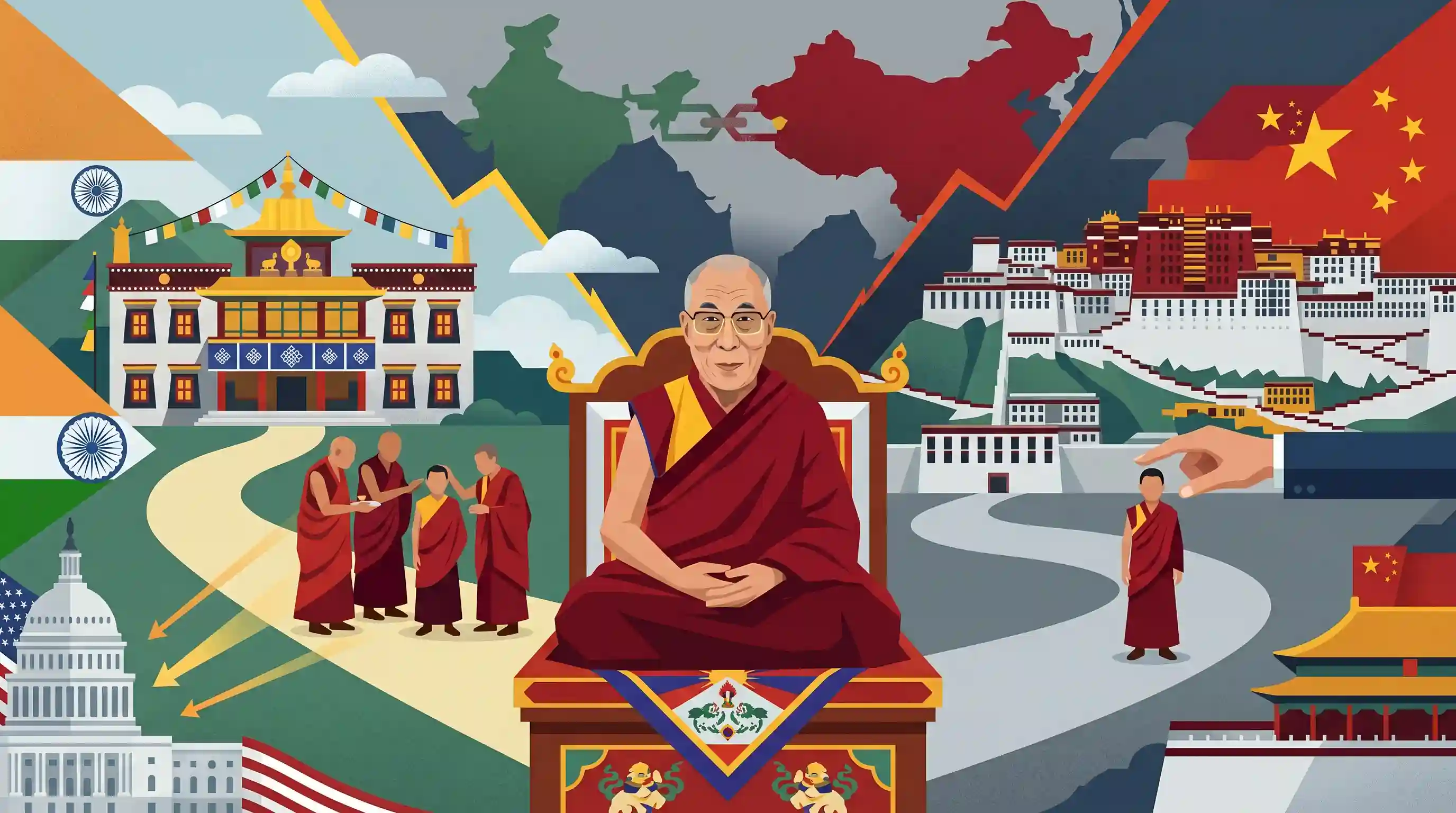
The article outlines the profound geopolitical and cultural significance of the 14th Dalai Lama's approaching 90th birthday, focusing primarily on the looming succession crisis. China seeks to assert total control over the reincarnation process to cement its political authority over Tibet, while the Tibetan government-in-exile and the Dalai Lama insist the choice must remain free from Chinese interference and occur in a free nation. This impending succession battle holds deep implications for Sino-Indian relations, as India provides refuge to the Dalai Lama, and for broader global geopolitics, highlighted by increasing US legislative support for Tibetan autonomy.
Key Points
- The upcoming 90th birthday of the 14th Dalai Lama amplifies the geopolitical and religious debate surrounding his succession and the reincarnation process.
- China intends to co-opt the reincarnation process to appoint a pliable successor, aiming to solidify its control over Tibet and extend influence across the Himalayan region.
- The Dalai Lama and the Central Tibetan Administration (CTA) assert that his successor will be born in a free country (likely India), rejecting any politically motivated interference from Beijing.
- The succession issue remains a significant irritant in India-China relations, given India's long-standing hosting of the Dalai Lama and the Tibetan government-in-exile in Dharamshala.
- Global powers, notably the United States, are countering China's assimilationist policies in Tibet through legislative actions like the Resolve Tibet Act, bolstering international support for Tibetan autonomy.
Important Terms
Resolve Tibet Act (2024)

2024 US law (Promoting a Resolution to the Tibet-China Dispute Act) that challenges China's sovereignty claims, labels Tibet as an unresolved dispute, and funds efforts to counter Chinese disinformation about Tibetan history.
UPSC context
GS II: Effect of policies of developed countries on India; tests understanding of shifting US-Tibet-China dynamics and their impact on India.
Middle Way Approach (Umaylam)
The Dalai Lama's official policy seeking 'genuine autonomy' for the Tibetan people within the framework of the Chinese Constitution, rejecting both the current status quo and full independence.
UPSC context
GS II: International Relations; relevant for questions on peaceful conflict resolution and India's long-standing support for Tibetan cultural autonomy.
Central Tibetan Administration (CTA)
The Tibetan government-in-exile based in Dharamshala, India. It provides democratic governance, education, and welfare for the Tibetan diaspora while advocating for the 'Middle Way' solution to the Tibet issue.
UPSC context
GS II: India and its neighborhood; highlights India's strategic role as a host and its delicate balancing act with China.
Tulku System (Reincarnation)
A Tibetan Buddhist tradition where high-ranking spiritual leaders (Lamas) are believed to be reborn. The 14th Dalai Lama insists his successor must be born in a 'free nation,' directly challenging China's control.
UPSC context
GS I & II: Art and Culture; also tests the intersection of religious tradition with modern territorial sovereignty and human rights.
Panchen Lama
The second-highest spiritual leader in the Gelug school of Tibetan Buddhism. Historically, the Panchen Lama and Dalai Lama play reciprocal roles in recognizing each other's reincarnations, making their lineage politically sensitive.
UPSC context
GS II: International Relations; tests knowledge of succession crises and China's 'Sinicization' of Tibetan Buddhism to control religious leadership.
Prelims Trap
India officially recognizes the Central Tibetan Administration (CTA) as the legitimate sovereign government-in-exile.
India provides asylum to the Dalai Lama and hosts the CTA, but strategically avoids officially recognizing it as a sovereign government to maintain a diplomatic balance with Beijing.
Static Concepts Connected
What is the historical basis of India's official diplomatic stance on Tibet?
- Panchsheel Agreement (1954): India officially recognized Tibet as a "region of China" and relinquished extra-territorial privileges inherited from British rule, establishing the Five Principles of Peaceful Coexistence.
- Humanitarian Asylum (1959): India granted humanitarian asylum to the Dalai Lama, asserting it as a non-political act. However, Beijing historically views this as direct interference in its affairs.
What are the key elements of the Gelug school and Tulku tradition?
- Gelug School: The newest and most dominant school of Tibetan Buddhism, also known as the "Yellow Hat" sect, traditionally headed spiritually by the Dalai Lama.
- Tulku Tradition: A unique Tibetan Buddhist concept where enlightened masters (Bodhisattvas) consciously choose their time and place of rebirth to continue their spiritual mission for humanity.
Cross-Topic Patterns
US domestic laws shaping Asian geopolitics
The 'Resolve Tibet Act' mirrors the 'Taiwan Relations Act', showing how the US leverages domestic legislation to challenge China's core territorial assertions and influence broader Indo-Pacific geopolitics.
Border security and Himalayan Buddhist populations
The Dalai Lama's succession directly impacts the religious allegiance of border communities in Ladakh, Sikkim, and Arunachal Pradesh (Tawang), deeply intertwining spiritual authority with India's frontier security.

US Resolve Tibet Act, Tulku succession, and China's religious decrees are highly likely to form a combined IR/Culture question.
Linked PYQs · 3
Linked PYQs · 3
- 2014MainsGS2
With respect to the South China sea, maritime territorial disputes and rising tension affirm the need for safeguarding maritime security to ensure freedom of navigation and over flight throughout the region. In this context, discuss the bilateral issues between India and China.
- 2024PrelimsGS1
Sanghabhuti, an Indian Buddhist monk, who travelled to China at the end of the fourth century AD, was the author of a commentary on:
- 2019PrelimsGS1
Consider the following: 1. Deification of the Buddha 2. Treading the path of Bodhisattvas 3. Image worship and rituals Which of the above is/are the feature/features of Mahayana Buddhism?
