Agriculture and Dairy Disputes Impede India US Trade Pact
Source:The Hindu ↗
Why It Matters
The article highlights the classic conflict in international trade diplomacy: balancing strategic geopolitical partnerships with the need to protect vulnerable domestic economic sectors, providing key insights into India's foreign trade policy priorities.
Summary
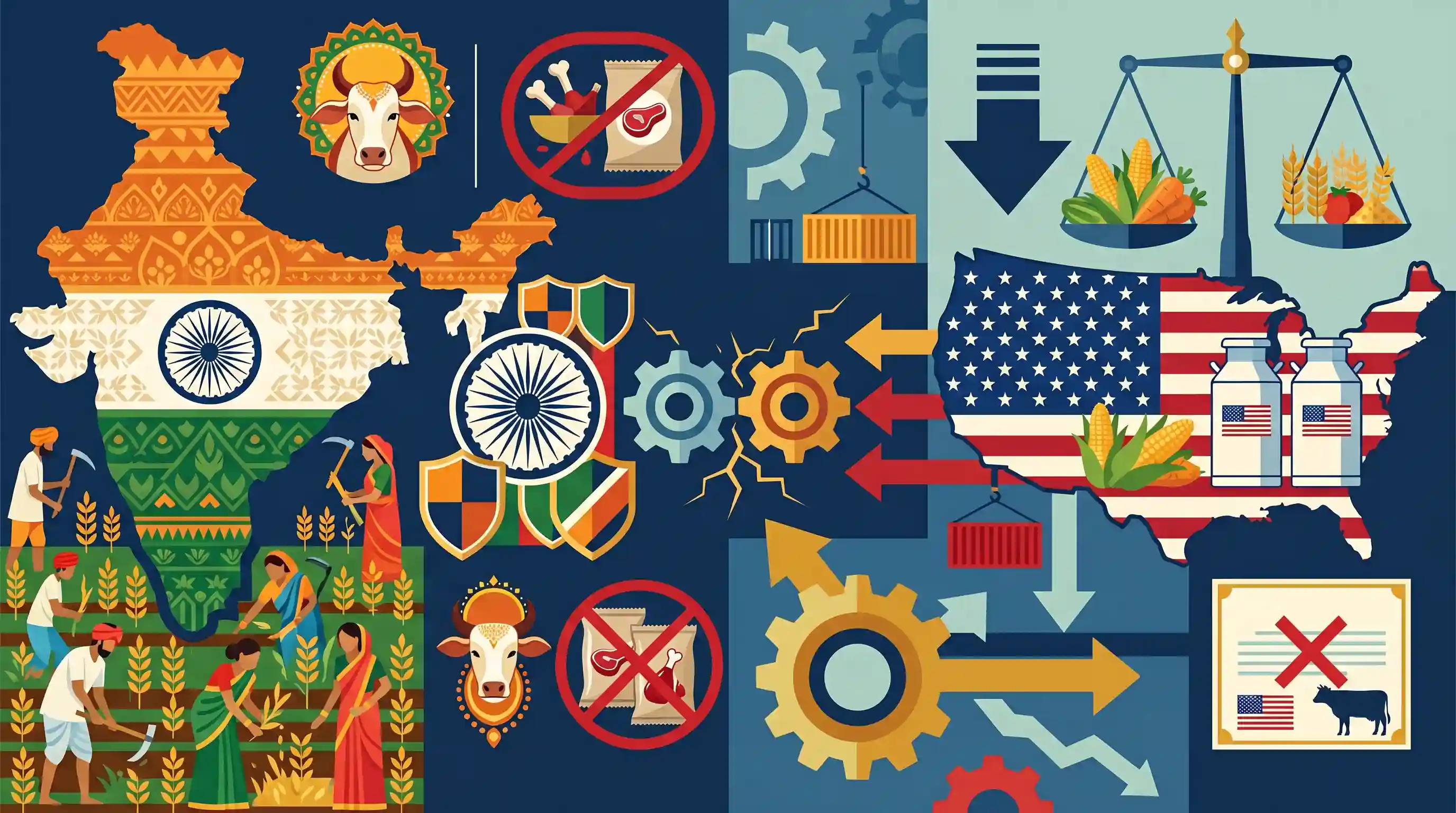
Negotiations for an India-U.S. bilateral trade agreement remain stalled primarily due to friction over the agriculture and dairy sectors. The U.S. is pushing for lower tariffs and greater market access for its farm goods, but India continues to protect its domestic agricultural workforce. Furthermore, India imposes strict certification requirements on dairy imports to ensure cattle are not fed animal extracts, a cultural imperative that the U.S. views as a non-tariff barrier. Balancing these domestic economic and cultural sensitivities with the desire for a broader strategic partnership remains a central challenge in India-U.S. economic diplomacy.
Key Points
- Disagreements over market access in the agriculture and dairy sectors are the primary bottlenecks in finalizing an India-U.S. bilateral trade pact.
- The U.S. seeks reduced tariffs for its agricultural products and the removal of non-tariff barriers restricting its dairy exports to the Indian market.
- India maintains strict certification norms for dairy imports (requiring proof that cattle are not given animal-derived feed) due to cultural sensitivities, which acts as a barrier to U.S. dairy.
- India's defensive stance in agriculture is driven by the need to protect the livelihoods of its millions of smallholder farmers against large-scale, subsidized U.S. agribusinesses.
Important Terms
Generalized System of Preferences (GSP)

A U.S. trade program providing non-reciprocal, duty-free entry for thousands of products from developing countries. India's beneficiary status was revoked in 2019, making its restoration a key negotiation priority.
UPSC context
GS Paper 2 (Bilateral Relations) & GS Paper 3 (Economy). Tests understanding of trade incentives and Indo-US economic friction.
India-U.S. Bilateral Trade Agreement
A proposed comprehensive economic pact between New Delhi and Washington aimed at reducing tariffs and increasing market access, currently focusing on a target of $500 billion in bilateral trade by 2030.
UPSC context
GS Paper 2 (International Relations). Crucial for questions on strategic partnerships and "trade-led diplomacy" challenges.
Non-Tariff Barriers (NTBs)
Trade restrictions, such as quotas, licensing, or certification requirements, used to limit imports without using direct tariffs. India's dairy certification rules are viewed as NTBs by the U.S.
UPSC context
GS Paper 3 (Economic Development). Tests knowledge of protectionist measures and technical barriers to international trade.
United States Trade Representative (USTR)
An agency of the U.S. federal government responsible for developing and recommending U.S. trade policy to the President and conducting bilateral/multilateral trade negotiations.
UPSC context
GS Paper 2. Relevant for understanding the institutional framework of global trade and major actors in bilateral disputes.
World Trade Organization (WTO)
The global international organization dealing with the rules of trade between nations. It provides a forum for negotiating trade agreements and a dispute settlement mechanism for trade conflicts.
UPSC context
GS Paper 3 (Major crops/cropping patterns). Tests knowledge of international standards (SPS/TBT) affecting Indian agricultural exports and imports.
Sanitary and Phytosanitary (SPS) Measures
WTO-governed measures used to protect human, animal, or plant life/health from risks like pests or additives. India uses these for dairy imports to align with cultural/religious values.
UPSC context
GS Paper 3. Critical for understanding technical trade friction and food safety standards in international commerce.
Prelims Trap
WTO's SPS measures allow member countries to restrict agricultural imports based on deep-seated socio-cultural or religious beliefs.
SPS measures must be strictly based on scientific risk assessments under WTO norms. The US leverages this to challenge India's culturally-driven dairy certification as a disguised trade restriction.
Static Concepts Connected
What is the difference between SPS and TBT agreements under the WTO?
- SPS Agreement: Focuses on protecting human, animal, or plant life from pests, diseases, and toxins. Import restrictions must be justified by scientific risk assessments.
- TBT Agreement: Covers technical regulations, product standards, packaging, and labeling not covered by SPS. Ensures technical standards do not create unnecessary trade obstacles.
- Key distinction: SPS is specific to biological and health risks, whereas TBT applies to broader technical, design, and quality specifications of traded goods.
What structural factors drive India's defensive stance in agricultural trade deals?
- Smallholder dominance: Around 86% of Indian farmers are small or marginal (under 2 hectares), unable to absorb price shocks or compete with massive, heavily subsidized Western agribusinesses.
- Livelihood security: Agriculture remains India's largest employer. Unrestricted tariff-free imports could devastate rural incomes and threaten national socio-economic stability.
- Non-tariff concerns: India strictly controls imports like genetically modified (GM) crops and dairy derived from animal-fed cattle, blending trade policy with cultural sensitivities.
Cross-Topic Patterns
Strategic vs Economic divergence
Despite converging on Indo-Pacific security via the Quad, India and the U.S. diverge sharply on trade, with agriculture acting as a persistent structural ceiling to bilateral FTAs.
WTO Peace Clause linkage
India's domestic agricultural protectionism here mirrors its ongoing fight at the WTO over public stockholding (PSH) subsidies and the permanent Peace Clause for food security.

Expect a 2026 prelims statement testing the strict scientific-basis requirement of WTO SPS measures versus general Non-Tariff Barriers.
Linked PYQs · 2
Linked PYQs · 2
- 2023MainsGS3
What are the direct and indirect subsidies provided to farm sector in India? Discuss the issues raised by the World Trade Organization (WTO) in relation to agricultural subsidies.
- 2014MainsGS2
The aim of Information Technology Agreements (ITAs) is to lower all taxes and tariffs on information technology products by signatories to zero. What impact would such agreements have on India's interests?
