Andhra Pradesh Power Demand Surge and Energy Management
Source:thehindu ↗
Why It Matters
The article demonstrates the cascading effects of climate anomalies like El Nino on state infrastructure and economy. It highlights the critical need for a diversified energy mix (incorporating renewables) and market mechanisms (like power exchanges) to ensure energy security during climate-induced peak demand periods.
Summary
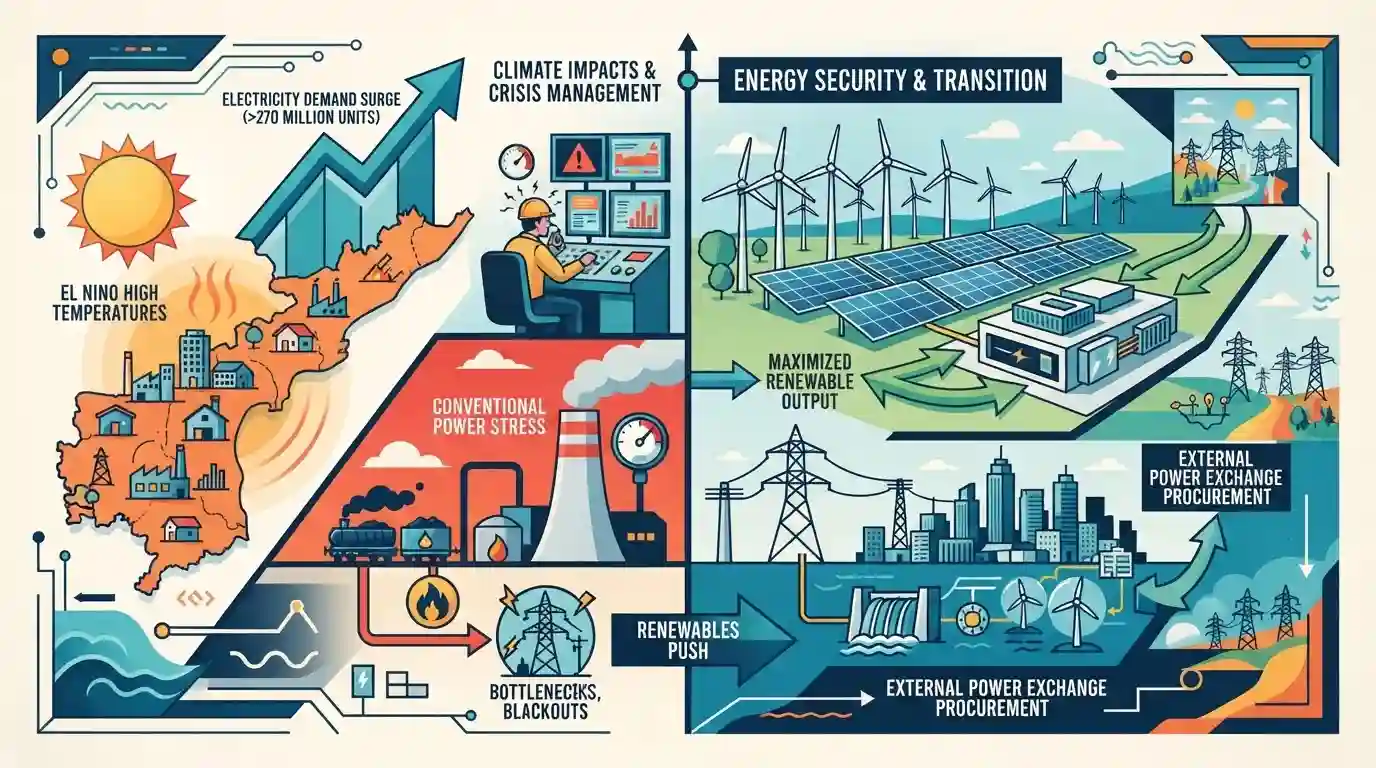
Andhra Pradesh is experiencing a significant surge in electricity consumption, with daily demand exceeding 270 million units, primarily driven by high temperatures linked to the El Nino phenomenon. To manage the crisis and ensure uninterrupted supply, the state government has mandated increased power generation and procurement from external power exchanges. Furthermore, there is a strategic push to ramp up renewable energy output to alleviate the stress on conventional thermal power plants, highlighting the intersection of climate impacts and energy infrastructure management.
Key Points
- Andhra Pradesh's daily electricity demand has surged past 270 million units (MU) due to intense heat waves caused by the El Nino effect.
- Energy Minister Gottipati Ravi Kumar directed officials to increase power generation and procure electricity from power exchanges, including the Term-Ahead Market.
- The state aims to boost renewable energy generation to reduce the operational burden on traditional thermal power units.
- AP Genco and DISCOMs are coordinating closely, utilizing data from the Real-Time Governance Society (RTGS) to manage peak load demands efficiently.
Important Terms
Term-Ahead Market (TAM)

A bilateral electricity trading mechanism allowing participants to buy or sell electricity on a short-term basis (up to 90 days ahead) through exchanges, helping utilities manage power portfolios efficiently.
UPSC context
GS-3 (Economy/Energy). Important for understanding power market reforms, grid stability, and renewable energy integration.
DISCOMs
Utility companies responsible for the final stage of electricity delivery. They procure power from generators and manage the local distribution network, metering, and consumer billing.
UPSC context
GS-3 (Economy/Infrastructure). Tests knowledge of India's power sector health, AT&C losses, and targeted government reforms like UDAY and RDSS.
Real-Time Governance Society (RTGS)
An e-governance initiative by the Andhra Pradesh government that unifies departmental databases, IoT sensors, and citizen feedback into a central platform for data-driven, real-time administration.
UPSC context
GS-2 (Governance). Exemplifies e-governance models, data-driven policymaking, transparency, and citizen-centric public service delivery.
AP Genco
The state-owned electricity generating company of Andhra Pradesh. Formed in 1999 following power sector reforms, it is responsible for establishing, operating, and maintaining thermal, hydro, and solar power plants.
UPSC context
GS-3 (Infrastructure). Acts as a state-level case study on the unbundling of electricity boards and the transition toward renewable generation.
AP Transco
The state electric power transmission company of Andhra Pradesh. It manages the high-voltage grid infrastructure and focuses on strengthening transmission networks to ensure stable power supply and renewable energy integration.
UPSC context
GS-3 (Infrastructure). Relevant for topics regarding grid stability, power evacuation infrastructure, and modernizing state electricity networks.
Prelims Trap
"Term-Ahead Market (TAM) allows entities to trade electricity derivatives for long-term power purchase agreements."
TAM is exclusively for the physical delivery of electricity for short-term durations (up to 11 days), not financial derivatives or long-term PPAs.
Static Concepts Connected
How does El Niño directly impact India's power generation mix?
- Hydro decline: Deficient rainfall reduces reservoir levels, drastically cutting hydroelectric power output across the country.
- Thermal burden: Spiking cooling demands force a much heavier reliance on coal-fired thermal plants to meet the increased base load, straining coal logistics.
- Wind variability: Altered atmospheric circulation and temperature gradients often suppress wind speeds, negatively impacting wind energy yields during peak summer months.
What are the primary short-term electricity markets on the Indian Energy Exchange (IEX)?
- Day-Ahead Market (DAM): Allows physical trading of electricity for delivery the very next day, usually cleared in 15-minute time blocks.
- Term-Ahead Market (TAM): Enables entities to trade electricity for short-term future durations (up to 11 days) to manage near-future supply deficits.
- Green Markets (GTAM): Green DAM/TAM allows renewable energy developers to sell green power directly, helping DISCOMs meet their Renewable Purchase Obligations (RPOs).
Cross-Topic Patterns
Climate Change vs. Grid Security
Extreme weather events like El Nino-driven heatwaves stress grid infrastructure, forcing a heavier reliance on coal base-load and complicating India's renewable energy transition goals.
E-Governance in DISCOM Management
Using AP's Real-Time Governance Society (RTGS) for peak load tracking exemplifies how states leverage data analytics to modernize DISCOMs and prevent grid failures, aligning with the Revamped Distribution Sector Scheme.

El Nino's cascading impact—linking monsoon deficits, hydro-power drops, and short-term grid stress via TAM—is ripe for 2026 Prelims.
Linked PYQs · 2
Linked PYQs · 2
- 2019APPSC_PRELIMSGS1
El-Nino is a complex weather system that appears once every three to seven years. Consider the following statements in this regard : A. The appearance of warm currents off the Coast of Peru in the Eastern Pacific. B. The word El-Nino means 'Christ Child' because the current appears around Christmas in December. C. El-Nino was one of the reasons for the deficit rainfall in India (2014). Which of the statements given above is/are correct ?
- 2024APPSC_PRELIMSGS1
The Interim Union Budget (FY25) has proposed initiatives to boost India's Green Energy Sector. Which of the following proposals are connected with developing India's Green Energy ? I. Viability Gap Funding (VGF) for utilizing solar energy projects II. To set up coal gasification and liquefaction capacity of 100MT by 2030 III. Optional blending of Compressed Bio Gas (CBG) in Compressed Natural Gas (CNG) for transport and Piped Natural Gas (PNG) for domestic purposes IV. Provision of financial assistance for procurement of biomass aggregation machinery V. Setting up of a payment security system for expanding the bio-manufacturing system in the country Select the correct answer using the codes given below :
