US proposes Peace Framework and Asset Release for Iran Deal
Source:Indian Express ↗
Why It Matters
The stability of the Middle East and the security of the Strait of Hormuz are intrinsically linked to global energy security. Any disruptions or peace settlements directly affect global crude oil prices, supply chains, and macroeconomic stability for energy-importing nations like India. The evolving US-Iran dynamics and Pakistan's role as a mediator also present important geopolitical shifts in India's extended neighborhood.
Summary
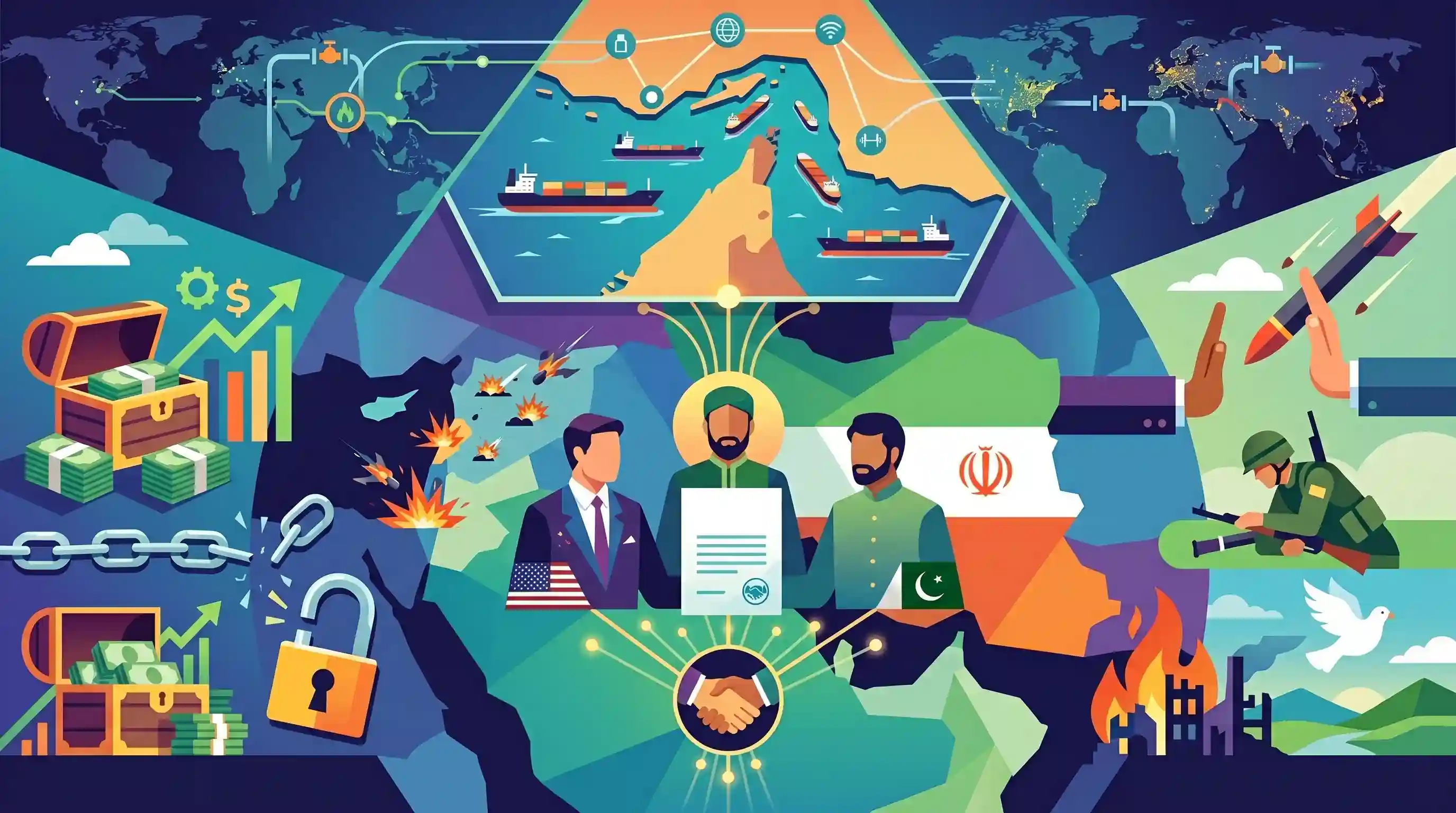
US Vice President JD Vance has outlined a potential peace framework between the United States and Iran, brokered by Pakistan in Islamabad, aiming to end the 2026 Iran War. The tentative deal offers Iran significant concessions, including sanctions relief and the phased release of up to $60 billion in frozen assets. In exchange, Iran must halt military actions and ensure the unhindered passage of global shipping through the Strait of Hormuz. This maritime chokepoint is critical to global energy security, handling a substantial portion of the world's oil trade. The negotiations are unfolding against a backdrop of continuing regional tensions, including ongoing airstrikes in Lebanon.
Key Points
- US Vice President JD Vance discussed a potential US-Iran peace framework, brokered by Pakistan in Islamabad, to formally end the 2026 Iran War.
- The proposed deal involves significant US concessions, including sanctions relief and unfreezing up to $60 billion in Iranian assets, contingent upon phased compliance.
- A central condition of the deal is Iran guaranteeing the safe, uninterrupted passage of commercial and energy vessels through the Strait of Hormuz.
- The Strait of Hormuz is highlighted as a critical geopolitical chokepoint, handling 20-30% of global oil shipments, making it vital for global energy security and macroeconomic stability.
- The talks are occurring amidst ongoing regional volatility, including airstrikes in Lebanon, reflecting the complex and interconnected geopolitics of West Asia.
Important Terms
Strait of Hormuz

A narrow waterway connecting the Persian Gulf and the Gulf of Oman. It handles roughly 20-30% of global oil trade, making it the world’s most critical energy chokepoint.
UPSC context
GS Paper I (Geography) and GS II (IR); tests knowledge of global energy lifelines and India’s maritime security interests.
Strategic Maritime Chokepoint
Naturally narrow sea passages that concentrate high volumes of shipping traffic. Control over these points provides significant geopolitical leverage and can disrupt global trade if blocked.
UPSC context
GS Paper II (IR); critical for questions on maritime security, freedom of navigation, and trade vulnerabilities.
Frozen Assets
Financial resources of a nation or entity held in foreign banks that are legally blocked, typically to punish violations of international law or as diplomatic leverage.
UPSC context
GS Paper II (IR); relevant for understanding economic diplomacy and bilateral negotiations, particularly between the US and Iran.
Sanctions Relief
The reduction or removal of economic and trade prohibitions previously imposed on a country, usually in exchange for policy shifts or compliance with diplomatic treaties.
UPSC context
GS Paper II (IR); important for analyzing the JCPOA and India’s energy import strategies from sanctioned nations.
Geopolitics of West Asia
The study of political and strategic interactions in the Middle East, driven by oil wealth, religious dynamics, and the influence of global powers like the US.
UPSC context
GS Paper II (IR); focuses on India’s regional interests, including energy security, remittances, and the safety of the Indian diaspora.
Peace Framework
A structured diplomatic plan designed to end hostilities through mutual concessions, such as halting military actions in exchange for asset releases and sanctions removal.
UPSC context
GS Paper II (IR); tests the ability to evaluate regional peace processes and their impact on India’s "Link West" policy.
Prelims Trap
"Coastal states like Iran can legally suspend transit passage through the Strait of Hormuz during wartime for national security."
Under UNCLOS, the right of 'transit passage' through straits used for international navigation cannot be suspended by bordering states, unlike 'innocent passage' in territorial waters.
Static Concepts Connected
What are the bordering nations and connected water bodies of the Strait of Hormuz?
- Bordering Nations: Iran to the north, and the United Arab Emirates (UAE) and Oman (Musandam Peninsula exclave) to the south.
- Connected Waters: It acts as a critical chokepoint linking the Persian Gulf in the west to the Gulf of Oman and the Arabian Sea in the southeast.
- Strategic Value: It is the only sea passage from the Persian Gulf to the open ocean, handling roughly 20-30% of global oil consumption.
How does 'Transit Passage' differ from 'Innocent Passage' under UNCLOS?
- Transit Passage: Applies to straits used for international navigation. Allows continuous, expeditious transit for all ships and aircraft, and crucially, cannot be suspended by coastal states.
- Innocent Passage: Applies to territorial waters. Requires submarines to navigate on the surface and show their flag. Coastal states can temporarily suspend it for essential security reasons.
Cross-Topic Patterns
Pakistan's mediation vs India's Look West
Pakistan brokering a US-Iran deal elevates its geopolitical weight, complicating India's strategic outreach in West Asia and its bypassing strategies via the Chabahar Port.
US sanctions relief & INSTC operationalization
The unfreezing of Iranian assets directly impacts India's geo-economic goals, potentially removing severe banking bottlenecks and CAATSA threats for the International North-South Transport Corridor (INSTC).

Strait of Hormuz geography + UNCLOS transit passage rules likely to form a dual-statement Prelims question given the 2026 Iran War context.
Linked PYQs · 4
Linked PYQs · 4
- 2025MainsGS2
"Energy security constitutes the dominant kingpin of India's foreign policy, and is linked with India's overarching influence in Middle Eastern countries.” How would you integrate energy security with India's foreign policy trajectories in the coming years?
- 2024MainsGS2
Discuss the geopolitical and geostrategic importance of Maldives for India with a focus on global trade and energy flows. Further also discuss how this relationship affects India's maritime security and regional stability amidst international competition ?
- 2017MainsGS2
The question of India's Energy Security constitutes the most important part of India's economic progress. Analyze India's energy policy cooperation with West Asian countries.
- 2024PrelimsGS1
Consider the following statements : Statement-I : Sumed pipeline is a strategic route for Persian Gulf oil and natural gas shipments to Europe. Statement-II : Sumed pipeline connects the Red Sea with the Mediterranean Sea. Which one of the following is correct in respect of the above statements?
