Cyclone Montha impacts and railway infrastructure vulnerability
Source:The Hindu ↗
Why It Matters
It demonstrates the real-world impact of extreme weather events on critical infrastructure like railways, reinforcing the importance of disaster preparedness, inter-agency coordination (SCR and TSRTC), and climate-resilient infrastructure planning.
Summary
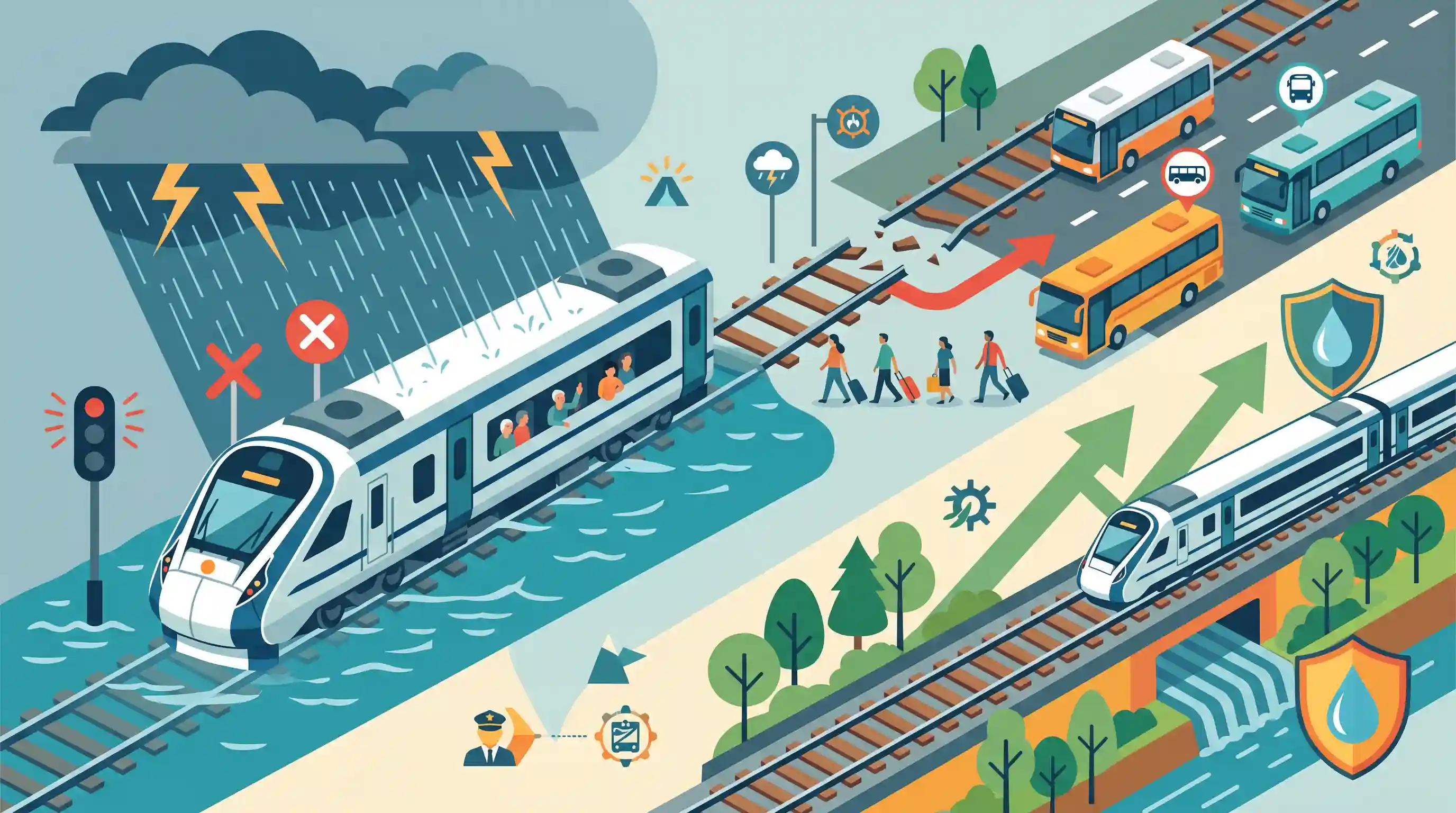
Heavy rains induced by Cyclone Montha have caused extensive waterlogging on railway tracks in Telangana, particularly in the Mahabubabad-Dornakal-Khammam section, severely disrupting train services. Key trains, including the Vande Bharat Express, were cancelled, diverted, or rescheduled. The South Central Railway (SCR) had to arrange alternative bus transport for stranded passengers. This disruption underscores the urgent need for enhancing the climate resilience of critical transport infrastructure against extreme weather events and inland flooding.
Key Points
- Incessant rainfall triggered by Cyclone Montha caused severe waterlogging along the Mahabubabad-Dornakal-Khammam railway section in Telangana.
- Several major train services, including the Vande Bharat Express, were cancelled, diverted, or delayed due to inundated tracks.
- South Central Railway (SCR) coordinated with the state road transport corporation to arrange buses for stranded passengers.
- The incident highlights the vulnerability of critical transport infrastructure to extreme weather events and the necessity of building disaster resilience.
Important Terms
Vande Bharat Express

India's first indigenously designed and manufactured semi-high-speed, self-propelled train set (Train 18), featuring faster acceleration and advanced passenger amenities like GPS-based systems and bio-vacuum toilets.
UPSC context
GS3: Infrastructure and Technology; relevant for 'Make in India' and modernization of Indian Railways.
South Central Railway (SCR)
One of the 19 zones of Indian Railways, headquartered in Secunderabad, with a jurisdiction spanning Telangana, Andhra Pradesh, and parts of Maharashtra, Karnataka, and Madhya Pradesh.
UPSC context
GS3: Infrastructure; tests knowledge of India's transport geography and critical logistical hubs.
Climate Resilience
The ability of infrastructure and systems to anticipate, prepare for, and adapt to changing climate conditions and withstand or recover rapidly from disruptions caused by climate-related events.
UPSC context
GS3: Disaster Management and Environment; crucial for planning sustainable infrastructure against extreme weather.
Tropical Cyclone
A rapid-rotation storm system characterized by a low-pressure center, strong winds, and heavy rain, originating over warm tropical oceans.
UPSC context
GS1: Geography (Physical); GS3: Disaster Management; focuses on cyclone formation, naming, and mitigation strategies.
Inland Flooding
Flooding that occurs in landlocked areas, typically caused by intense rainfall that overwhelms drainage systems or causes rivers and lakes to overflow far from the coast.
UPSC context
GS3: Disaster Management; tests understanding of urban flooding and drainage infrastructure vulnerabilities.
Telangana State Road Transport Corporation (TSRTC)
A state-owned corporation that provides public transport bus services within the state of Telangana, often serving as a critical alternative during rail or road disruptions.
UPSC context
GS3: Infrastructure; represents state-level public utility services and multi-modal transport integration.
Prelims Trap
CDRI is a specialized UN agency established to implement the Sendai Framework.
CDRI is an independent multilateral partnership launched by India at the 2019 UN Climate Action Summit. It is not a specialized UN agency.
Static Concepts Connected
What are the prerequisite conditions for the formation of tropical cyclones?
- Warm sea surface: Large sea surface with temperatures exceeding 26.5°C to provide continuous moisture and heat.
- Coriolis force: Presence of the Coriolis force is necessary to create a cyclonic vortex.
- Low wind shear: Small variations in the vertical wind speed are required to prevent the storm from being torn apart.
- Pre-existing low: A pre-existing weak low-pressure area or low-level cyclonic circulation acts as the initial trigger.
What are the key features of the Coalition for Disaster Resilient Infrastructure (CDRI)?
- Origin: Launched by India at the 2019 UN Climate Action Summit to promote resilient infrastructure.
- Objective: Aims to build resilience of infrastructure systems to climate and disaster risks, supporting sustainable development.
- Headquarters: The CDRI Secretariat is headquartered in New Delhi, India.
Cross-Topic Patterns
Rapid Intensification & SST Rise
Rising Sea Surface Temperatures (SST) are causing cyclones to intensify rapidly before landfall, reducing IMD warning lead times and increasing the severity of inland flooding events.
Sendai Target 'D' & Railways
Disruptions to the Vande Bharat network highlight Sendai Target 'D', which mandates reducing disaster damage to critical infrastructure and preventing disruption of basic utility services.

Mains 2026 may ask to evaluate India's progress on Sendai Target D, linking rapid cyclone intensification with critical infrastructure gaps.
Linked PYQs · 3
Linked PYQs · 3
- 2024MainsGS3
What is disaster resilience? How is it determined? Describe various elements of a resilience framework. Also mention the global targets of Sendai Framework for Disaster Risk Reduction (2015–2030).
- 2024MainsGS3
Flooding in urban areas is an emerging climate-induced disaster. Discuss the causes of this disaster. Mention the features of two such major floods in the last two decades in India. Describe the policies and frameworks in India that aim at tackling such floods.
- 2024MainsGS1
What is sea surface temperature rise? How does it affect the formation of tropical cyclones?
