Operation Sagar Bandhu for Cyclone Ditwah in Sri Lanka
Source:The Hindu ↗
Why It Matters
The article provides a concrete contemporary example of India's 'Neighbourhood First' policy and 'Vision MAHASAGAR' in action. It is highly relevant for GS2 questions on India-Sri Lanka bilateral relations and India's role as a net security provider/first responder in the Indian Ocean Region, as well as GS3 topics regarding the role of defense forces in disaster management (HADR).
Summary
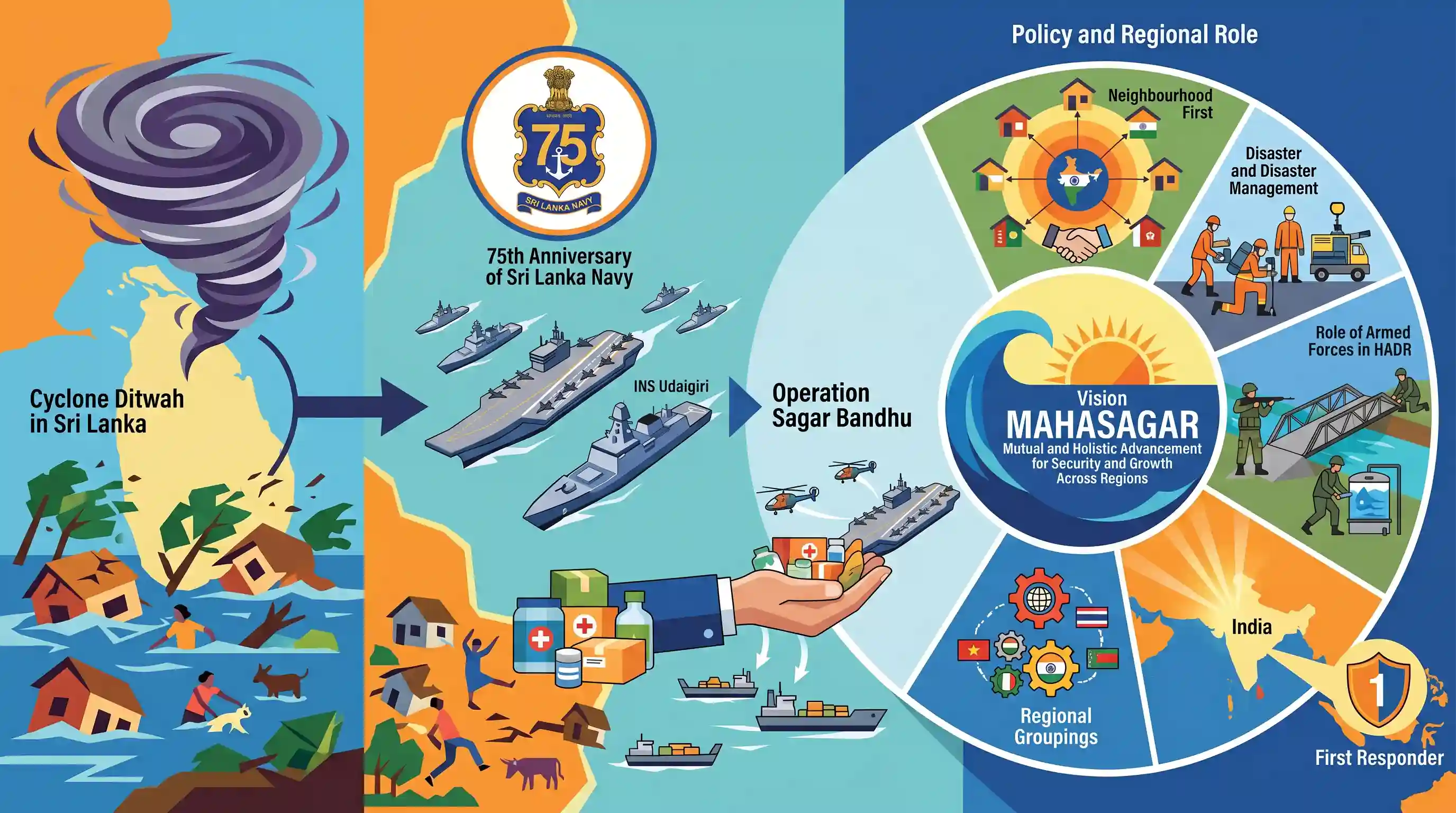
In response to the devastation caused by Cyclone Ditwah in Sri Lanka, India has launched 'Operation Sagar Bandhu' to provide immediate humanitarian assistance. Utilizing naval assets like INS Vikrant and INS Udaigiri—which were present for the Sri Lanka Navy's 75th-anniversary review—India swiftly delivered relief materials. The operation highlights India's proactive disaster response diplomacy, reinforcing its 'Neighbourhood First' policy and 'Vision MAHASAGAR' by acting as the first responder in the Indian Ocean Region.
Key Points
- Cyclone Ditwah wreaked havoc in Sri Lanka, leaving over 50 dead and affecting tens of thousands of people.
- India launched 'Operation Sagar Bandhu' to provide swift Humanitarian Assistance and Disaster Relief (HADR) to Sri Lanka.
- Relief materials were promptly delivered by Indian Navy ships INS Vikrant and INS Udaigiri, which were already in Sri Lanka for a fleet review.
- The operation operationalizes India's 'Neighbourhood First' policy and Vision MAHASAGAR (Mutual And Holistic Advancement for Security and Growth Across Regions).
- It underscores India's evolving role as a 'net security provider' and 'first responder' in the Indian Ocean Region during natural crises.
Important Terms
Operation Sagar Bandhu

India's 2025 HADR mission assisting Sri Lanka after Cyclone Ditwah, involving naval and air assets delivering tons of relief material and restoring critical infrastructure.
UPSC context
GS II (International Relations) & GS III (Disaster Management); tests India's 'first responder' role and disaster diplomacy.
Neighbourhood First policy
A strategic foreign policy prioritising friendly, stable, and mutually beneficial ties with immediate neighbours through enhanced connectivity, economic integration, and proactive humanitarian assistance.
UPSC context
GS II (Bilateral Relations); fundamental for understanding India’s regional leadership and management of its immediate periphery.
Vision MAHASAGAR
Acronym for 'Mutual and Holistic Advancement for Security and Growth Across Regions,' an Indian Navy outreach initiative for maritime cooperation and collective security.
UPSC context
GS II (International Relations); reflects India’s evolved maritime strategy for the Global South and Indian Ocean Region.
Cyclone Ditwah
A catastrophic tropical cyclone that hit Sri Lanka in November 2025, causing extreme flooding and landslides, leading to hundreds of deaths and massive displacement.
UPSC context
GS III (Disaster Management); a case study for regional climate vulnerabilities and the impact of extreme weather events.
Humanitarian Assistance and Disaster Relief (HADR)
Non-combat military operations providing life-saving aid and logistics during disasters, serving as a key tool for Indian 'soft power' and regional stability.
UPSC context
GS II & GS III; evaluates the role of armed forces in non-traditional security challenges and diplomatic outreach.
INS Vikrant
India's first indigenously designed and built aircraft carrier, commissioned in 2022; used in Operation Sagar Bandhu for search-and-rescue and emergency supply delivery.
UPSC context
GS III (Security/Technology) & GS II; represents self-reliance in defence (Atmanirbhar Bharat) and maritime capability.
Prelims Trap
Operation Sagar Bandhu is an Indian Navy mission to provide maritime security escorts for commercial vessels in the Red Sea.
Aspirants often confuse Indian Navy missions. Sagar Bandhu is an HADR mission for Sri Lanka post-cyclone, not an anti-piracy or maritime escort operation in the Red Sea like Operation Sankalp.
Static Concepts Connected
How are tropical cyclones named in the North Indian Ocean?
- Naming Panel: 13 member countries of the WMO/ESCAP Panel contribute 13 names each to a master rolling list for the Bay of Bengal and Arabian Sea.
- RSMC New Delhi: The Regional Specialised Meteorological Centre (RSMC) in New Delhi officially assigns these names sequentially to developing cyclones in the region.
- Neutrality Criteria: Proposed names must be politically, religiously, and culturally neutral, short, easy to pronounce, and cannot exceed eight letters.
What are the core pillars of India's SAGAR and Vision MAHASAGAR doctrines?
- SAGAR Doctrine: Launched in 2015, SAGAR (Security and Growth for All in the Region) aims to ensure a free, open, and inclusive Indian Ocean Region.
- Vision MAHASAGAR: An evolution of SAGAR, it emphasizes "Mutual And Holistic Advancement for Security and Growth Across Regions," expanding geographical scope and formalized maritime head interactions.
- First Responder Posture: A strategic posture where India leverages its blue-water naval capabilities to be the earliest provider of humanitarian aid during regional crises.
Cross-Topic Patterns
HADR as a counter-geopolitics tool
India’s 'First Responder' identity via missions like Sagar Bandhu strategically contrasts its swift, unconditional humanitarian assistance against China’s debt-heavy infrastructure footprint in Indian Ocean island nations.
Blue-water assets for diplomatic soft power
Deploying INS Vikrant for disaster relief demonstrates how capital-intensive aircraft carriers double as floating logistical bases, projecting both hard security and vital humanitarian soft power simultaneously.

Expect a Prelims match-the-following on recent Indian HADR missions (Sagar Bandhu, Karuna, Dost) paired with their target countries.
Linked PYQs · 2
Linked PYQs · 2
- 2022MainsGS2
India is an age-old friend of Sri Lanka.’ Discuss India's role in the recent crisis in Sri Lanka in the light of the preceding statement.
- 2020MainsGS3
Discuss the recent measures initiated in disaster management by the Government of India departing from the earlier reactive approach.
