Cyclone Ditwah humanitarian assistance and disaster relief operations
Source:The Hindu ↗
Why It Matters
The event highlights India's critical role as a first responder in South Asia under its 'Neighbourhood First' policy. It also brings attention to the socio-economic vulnerabilities of the Indian-origin Malaiyaha Tamils in Sri Lanka, connecting to historical topics of colonial-era labour migration, and emphasizes the increasing frequency and impact of climate-induced disasters like cyclones and landslides in the Indian Ocean region.
Summary
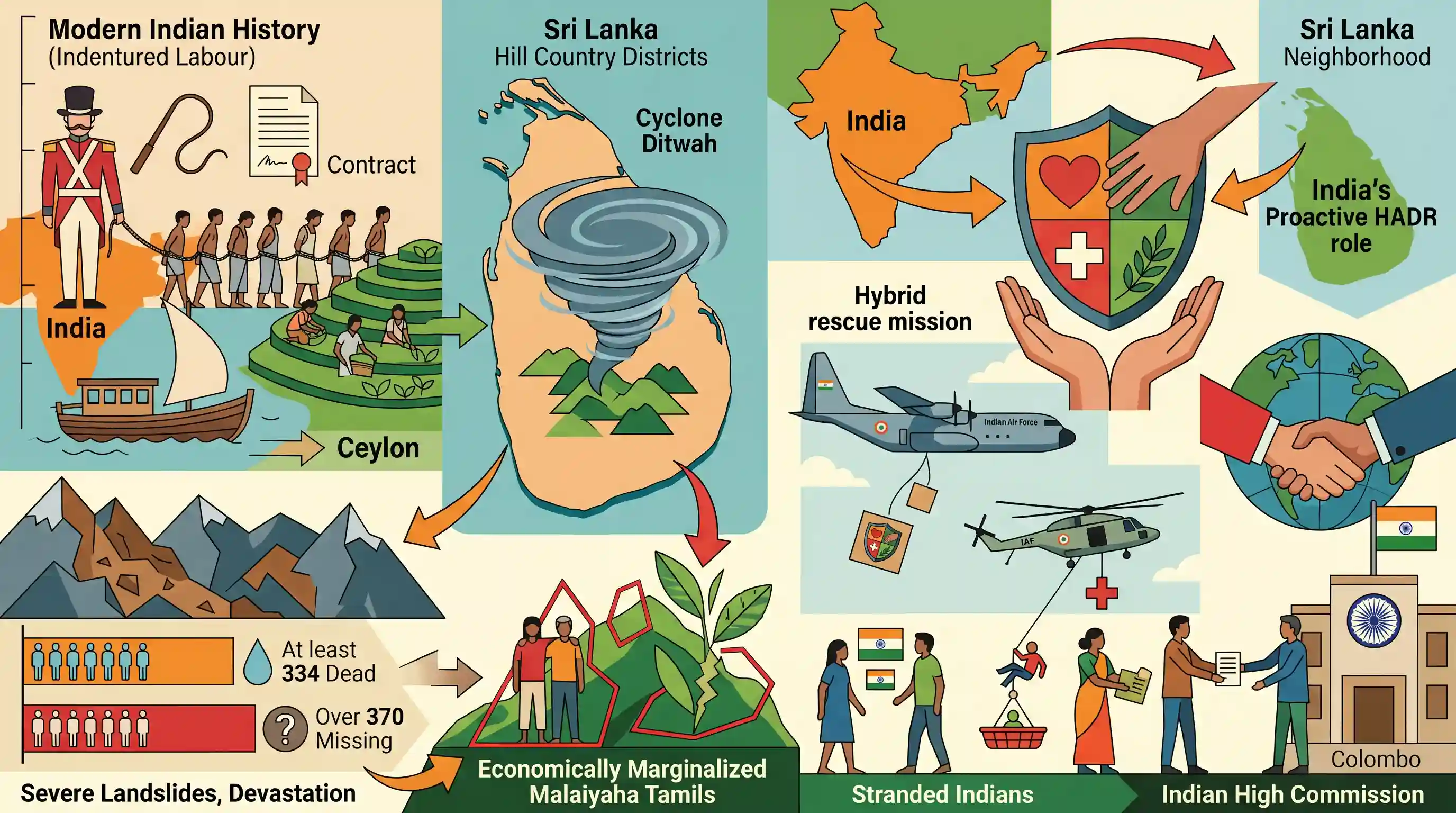
Cyclone Ditwah has caused extensive devastation in Sri Lanka, triggering severe landslides that have left at least 334 dead and over 370 missing. The cyclone disproportionately impacted the economically marginalized Malaiyaha Tamils—descendants of South Indian plantation workers brought by the British—living in the hill country districts. In response to the crisis, the Indian Air Force launched a hybrid rescue mission to assist Sri Lankan authorities, while the Indian High Commission helped stranded Indians, underscoring India's proactive Humanitarian Assistance and Disaster Relief (HADR) role in the neighbourhood.
Key Points
- Cyclone Ditwah severely impacted Sri Lanka, causing massive rainfall, multiple landslides, and resulting in at least 334 deaths and 370 missing persons.
- The hill districts of Badulla, Kandy, Nuwara Eliya, and Matale were among the worst-hit areas, displacing over two lakh people.
- The disaster disproportionately affected the Malaiyaha Tamils, descendants of South Indian plantation workers brought by the British, whose colonial-era line rooms collapsed under landslides.
- The Indian Air Force collaborated with Sri Lankan authorities in a 'hybrid rescue mission' to evacuate stranded individuals.
- The Indian High Commission in Colombo facilitated the safe return of stranded Indian nationals.
Important Terms
Malaiyaha Tamils

Descendants of 19th-century South Indian indentured labourers brought by the British to work on Sri Lanka's tea and rubber plantations; historically marginalized and distinct from 'Sri Lankan Tamils'.
UPSC context
GS Paper I (Modern History/Social Issues) and GS Paper II (Indian Diaspora); tests knowledge of colonial labour migration and overseas Indian communities.
Humanitarian Assistance and Disaster Relief (HADR)
Coordinated civil-military operations—often led by the Indian Armed Forces—to provide rapid relief, rescue, and medical aid during natural disasters or humanitarian crises abroad.
UPSC context
GS Paper II (International Relations) and GS Paper III (Disaster Management); tests India's role as a 'net security provider' and 'first responder'.
Neighborhood First Policy
A strategic foreign policy priority focusing on strengthening bilateral ties, regional connectivity, and stability with India's immediate neighbors like Sri Lanka, Nepal, and Bangladesh.
UPSC context
GS Paper II (Bilateral and Regional Relations); central to questions on India's geopolitical strategy and regional leadership.
Disaster Management Centre (DMC)
The apex government body in Sri Lanka responsible for coordinating disaster risk reduction, early warnings, and emergency response operations under the Disaster Management Act No. 13 of 2005.
UPSC context
GS Paper III (Disaster Management); relevant for comparative studies of international disaster response frameworks and inter-agency coordination.
Indian High Commission
The primary diplomatic mission representing Indian interests in Sri Lanka, responsible for coordinating bilateral aid, protecting Indian nationals, and managing diaspora relations.
UPSC context
GS Paper II (International Relations); focuses on the role of diplomatic channels in crisis management and bilateral cooperation.
Indian Diaspora
The global community of people of Indian origin (PIOs) and Non-Resident Indians (NRIs); in Sri Lanka, this specifically includes the 'Indian-origin Tamils' or Malaiyaha community.
UPSC context
GS Paper II (Effect of policies and politics of developed and developing countries on India’s interests, Indian Diaspora).
Prelims Trap
"Malaiyaha Tamils are the indigenous Tamil population inhabiting the Northern and Eastern provinces of Sri Lanka."
Malaiyaha (Hill Country) Tamils are descendants of South Indian indentured labourers brought by the British to central highlands, distinct from the indigenous Sri Lankan Tamils.
Static Concepts Connected
How did the British indentured labour system operate in Sri Lanka?
- Kangani system: Recruitment largely relied on headmen (Kanganis) who mobilized peasant families from the drought-prone districts of the Madras Presidency.
- Plantation economy: They were primarily imported to work on cash-crop coffee, and later tea and rubber estates in the central hill districts (e.g., Nuwara Eliya).
- Post-independence statelessness: The 1948 Ceylon Citizenship Act largely disenfranchised this group, leaving hundreds of thousands stateless until bilateral pacts (like the Sirimavo-Shastri pact) intervened.
What are the primary structural mitigations for landslides under NDMA guidelines?
- Hazard Zonation: Macro and micro-level Landslide Hazard Zonation (LHZ) mapping to identify vulnerable slopes and regulate land use accordingly.
- Slope restriction: Prohibiting or strictly regulating heavy building construction on hill slopes with a gradient exceeding 30 degrees.
- Drainage management: Building retaining walls, terracing, and surface drainage channels to prevent soil saturation and basal erosion during extreme rainfall events.
Cross-Topic Patterns
HADR + First Responder diplomacy
The IAF’s hybrid rescue mission exemplifies India's strategic projection of soft power, reinforcing its "First Responder" status in the Indian Ocean Region under the SAGAR doctrine and Neighbourhood First policy.
Colonial labour + Disaster geography
The collapse of colonial-era 'line rooms' demonstrates how historical marginalization structurally forces indentured diaspora descendants to reside in steep, hazard-prone terrains with limited civic infrastructure.

Expect a 2026 Prelims question mapping the historical Kangani labour system to the contemporary geographic distribution of Sri Lanka's Tamils.
Linked PYQs · 4
Linked PYQs · 4
- 2021MainsGS3
Describe the various causes and the effects of landslides. Mention the important components of the National Landslide Risk Management Strategy.
- 2019MainsGS3
Disaster preparedness is the first step in any disaster management process. Explain how hazard zonation mapping will help disaster mitigation in the case of landslides.
- 2022MainsGS2
India is an age-old friend of Sri Lanka.’ Discuss India's role in the recent crisis in Sri Lanka in the light of the preceding statement.
- 2018MainsGS1
Why indentured labour was taken by the British from India to other colonies? Have they been able to preserve their cultural identity over there?
