Cyclone Arnab and Disaster Management Preparedness in Coastal States
Source:The Hindu ↗
हे का महत्त्वाचे आहे
It exemplifies real-time disaster management, proactive mitigation (such as securing thousands of boats), and early warning responses along India's cyclone-prone eastern coastline, tying directly into GS3 disaster management frameworks.
सारांश
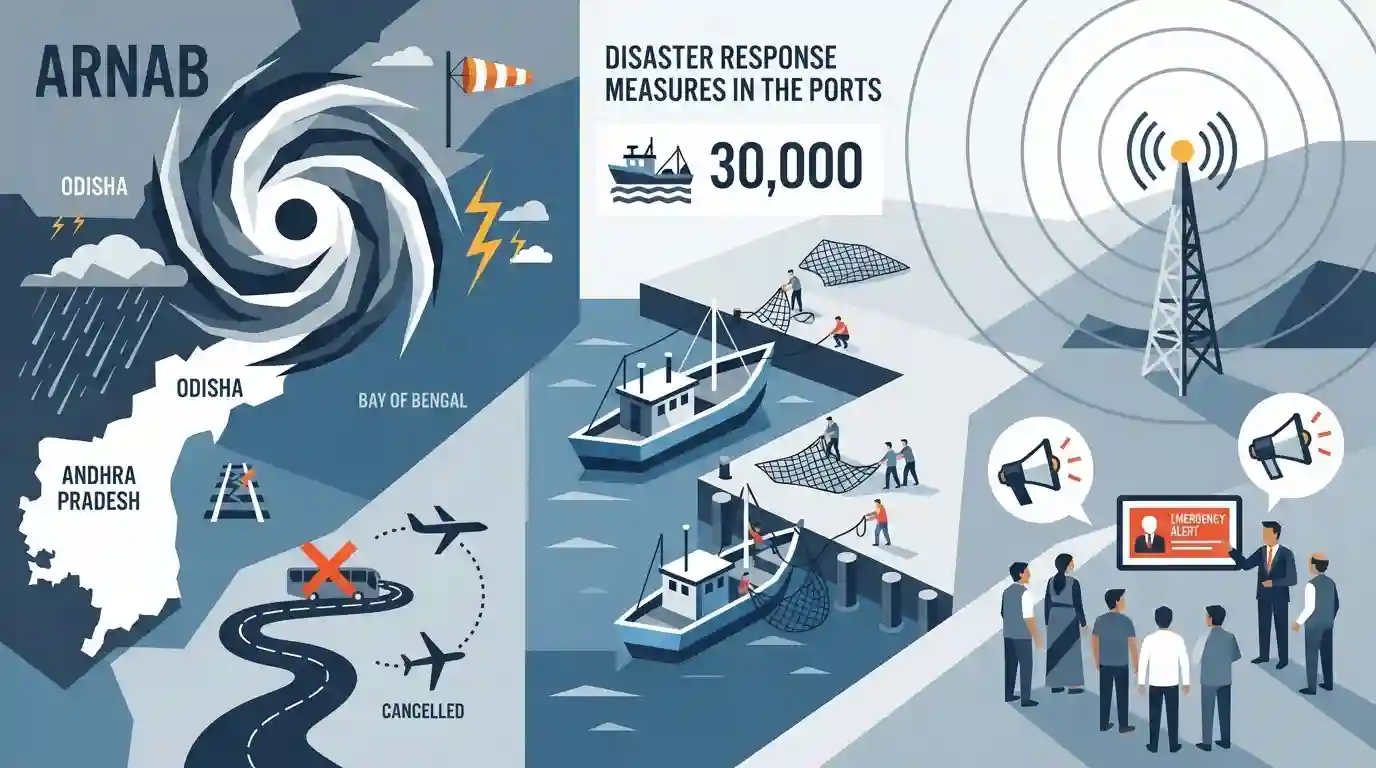
Cyclone 'Arnab' brought severe weather conditions, heavy rainfall, and transport disruptions to Andhra Pradesh while putting southern Odisha on high alert. Authorities undertook proactive disaster response measures, including the securing of 30,000 fishing boats and deployment of early warning protocols.
मुख्य मुद्दे
- Cyclone Arnab triggers heavy downpours, causing widespread disruptions including transport cancellations (flights and trains) across Andhra Pradesh and putting southern Odisha on high alert.
- Proactive disaster management measures are visible, such as bringing ashore 30,000 fishing boats to prevent loss of equipment and lives in coastal regions.
- Highlights the vulnerability of India's eastern coastline (Bay of Bengal) to tropical cyclones and the critical role of early warning systems and proactive evacuation.
महत्त्वाच्या संज्ञा
India Meteorological Department (IMD)

The premier government agency under the Ministry of Earth Sciences responsible for meteorological observations, weather forecasting, and issuing early cyclone warnings in India.
UPSC context
GS Paper III (Disaster Management) — tests the institutional framework for early warning systems and tropical cyclone preparedness.
National Disaster Response Force (NDRF)
India's specialized statutory force established under the Disaster Management Act, 2005, for undertaking rescue, relief, and proactive deployment during natural and man-made disasters.
UPSC context
GS Paper III (Disaster Management) — tests institutional response mechanisms, emergency rescue capabilities, and pre-disaster preparedness.
पूर्वपरीक्षा सापळा
The India Meteorological Department directly executes mandatory coastal evacuations and secures fishing boats during cyclonic landfalls.
The IMD provides graded warnings (Cyclone Watch, Alert, Warning), but local evacuations and enforcement are executed by state machinery and SDRF/district administration under NDMA guidelines, not directly by central agencies alone.
संबंधित स्थिर संकल्पना
What are the key institutional mechanisms and frameworks for disaster management in India under the Disaster Management Act, 2005?
- NDMA Role: Apex Body: National Disaster Management Authority (NDMA) headed by the Prime Minister lays down policies and guidelines.
- NEC Mandate: Executive Arm: National Executive Committee (NEC) assists NDMA in coordinating national-level disaster response.
- NDRF Deployment: Operational Force: National Disaster Response Force (NDRF) specializes in rescue and relief operations during disasters.
- Financial Architecture: Finances: National Disaster Response Fund (NDRF) and State Disaster Response Fund (SDRF) provide financial backup.
What are the favorable conditions for the genesis of tropical cyclones in the Bay of Bengal?
- High SST: Sea Surface Temperature: Warm ocean temperatures exceeding 26.5°C extending to a depth of at least 60 meters.
- Coriolis Force: Coriolis Force: Presence of adequate Coriolis force to initiate cyclonic rotation (absent very close to the equator).
- Low Wind Shear: Vertical Wind Shear: Low vertical wind shear which prevents disruption of the developing warm core vortex.
- Pre-existing Vortex: Pre-existing Low: Presence of a pre-existing weak low-pressure area or low-level cyclonic circulation.
आंतर-विषय नमुने
Cyclones + Transport Resilience + GatiShakti
Bay of Bengal cyclonic events directly test India's coastal infrastructure resilience, integrating disaster mitigation with the PM GatiShakti transport corridor planning.
Disaster Management + Sendai Framework Targets
Preemptive evacuation protocols during severe cyclones operationalize India's commitments under the Sendai Framework for Disaster Risk Reduction.

Bay of Bengal cyclone frequency + zero-casualty paradigm shift in disaster management is a prime candidate for a Mains GS-3 question.
संबंधित PYQ · 3
संबंधित PYQ · 3
- 2020MainsGS3
Discuss the recent measures initiated in disaster management by the Government of India departing from the earlier reactive approach.
- 2018MainsGS3
Describe various measures taken in India for Disaster Risk Reduction (DRR) before and after signing 'Sendai Framework for DRR (2015-2030)'. How is this framework different from Hyogo Framework for Action, 2005?
- 2026PrelimsGS1
Which of the following best explain(s) the rationale for protecting mangrove ecosystems in the context of climate resilience? 1. Mangroves reduce tidal energy and store freshwater, making them ideal sites for paddy cultivation in saline estuarine belts. 2. Their salt-sensitive roots filter seawater, making mangroves key to converting coastal land into freshwater aquaculture zones. 3. By withstanding tidal surges and offering biomass resources, mangroves function both as natural bio-shields and livelihood bases for rural communities. Select the answer using the code given below :
