Frequent Successive Cyclones in Andhra Pradesh and Climate Impact
Source:The Hindu ↗
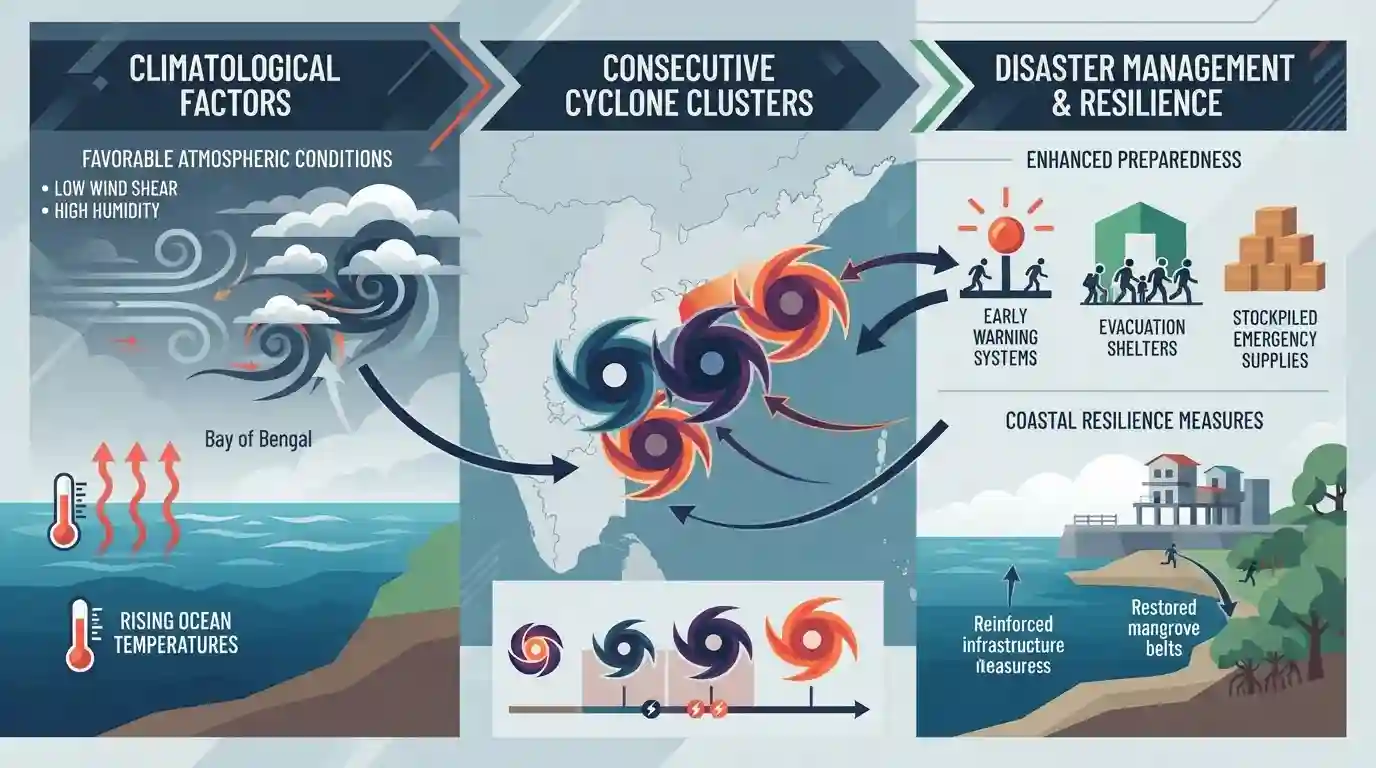
Why It Matters
The phenomenon of multiple successive tropical cyclones in a short span highlights shifting climatic trends over the Bay of Bengal and tests India's disaster management preparedness and coastal resilience frameworks.
Summary
The article examines the meteorological factors behind the unprecedented occurrence of three consecutive cyclones affecting Andhra Pradesh within a single month. It highlights the growing challenges of clustered tropical cyclone activity in the Bay of Bengal, driven by rising ocean temperatures and favorable atmospheric conditions, and underscores the imperative for enhanced disaster preparedness and coastal resilience.
Key Points
- Andhra Pradesh faced an unusual frequency of three cyclones within a single month, raising concerns about changing climatic patterns in the Bay of Bengal.
- The clustering of cyclones is influenced by factors such as rising sea surface temperatures, favorable Madden-Julian Oscillation (MJO) phases, and altered wind shear patterns.
- Frequent successive tropical cyclones severely impact coastal agriculture, infrastructure, and livelihoods, necessitating robust disaster management and climate adaptation strategies.
Important Terms
India Meteorological Department (IMD)

The nodal agency under the Ministry of Earth Sciences responsible for meteorological observations, weather forecasting, and issuing timely warnings for natural disasters like tropical cyclones in India.
UPSC context
Important for GS Paper III (Disaster Management and Environment); tests understanding of institutional frameworks for early-warning systems and hazard mitigation.
Static Concepts Connected
What are the key meteorological parameters required for tropical cyclogenesis?
- High SST: Sea surface temperature must exceed 28°C to provide continuous latent heat energy for storm intensification.
- Wind Shear: Low vertical wind shear is essential to prevent the disruption of the vertical vortex structure of the developing storm.
- Coriolis Force: Coriolis force must be sufficiently non-zero, which explains why tropical cyclones do not form within 5 degrees of the equator.
- Vorticity: Pre-existing weak low-pressure area or vorticity provides the initial rotational seed for cyclogenesis.
Cross-Topic Patterns
Tropical Cyclones + Coastal Groundwater Salinity
Successive cyclones cause saltwater intrusion into coastal aquifers, directly linking tropical meteorology to agrarian distress, food security, and groundwater depletion under GS Paper III.

Bay of Bengal cyclone clustering + MJO phase coupling likely to be framed as an assertion-reason question in Prelims.
Linked PYQs · 3
Linked PYQs · 3
- 2025PrelimsGS1
The World Bank warned that India could become one of the first places where wet-bulb temperatures routinely exceed 35 °C. Which of the following statements best reflect(s) the implication of the above-said report? I. Peninsular India will most likely suffer from flooding, tropical cyclones and droughts. II. The survival of animals including humans will be affected as shedding of their body heat through perspiration becomes difficult. Select the correct answer using the code given below.
- 2026PrelimsGS1
Which of the following best explain(s) the rationale for protecting mangrove ecosystems in the context of climate resilience? 1. Mangroves reduce tidal energy and store freshwater, making them ideal sites for paddy cultivation in saline estuarine belts. 2. Their salt-sensitive roots filter seawater, making mangroves key to converting coastal land into freshwater aquaculture zones. 3. By withstanding tidal surges and offering biomass resources, mangroves function both as natural bio-shields and livelihood bases for rural communities. Select the answer using the code given below :
- 2022MainsGS3
Explain the causes and effects of coastal erosion in India. What are the available coastal management techniques for combating the hazard?
