Cyclone Akvan Landfall and IMD Warnings for Andhra Pradesh
Source:The Hindu ↗
Why It Matters
Understanding tropical cyclone formation, IMD warning protocols, and shift towards proactive disaster management in coastal regions is crucial for GS-3 Disaster Management and GS-1 Climatology.
Summary
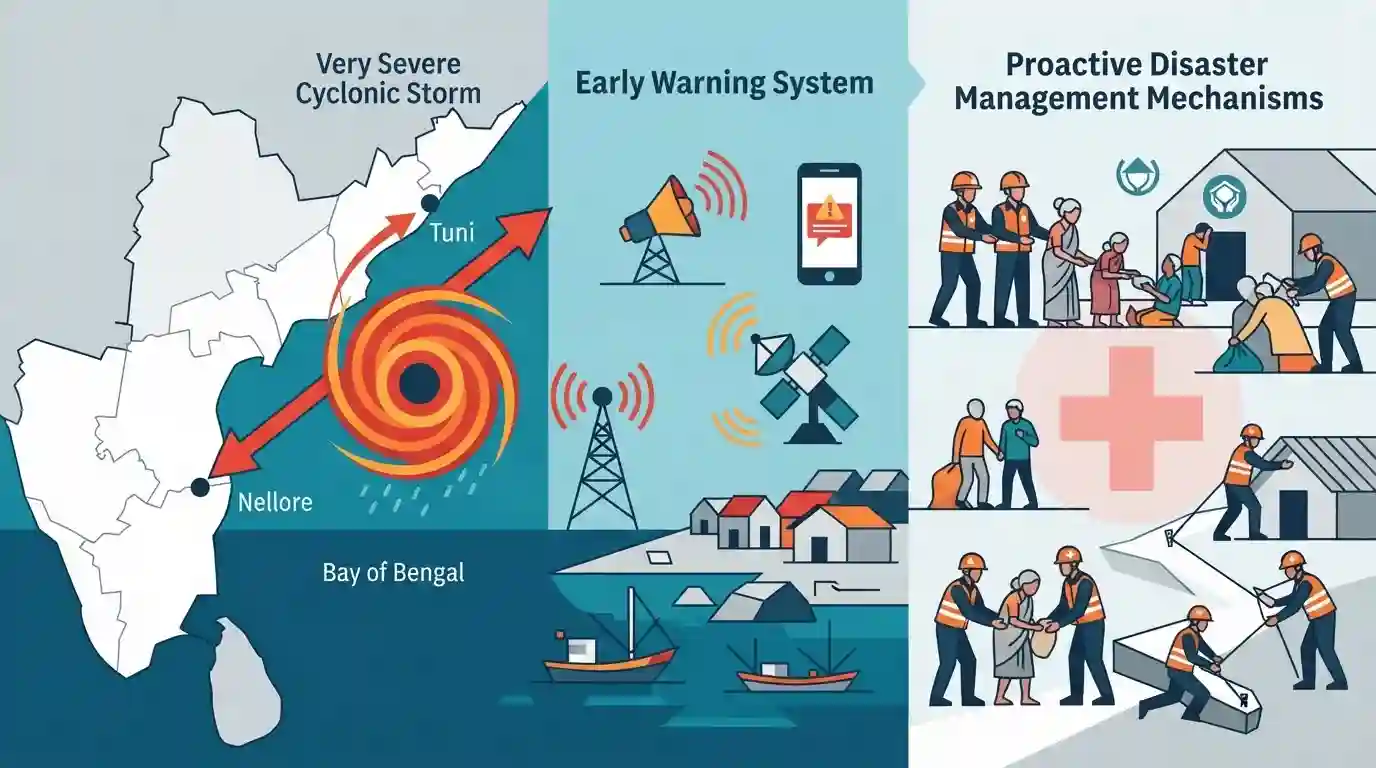
The India Meteorological Department (IMD) issued warnings regarding Cyclone Akvan, which is expected to cross the Andhra Pradesh coast between Nellore and Tuni as a very severe cyclonic storm. The event highlights regional vulnerability, early warning infrastructure, and proactive disaster management mechanisms along India's eastern seaboard.
Key Points
- Cyclone Akvan is forecast to make landfall as a very severe cyclonic storm between Nellore and Tuni along the Andhra Pradesh coast.
- The India Meteorological Department (IMD) issued advisories and track predictions for the severe weather system.
- Highlights the vulnerability of India's eastern coastline to tropical cyclones during the post-monsoon season.
- Emphasizes the critical role of institutional early warning systems and proactive disaster preparedness under NDMA guidelines.
Important Terms
India Meteorological Department

The national meteorological service of India and the principal government agency in all matters relating to meteorology, seismology, and associated subjects, operating under the Ministry of Earth Sciences.
UPSC context
UPSC Prelims/Mains (GS Paper III - Disaster Management): Tests understanding of institutional mechanisms for weather forecasting and disaster early warning systems.
IMD
Abbreviation for the India Meteorological Department, responsible for recording meteorological observations, providing weather forecasts, and issuing early warnings for natural disasters like cyclones.
UPSC context
UPSC Prelims: Frequently featured in questions regarding institutional setups for disaster mitigation, climate tracking, and early warning architecture in India.
Prelims Trap
Very severe cyclonic storm wind speeds range between 64 and 89 knots (118–166 km/h)
Aspirants often confuse 'Severe Cyclonic Storm' with 'Very Severe Cyclonic Storm' or 'Super Cyclonic Storm' thresholds under IMD scales.
Static Concepts Connected
How does the IMD classify tropical cyclones based on maximum sustained wind speeds?
- Cyclonic Storm: Cyclonic Storm: 34–47 knots (62–88 km/h) sustained wind speed.
- Severe Storm: Severe Cyclonic Storm: 48–63 knots (89–117 km/h) sustained wind speed.
- Very Severe: Very Severe Cyclonic Storm: 64–89 knots (118–166 km/h) sustained wind speed.
- Super Cyclone: Super Cyclone: 120 knots and above (221 km/h and above).
Why is the Bay of Bengal more prone to severe cyclones than the Arabian Sea during the post-monsoon season?
- Warm Waters: Higher Sea Surface Temperatures (SST): BoB maintains warmer surface waters (>28°C) conducive to deep convection.
- Stratification: Freshwater Inflow: Major rivers (Ganga, Brahmaputra, Godavari) create a stable upper-ocean warm layer, preventing deep vertical mixing of cold water.
- Typhoon Remnants: Topography and Remnants: Low-level cyclonic vortices frequently drift across from the South China Sea into the Bay.
Cross-Topic Patterns
Cyclone Preparedness + Fiscal Federalism
Cyclone warnings intersect with Article 21 rights and fiscal devolution under the Finance Commission for disaster relief funds (SDRF/NDRF).
Bay of Bengal Cyclogenesis + Climate Negotiations
Bay of Bengal cyclogenesis is exacerbated by rising sea surface temperatures, linking regional meteorology directly to global climate change negotiations and UNFCCC Loss & Damage financing.

IMD cyclone intensity scale + Bay of Bengal post-monsoon cyclogenesis frequency is a prime target for a multi-statement Prelims MCQ.
Linked PYQs · 3
Linked PYQs · 3
- 2026PrelimsGS1
Which of the following statements with regard to India's indigenous new high resolution weather model, the 'Bharat Forecast System,' is/are correct? 1. Its objective is to generate forecasts at the Panchayats cluster level. 2. It was developed by IIT Delhi. Select the answer using the code given below :
- 2020PrelimsGS1
Consider the following statements: 1. Jet streams occur in the Northern Hemisphere only. 2. Only some cyclones develop an eye. 3. The temperature inside the eye of a cyclone is nearly 10°C lesser than that of the surroundings. Which of the statements given above is/are correct?
- 2020MainsGS3
Discuss the recent measures initiated in disaster management by the Government of India departing from the earlier reactive approach.
