Balochistan insurgency and regional security challenges
Source:The Hindu ↗
Why It Matters
Provides crucial context on Pakistan's internal fault lines, the socio-economic drivers of insurgency (paralleling India's LWE challenges), and the geopolitical ramifications of CPEC and the Taliban's return in Afghanistan. Understanding these dynamics is essential for answering questions on regional security, India-Pakistan relations, and the unintended consequences of mega-infrastructure projects without local buy-in.
Summary
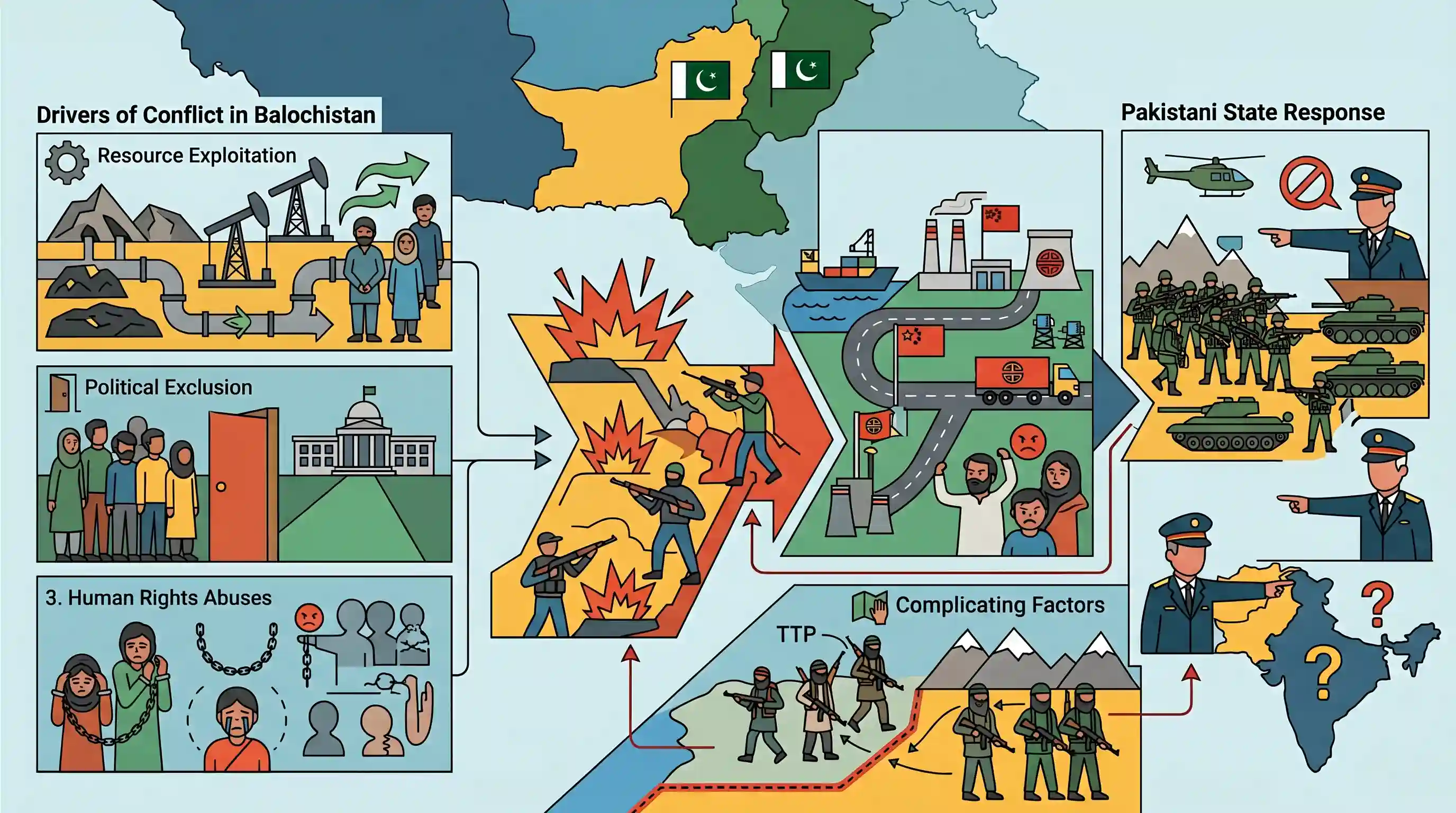
The editorial analyzes the escalating cycle of violence in Pakistan's Balochistan province, driven by the Balochistan Liberation Army (BLA). The insurgency is fueled by deep-seated grievances over the systemic exploitation of local resources, political exclusion, and alleged human rights abuses by the Pakistani state. The rollout of the China-Pakistan Economic Corridor (CPEC) has further alienated locals who feel bypassed by its benefits. Instead of addressing the root socio-economic and political causes, Pakistan has relied on military force and reflexively blamed India. The situation is further complicated by the regrouping of the Tehreek-e-Taliban Pakistan (TTP) in neighboring Afghanistan.
Key Points
- Balochistan is experiencing a significant surge in violent insurgency led by groups like the Balochistan Liberation Army (BLA) targeting the Pakistani military and state infrastructure.
- The roots of the conflict lie in historical political marginalization, exploitation of the region's vast natural resources without local development, and severe human rights violations, including widespread enforced disappearances.
- The China-Pakistan Economic Corridor (CPEC) has worsened local alienation, as the Baloch people feel excluded from the economic benefits of these mega-infrastructure projects.
- Pakistan's government relies primarily on military crackdowns rather than pursuing genuine political reconciliation and socio-economic development.
- Pakistan consistently attempts to externalize the problem by blaming India for supporting the Baloch insurgency, while the return of the Taliban in Afghanistan has provided safe havens for groups like the TTP to regroup and embolden regional militancy.
Important Terms
China-Pakistan Economic Corridor (CPEC)

A flagship infrastructure project of China's Belt and Road Initiative, linking Gwadar Port in Pakistan to Xinjiang, China, focusing on energy, transport, and industrial growth.
UPSC context
GS Paper II: India and its neighborhood. Tests impact of regional infrastructure on India’s strategic and sovereignty interests.
Balochistan Liberation Army (BLA)
A separatist militant group in Pakistan's Balochistan province seeking independence. It targets state security forces and Chinese-led development projects, citing resource exploitation and human rights abuses.
UPSC context
GS Paper III: Security challenges in border areas. Tests understanding of regional insurgencies and their impact on neighborhood stability.
Tehreek-e-Taliban Pakistan (TTP)
An umbrella organization of various Islamist militant groups operating along the Afghan-Pakistan border. It aims to overthrow the Pakistani state and enforce a strict Sharia-based system.
UPSC context
GS Paper III: Linkages between development and extremism. Tests understanding of cross-border terrorism and regional security dynamics.
Taliban
A Deobandi-Islamic fundamentalist political and military movement currently governing Afghanistan. Their return to power has reshaped South Asian geopolitics, security, and counter-terrorism efforts.
UPSC context
GS Paper II: International Relations. Tests impact of radical regimes on India's interests and regional security architecture.
Prelims Trap
"The Balochistan Liberation Army (BLA) is a religious extremist organization fighting to establish Sharia."
The BLA is an ethno-nationalist separatist group fighting against resource exploitation and political marginalization, unlike religious outfits like the TTP.
Static Concepts Connected
What are India's primary strategic and territorial objections to the China-Pakistan Economic Corridor (CPEC)?
- Territorial violation: It passes through Pakistan-occupied Kashmir (PoK) and Gilgit-Baltistan, which India claims as its sovereign territory.
- String of Pearls: The development and potential militarization of Gwadar port threatens India's maritime security in the Arabian Sea.
How does the "development deficit" fuel extremism in resource-rich regions?
- Economic marginalization: State extraction of natural wealth displaces locals without providing equivalent jobs or royalties.
- Political alienation: Suppression of democratic protests forces aggrieved youth to legitimize armed rebellion as the only recourse.
Cross-Topic Patterns
Resource curse: Balochistan vs LWE
Both regions highlight how state-led extraction of minerals without local socio-economic integration triggers armed insurgencies, bridging GS2 (Neighbourhood) and GS3 (Extremism).
Gwadar vs Chabahar geopolitics
Instability and insurgent attacks around Pakistan's Gwadar port (CPEC) sharply contrast with India's strategic, stability-focused investments in Iran's nearby Chabahar port.

Mains 2026 could feature a GS2/GS3 question linking CPEC's failure in Balochistan to regional security and the "resource curse" phenomenon.
Linked PYQs · 3
Linked PYQs · 3
- 2020MainsGS3
Analyze internal security threats and transborder crimes along Myanmar, Bangladesh and Pakistan borders including Line of Control (LoC). Also discuss the role played by various security forces in this regard.
- 2022MainsGS3
Naxalism is a social, economic and developmental issue manifesting as a violent internal security threat. In this context, discuss the emerging issues and suggest a multilayered strategy to tackle the menace of Naxalism.
- 2011MainsGS2
Critically examine the security and strategic implications of the so-called 'string of pearls' theory for India.
