World Economic Forum report identifies top systemic risks for India
Source:The Hindu ↗
Why It Matters
The Global Risks Report acts as a crucial barometer for systemic vulnerabilities. For UPSC aspirants, it provides direct data points for Mains answers on cybersecurity infrastructure gaps, AI-induced disruptions, and the persistent challenges of income inequality in India. Furthermore, international indices and reports published by organizations like the WEF are high-yield topics for Prelims.
Summary
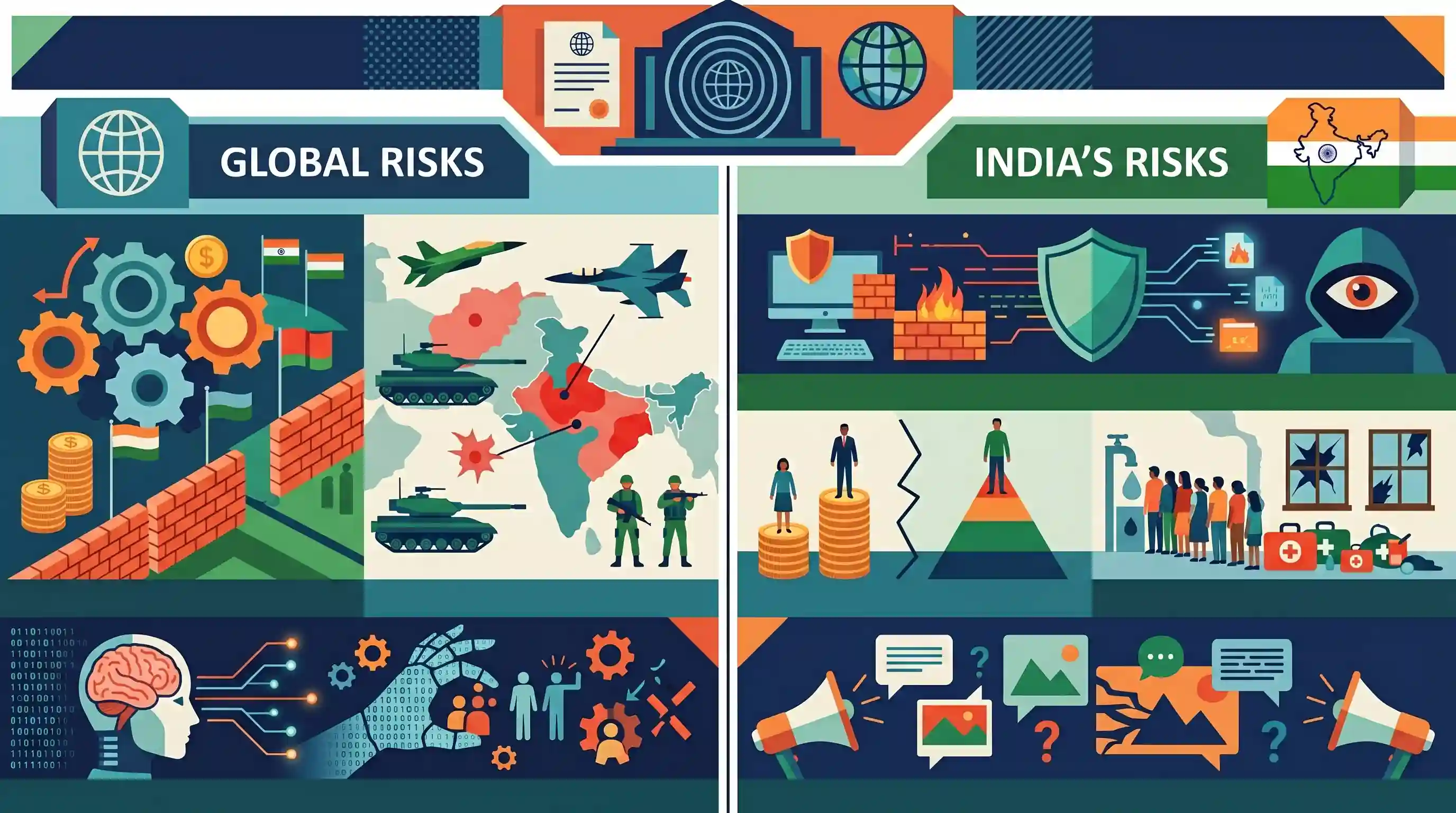
The World Economic Forum’s (WEF) Global Risks Report 2026 highlights differing immediate risk profiles globally and for India. While the global landscape is dominated by geoeconomic confrontation and State-based armed conflicts, India’s top concerns are centered on cybersecurity threats and socio-economic challenges, notably income inequality and insufficient public services. Additionally, the report notes a significant global uptick in concerns regarding technological risks, including the adverse impacts of Artificial Intelligence and widespread misinformation.
Key Points
- The World Economic Forum's Global Risks Report 2026 identifies geoeconomic confrontation and State-based armed conflicts as the top risks globally.
- In contrast, India's primary risks are cybersecurity vulnerabilities, followed closely by income and wealth inequality.
- Other top challenges identified for India include insufficient public services and social protections, as well as economic downturns.
- Technological risks have surged globally, with misinformation/disinformation, adverse outcomes of AI technologies, and cyber insecurity entering the top 10 global concerns.
- The report's findings are drawn from the Global Risks Perception Survey, reflecting the views of over 1,300 global leaders and experts.
Important Terms
World Economic Forum (WEF)

A Swiss-based international organization for public-private cooperation. It facilitates dialogue among global leaders to shape economic agendas and publishes key reports like the Global Risks Report.
UPSC context
GS Paper II/Prelims; tests knowledge of international institutions and their roles in global governance and economic policy.
Global Risks Report
An annual assessment by the WEF analyzing pressing global threats over short and long-term horizons across economic, environmental, geopolitical, societal, and technological domains.
UPSC context
GS Paper III/Prelims; tests ability to identify global trends and risk categories published by major international bodies.
Geoeconomic Confrontation
The deliberate use of economic instruments—such as tariffs, sanctions, and trade restrictions—by states to achieve geopolitical and strategic objectives, often replacing traditional military confrontation.
UPSC context
GS Paper II (International Relations); tests understanding of how economic power is weaponized in modern geopolitics.
Inclusive Growth
Economic growth that is broad-based and equitably distributed, ensuring all sections of society—particularly marginalized groups—participate in and benefit from development opportunities.
UPSC context
GS Paper III (Indian Economy); tests knowledge of growth strategies ensuring social justice and poverty reduction.
Cybersecurity
The protection of digital systems, networks, and data from unauthorized access, attacks, or damage. It is critical for national security and economic stability.
UPSC context
GS Paper III (Internal Security); tests understanding of digital threats to critical infrastructure and national security frameworks.
Income Inequality
The unequal distribution of household or individual income across a population. It is a major challenge to social cohesion and sustainable economic development.
UPSC context
GS Paper I (Social Issues) and GS III (Economy); tests analysis of social disparities and their impact on development.
Prelims Trap
"The Global Risks Report identifies geoeconomic confrontation and armed conflicts as India's primary immediate risks."
UPSC often swaps global data with India-specific data. Armed conflicts are the top global risk, but India's foremost risks are cybersecurity and socio-economic inequality.
Static Concepts Connected
What is the World Economic Forum (WEF) and its major reports?
- Origin & Structure: Founded in 1971 as a non-profit foundation, headquartered in Geneva, Switzerland, engaging political and business leaders.
- Major Reports: Includes the Global Competitiveness Report, Global Gender Gap Report, Global Risks Report, and Energy Transition Index.
What are the key institutional pillars of India's cybersecurity architecture?
- CERT-In: The national nodal agency under MeitY for responding to computer security incidents and issuing alerts.
- NCIIPC: Created under Section 70A of the IT Act, 2000 to protect Critical Information Infrastructure (CII).
- I4C: The Indian Cyber Crime Coordination Centre under the MHA tackles cybercrime in a coordinated manner.
Cross-Topic Patterns
Inequality & Standard Economic Metrics
WEF highlighting income inequality for India directly invokes static Prelims concepts like the Gini Coefficient, Lorenz Curve, and Kuznets Curve used to measure and track wealth distribution.
AI Misinformation & Internal Security
Global concerns over AI and misinformation bridge GS3 (cybersecurity and technology) and GS2 (election integrity, deepfakes, and the Election Commission's regulatory challenges).

Expect a Prelims statement deliberately swapping WEF's global top risk (armed conflict) with India's primary concern (cybersecurity).
Linked PYQs · 5
Linked PYQs · 5
- 2020MainsGS3
Discuss different types of cyber crimes and measures required to be taken to fight the menace.
- 2017MainsGS3
Discuss the potential threats of Cyber attack and the security framework to prevent it.
- 2024MainsGS3
Examine the pattern and trend of public expenditure on social services in the post-reforms period in India. To what extent this has been in consonance with achieving the objective of inclusive growth?
- 2022MainsGS3
Is inclusive growth possible under market economy ? State the significance of financial inclusion in achieving economic growth in India.
- 2019PrelimsGS1
The Global Competitiveness Report is published by the
