WEF Global Risks Report Highlights Cyber Threats and Inequality
Source:The Hindu ↗
Why It Matters
This WEF report provides critical data points for Mains GS3 (Internal Security & Cyber Threats) and GS2 (Social Justice, Poverty & Inequality) by highlighting India's primary vulnerabilities as assessed by global experts. It also serves as a high-yield factual resource for Prelims questions regarding indices and reports published by international organizations.
Summary
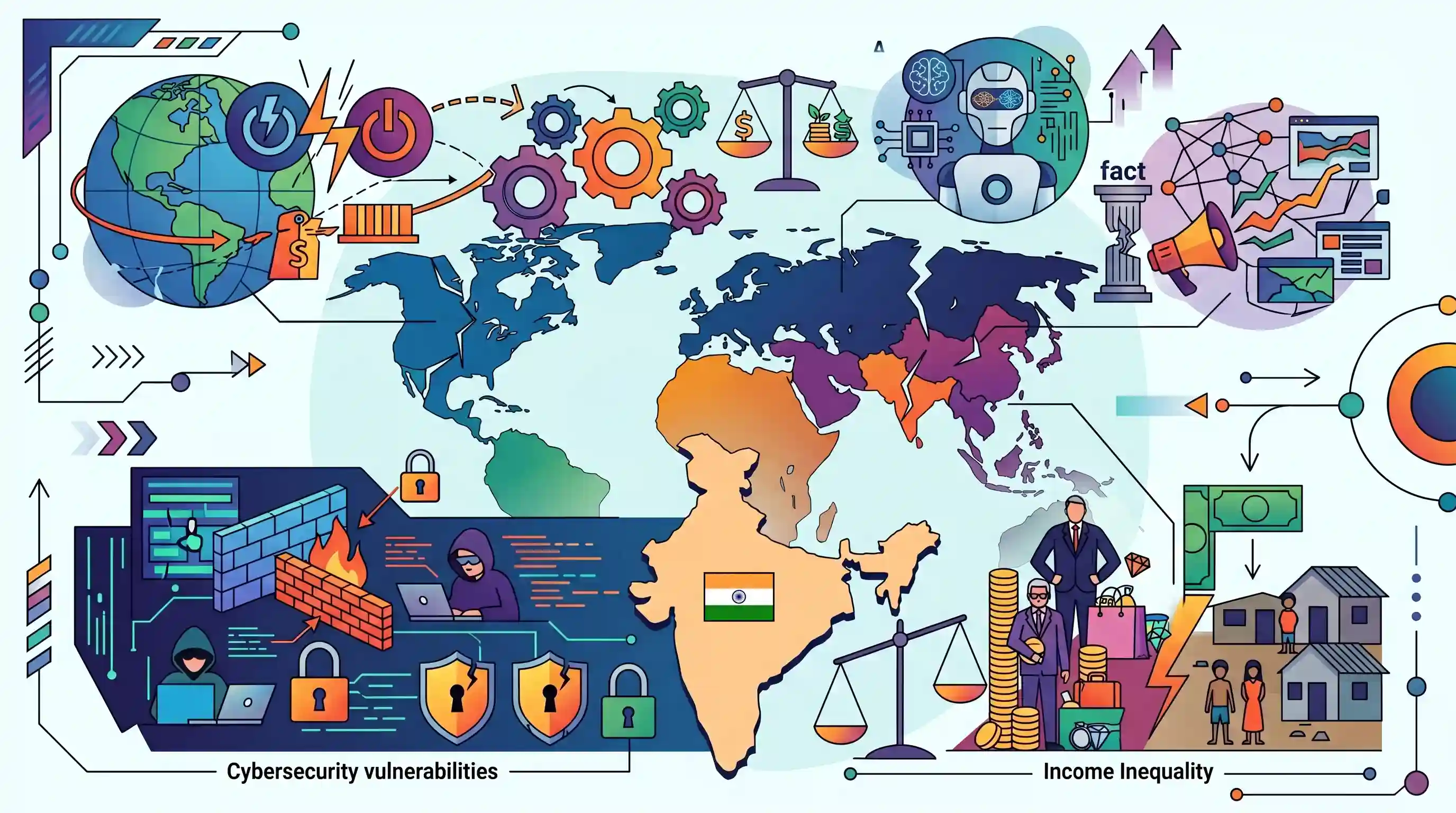
The World Economic Forum's Global Risks Report 2026 highlights geoeconomic confrontation as the foremost global risk, while identifying cybersecurity and income inequality as the top vulnerabilities specifically for India. Technological risks, including AI and misinformation, are seeing a sharp rise in global concern.
Key Points
- The WEF's Global Risks Report 2026 identifies geoeconomic confrontation as the biggest global risk, replacing state-based armed conflicts.
- For India, cybersecurity has emerged as the top risk, reflecting growing concerns over the vulnerability of its digital infrastructure.
- Income and wealth inequality, followed by insufficient public services and social protections, are the leading socio-economic risks threatening India.
- Technological risks are escalating globally, with misinformation, adverse outcomes of AI technologies, and cyber insecurity entering the top 10 global risks list.
Important Terms
World Economic Forum (WEF)

An international non-governmental organization based in Switzerland that facilitates public-private cooperation to address global economic, political, and social challenges through high-level summits and research.
UPSC context
GS Paper II (International Relations); GS Paper III (Economy). Important for understanding global governance and major policy-shaping international bodies.
Global Risks Report
An annual study analyzing major global threats across economic, environmental, geopolitical, societal, and technological categories, typically released before the WEF’s Annual Meeting in Davos.
UPSC context
GS Paper III (Internal Security/Economy). Tests ability to identify emerging global trends and specific vulnerabilities affecting India's stability.
Geoeconomic Confrontation
The strategic use of economic instruments—such as sanctions, trade restrictions, and technology bans—by states to achieve geopolitical goals and constrain rivals, often weakening multilateralism.
UPSC context
GS Paper II (International Relations). Essential for analyzing modern economic warfare, trade disputes, and their impact on India’s strategic autonomy.
Cybersecurity
The practice of protecting systems, networks, and digital infrastructure from attacks. It was identified as India’s top risk for 2026 due to deep dependence on digital governance.
UPSC context
GS Paper III (Internal Security). A core topic regarding national security, critical infrastructure protection, and the Digital India initiative.
Income Inequality
The significant disparity in the distribution of wealth and earnings among a population, identified as a primary socio-economic risk multiplier for India in 2026.
UPSC context
GS Paper III (Inclusive Growth); GS Paper I (Social Issues). Vital for discussing development goals and social stability.
Global Risks Perception Survey (GRPS)
The World Economic Forum’s primary expert survey that gathers data from over 1,300 leaders to rank the severity and likelihood of global risks.
UPSC context
GS Paper III (Economy). Knowledge of the methodology behind major international indices used to benchmark national risks.
Prelims Trap
The Global Risks Report is published annually by the World Bank or the International Monetary Fund.
The Global Risks Report is a flagship publication of the World Economic Forum (WEF), not the World Bank or IMF. UPSC frequently tests the exact publishing agency.
Static Concepts Connected
What are the primary nodal agencies for cybersecurity in India?
- CERT-In: Nodal agency under MeitY for responding to computer security incidents and issuing threat alerts.
- NCIIPC: Created under the IT Act to protect Critical Information Infrastructure (CII) like power, banking, and telecom sectors.
- I4C: Indian Cyber Crime Coordination Centre, established under the Ministry of Home Affairs to tackle cybercrime nationwide.
What are the common tools of geoeconomic confrontation?
- Economic Sanctions: Deliberate restrictions on trade, financial flows, or asset freezes to penalize a country.
- Export Controls: Strategic bans on the export of critical technologies, semiconductors, or critical minerals.
- Weaponized Tariffs: Using import duties to protect domestic industries or penalize geopolitical rivals (e.g., trade wars).
Cross-Topic Patterns
Global metrics mirroring internal security
The shift towards cybersecurity as India's top risk in WEF's report intersects directly with GS-3 Internal Security, particularly the vulnerability of Digital India and UPI infrastructure.
Deepfakes, AI, and Electoral Integrity
The WEF's warning on AI-driven misinformation connects directly to Election Commission guidelines on deepfakes and the need to update the Representation of the People Act, 1951.

Expect a matched-pair Prelims question on WEF reports, or a GS-3 Mains prompt linking AI-misinformation to India's cyber vulnerability.
Linked PYQs · 5
Linked PYQs · 5
- 2021MainsGS3
Keeping in view India's internal security, analyse the impact of cross-border cyber attacks. Also discuss defensive measures against these sophisticated attacks.
- 2022MainsGS3
What are the different elements of cyber security ? Keeping in view the challenges in cyber security, examine the extent to which India has successfully developed a comprehensive National Cyber Security Strategy.
- 2023MainsGS3
What are the internal security challenges being faced by India? Give out the role of Central Intelligence and Investigative Agencies tasked to counter such threats.
- 2025MainsGS2
Inequality in the ownership pattern of resources is one of the major causes of poverty. Discuss in the context of 'paradox of poverty'.
- 2019PrelimsGS1
The Global Competitiveness Report is published by the
