Police crackdown uncovers inter state digital fraud networks
Source:The Hindu ↗
Why It Matters
This incident serves as a practical case study for GS3 (Internal Security), illustrating the evolving nature of cybercrimes (mule accounts, impersonation of corporate entities) and the importance of institutional responses like the 1930 helpline and inter-state law enforcement coordination to counter digital financial fraud.
Summary
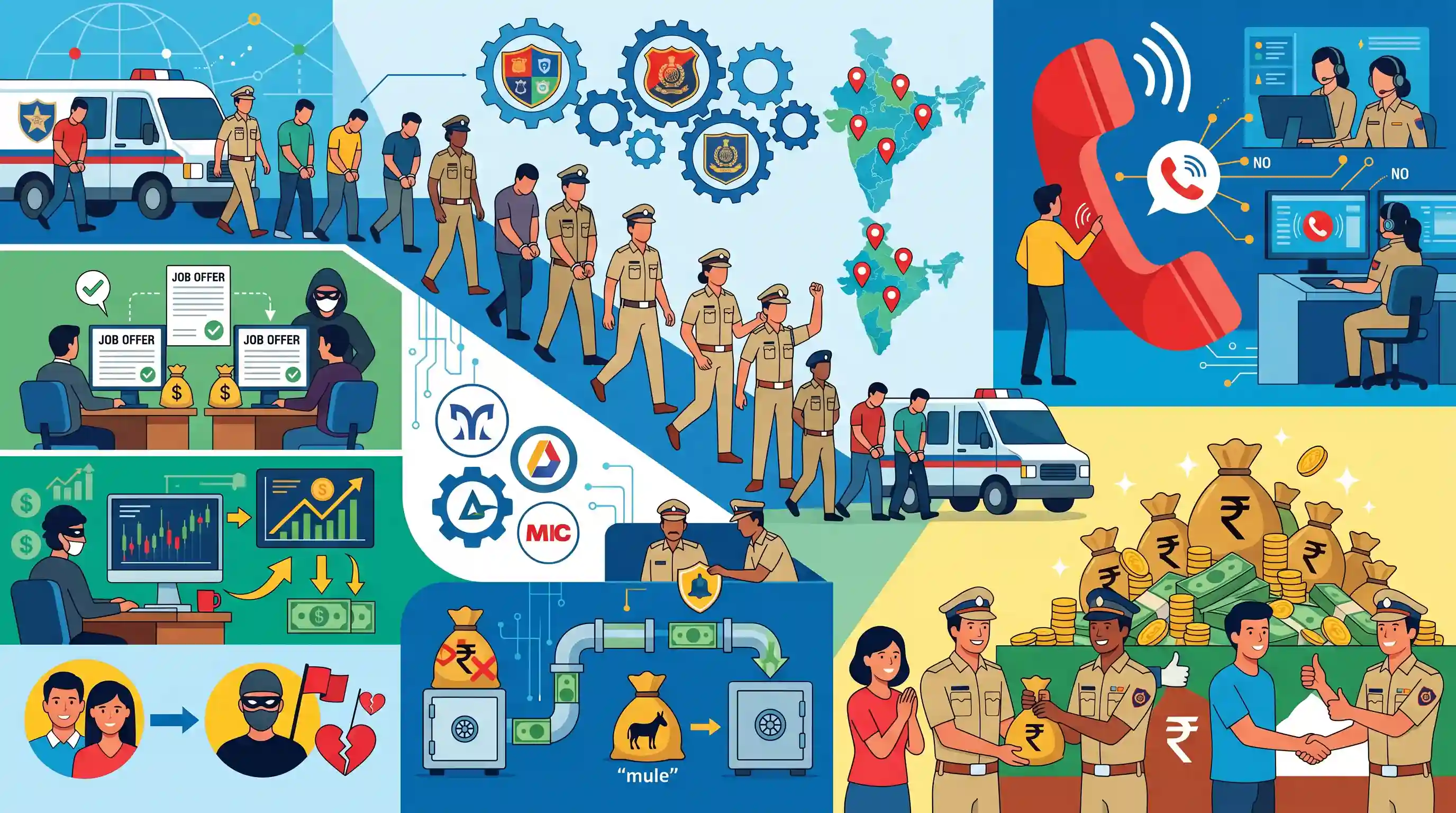
A week-long crackdown by the Cyberabad Police resulted in the arrest of 12 cybercriminals from various states, exposing sophisticated financial fraud networks involving fake job offers, trading scams, and matrimonial deception. The fraudsters impersonated prominent corporations and used mule bank accounts to siphon money. The police successfully refunded over ₹1 crore to victims and highlighted the necessity of using the 1930 national cybercrime helpline for immediate intervention.
Key Points
- Cyberabad Police arrested 12 inter-state cyber fraudsters during a week-long operation, successfully freezing and refunding ₹1.04 crore to victims.
- The criminals engaged in diverse modus operandi including trading frauds, job scams (impersonating reputable firms like Deloitte and Naukri.com), part-time task frauds, and matrimonial deception.
- The operations revealed organized networks utilizing "mule" bank accounts supplied by commission-seeking agents to route illicit funds across states.
- Authorities emphasized the critical role of timely reporting via the national '1930' helpline and the cybercrime reporting portal in mitigating financial losses.
Important Terms
National Cyber Crime Reporting Portal (NCRP)

A centralized GOI platform under the Ministry of Home Affairs for citizens to report all types of cybercrimes, including financial fraud and crimes against women/children.
UPSC context
GS Paper 3: Basics of Cyber Security; GS Paper 2: E-governance and citizen-centric services.
1930 Helpline
A dedicated 24x7 national toll-free helpline for immediate reporting of financial cyber frauds to facilitate the freezing of stolen funds by banks.
UPSC context
GS Paper 3: Internal Security; tests knowledge of immediate institutional responses to financial cybercrime.
Indian Cyber Crime Coordination Centre (I4C)
A nodal agency established by the Ministry of Home Affairs to provide a coordinated framework for law enforcement agencies to tackle cybercrime across India.
UPSC context
GS Paper 3: Internal Security; focus on institutional mechanisms for inter-state and trans-national crime coordination.
Mule Bank Accounts
Legitimate bank accounts used by criminals to receive and transfer illicit funds, often opened by individuals lured by commission or deceived by fake job offers.
UPSC context
GS Paper 3: Money Laundering and its prevention; relates to social engineering and financial system vulnerabilities.
Zero FIR
An FIR registered at any police station regardless of jurisdiction, which is later transferred to the relevant station for investigation.
UPSC context
GS Paper 2: Governance/Polity; essential for inter-state police coordination in mobile/digital crimes.
Seventh Schedule
A constitutional provision that classifies 'Police' and 'Public Order' as State subjects, making states primarily responsible for investigating crimes like cyber fraud.
UPSC context
GS Paper 2: Federalism; relevant for challenges in national coordination of cyber-security and law enforcement.
Cyberabad Police
A specialized wing of the Telangana Police known for high-tech investigation and handling significant inter-state cyber fraud cases in India's IT hubs.
UPSC context
GS Paper 3: Internal Security; example of state-level specialized agency response to complex digital fraud.
Prelims Trap
"The 1930 cybercrime helpline and reporting portal are operated by CERT-In or the RBI."
The 1930 helpline and NCRP fall under the Indian Cyber Crime Coordination Centre (I4C) under the Ministry of Home Affairs, not MeitY or RBI.
Static Concepts Connected
What is the mandate of the Indian Cyber Crime Coordination Centre (I4C)?
- MHA Nodal Body: Established by the Ministry of Home Affairs as a centralized, coordinated framework to tackle cybercrime across India.
- Core Components: Operates the National Cyber Crime Reporting Portal (NCRP) and the 1930 national helpline to facilitate real-time financial freezes.
- State Subject Limitations: While it coordinates inter-state intelligence, actual arrests are executed by state police forces, as 'Police' remains a State subject.
How do "Mule Accounts" interface with India's money laundering frameworks?
- Definition: Bank accounts opened via forged KYC or rented out to route illicit cybercrime proceeds, intentionally breaking the financial trail.
- PMLA Integration: I4C is notified under Section 66 of the PMLA, 2002, enabling it to share mule account intelligence seamlessly with the Enforcement Directorate.
Cross-Topic Patterns
Cybercrime & Cooperative Federalism
Cyber fraud transcends state borders, exposing jurisdictional friction since 'Police' is a State List entry. Frameworks like CCTNS and I4C bridge this gap, testing cooperative federalism.
Mule Accounts & Financial Inclusion
Rapid digital banking penetration has inadvertently expanded money-laundering vulnerabilities. Unsuspecting citizens often 'rent' their KYC-verified accounts for small commissions, becoming unwitting money mules.

Expect a Prelims question differentiating the exact mandates of I4C (MHA) vs CERT-In (MeitY) vs NCIIPC (NTRO) in tackling cyber threats.
Linked PYQs · 4
Linked PYQs · 4
- 2020MainsGS3
Discuss different types of cyber crimes and measures required to be taken to fight the menace.
- 2022MainsGS3
What are the different elements of cyber security ? Keeping in view the challenges in cyber security, examine the extent to which India has successfully developed a comprehensive National Cyber Security Strategy.
- 2017MainsGS3
Discuss the potential threats of Cyber attack and the security framework to prevent it.
- 2020PrelimsGS1
In India, under cyber insurance for individuals, which of the following benefits are generally covered, in addition to payment for the loss of funds and other benefits? 1. Cost of restoration of the computer system in case of malware disrupting access to one's computer 2. Cost of a new computer if some miscreant wilfully damages it, if proved so 3. Cost of hiring a specialized consultant to minimize the loss in case of cyber extortion 4. Cost of defence in the Court of Law if any third party files a suit Select the correct answer using the code given below:
