Transnational Cyber Slavery and Human Trafficking Syndicates
Source:The Hindu ↗
Why It Matters
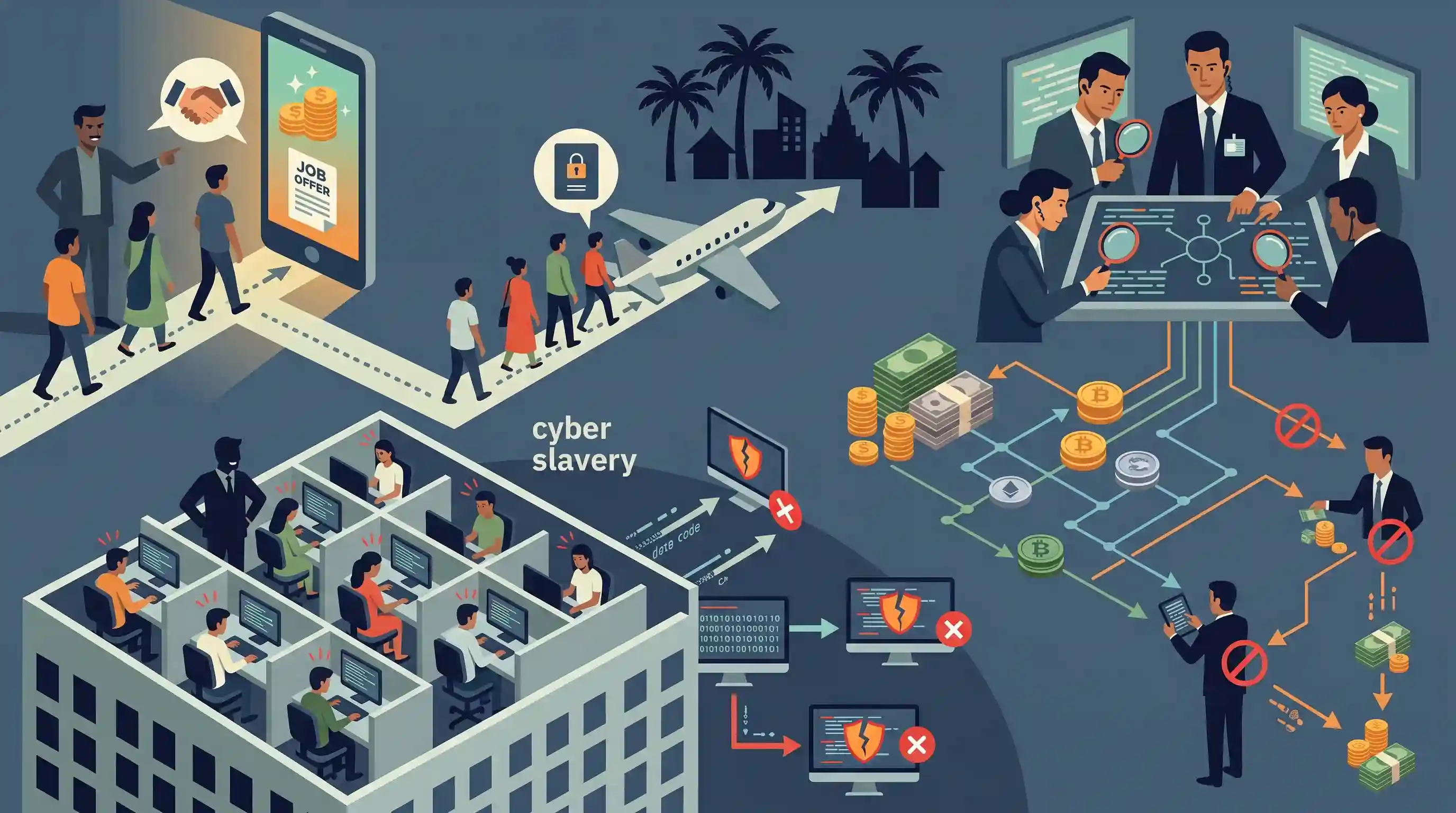
The emergence of 'cyber slavery' highlights a concerning nexus between human trafficking, cybercrime, and the use of cryptocurrencies by transnational criminal networks. This presents new jurisdictional and operational challenges for Indian law enforcement agencies and internal security frameworks.
Summary
The Central Bureau of Investigation (CBI) has launched a crackdown across four states to dismantle a human trafficking network involved in 'cyber slavery.' Indian nationals were lured with fake promises of lucrative jobs and trafficked to scam compounds in Southeast Asian countries, such as Myanmar and Cambodia. Upon arrival, their passports were confiscated, and they were forced to conduct cyber fraud operations under severe physical and psychological duress. The CBI's investigation utilized financial analysis, including tracking cryptocurrency transactions, to expose agents who supplied Indian nationals to overseas operators in exchange for illicit payments.
Key Points
- The Central Bureau of Investigation (CBI) raided multiple locations across four Indian states to dismantle a transnational human trafficking network.
- The network lured Indian nationals with false promises of high-paying jobs and trafficked them to Southeast Asian countries like Myanmar and Cambodia.
- Victims were forced into 'cyber slavery' inside scam compounds, coerced into executing cyber frauds, and subjected to physical and psychological harassment.
- Traffickers confiscated victims' passports, restricted their movement, and frequently demanded ransom payments from their families for their release.
- The CBI tracked cryptocurrency transactions and conducted detailed financial analysis to identify the agents receiving payments from the operators of these overseas scam compounds.
Important Terms
Central Bureau of Investigation (CBI)

India’s premier investigative agency for corruption, economic offenses, and serious crimes. It operates under the Delhi Special Police Establishment (DSPE) Act, 1946, and serves as the nodal agency for Interpol coordination in India.
UPSC context
GS II: Governance/Statutory Bodies. Tests knowledge of investigative powers, federal friction (state consent), and institutional reforms.
Cyber Slavery
An emerging form of human trafficking where victims are coerced into digital crimes—like phishing or investment scams—under threat of violence, often while held captive in overseas scam compounds.
UPSC context
GS III: Internal Security/Cyber Security. Tests awareness of emerging digital threats, transnational crime, and human rights violations.
Human Trafficking
The illegal recruitment, transportation, or exploitation of persons through force, fraud, or coercion. It is prohibited under Article 23 of the Constitution and criminalized under Section 370 of the IPC (now BNS).
UPSC context
GS II: Social Justice. Tests understanding of fundamental rights, legislative frameworks, and international conventions like UNTOC.
Transnational Organized Crime
Organized criminal activities operating across national borders, such as drug trafficking or human smuggling. These pose significant security threats and are addressed by the UN Convention against Transnational Organized Crime (UNTOC).
UPSC context
GS III: Internal Security. Tests ability to analyze security challenges, international cooperation (Interpol), and global crime-terror nexuses.
Money Laundering
The process of disguising the illegal origins of money to make it appear legitimate. In 'cyber slavery,' syndicates often use cryptocurrency to obscure audit trails and facilitate swift cross-border transfers.
UPSC context
GS III: Internal Security. Tests knowledge of the PMLA, cryptocurrency risks, and methods used by organized syndicates.
Prelims Trap
The NIA has the exclusive statutory mandate to investigate transnational human trafficking offenses in India.
While the NIA was empowered to probe human trafficking via the 2019 NIA (Amendment) Act, the CBI also retains jurisdiction and leads Interpol-coordinated transnational busts.
Static Concepts Connected
What is the legal mandate and international role of the CBI?
- DSPE Act 1946: Derives investigative powers from the Delhi Special Police Establishment (DSPE) Act, 1946. It is not a statutory body.
- Interpol NCB: Acts as the designated National Central Bureau (NCB) for Interpol in India, coordinating cross-border operations.
- State Consent: Requires state consent to operate within their jurisdiction, unless explicitly directed by the Supreme Court or High Courts.
How are Virtual Digital Assets (VDAs) regulated against money laundering in India?
- PMLA Coverage: Crypto exchanges and VDA service providers are now designated as "Reporting Entities" under the Prevention of Money Laundering Act.
- FIU-IND Registration: Entities must register with the Financial Intelligence Unit-India (FIU-IND) to operate legally.
- KYC Compliance: Mandated to maintain strict KYC records and report suspicious transnational transactions to authorities.
Cross-Topic Patterns
Golden Triangle's shift to digital fraud
The traditional narcotics hubs of the Golden Triangle (Myanmar, Thailand, Laos) are morphing into scam compounds, forcing a shift in India's border management and Act East diplomatic priorities.
Crypto as the modern hawala network
Transnational syndicates increasingly use Virtual Digital Assets to repatriate cybercrime profits, linking GS-3 cyber security with GS-3 money laundering and necessitating advanced blockchain forensics.

Cyber slavery + Golden Triangle's shift from narcotics + crypto laundering will likely form a hybrid 2026 GS-3 Internal Security question.
Linked PYQs · 3
Linked PYQs · 3
- 2022MainsGS3
Discuss the types of organised crimes. Describe the linkages between terrorists and organised crime that exist at the national and transnational levels.
- 2018MainsGS3
India's proximity to two of the world's biggest illicit opium-growing states has enhanced her internal security concerns. Explain the linkages between drug trafficking and other illicit activities such as gunrunning, money laundering and human trafficking. What counter-measures should be taken to prevent the same?
- 2020MainsGS3
Discuss different types of cyber crimes and measures required to be taken to fight the menace.
