Cauvery Water Dispute and CWMA Interstate Allocation Directives
Source:The Hindu ↗
આ શા માટે મહત્વનું છે
The Cauvery dispute is a classic case study for UPSC aspirants on the mechanisms (Article 262, Inter-State River Water Disputes Act) and challenges of inter-state resource sharing. It highlights the intersection of federalism, institutional arbitration (CWMA/CWRC), and the impact of climate variability on agriculture.
સારાંશ
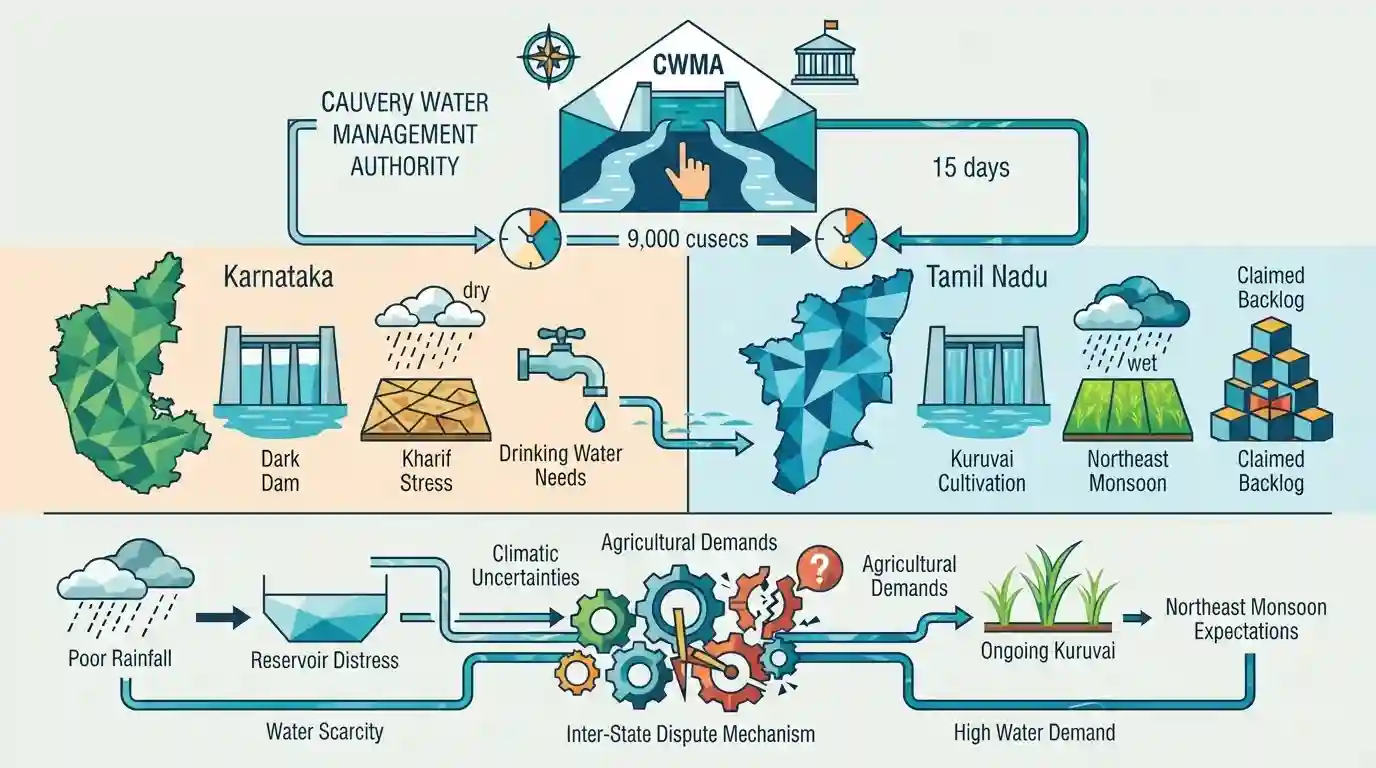
The Cauvery Water Management Authority (CWMA) has upheld a directive requiring Karnataka to release 9,000 cusecs of water daily to Tamil Nadu for the next 15 days. Karnataka contested the decision, citing severe water distress due to poor rainfall, which left inflows into its reservoirs nearly 50% below the 30-year average. The state emphasized threats to its own drinking water and kharif irrigation needs while pointing out that Tamil Nadu would benefit from the upcoming Northeast Monsoon. In contrast, Tamil Nadu sought a larger share to cover a claimed backlog and support extensive ongoing Kuruvai cultivation. The recurring dispute highlights the limitations of existing mechanisms in managing inter-state water conflicts, especially amid climatic uncertainties and agricultural demands.
મુખ્ય મુદ્દા
- The Cauvery Water Management Authority (CWMA) directed Karnataka to release water to Tamil Nadu at a rate of 9,000 cusecs per day for 15 days, totaling roughly 11.66 tmcft.
- Karnataka requested the release be limited to 6,000 cusecs, citing a severe basin distress with a 49.18% deficit in cumulative inflows to its four reservoirs compared to the 30-year average.
- Karnataka argued it had already released 18.748 tmcft against the mandated 15.940 tmcft in the preceding period, and highlighted its unmet kharif irrigation requirement of 111.52 tmcft.
- Tamil Nadu demanded 28.386 tmcft to cover an alleged backlog of 17.49 tmcft and sustain extensive Kuruvai cultivation over 8.41 lakh acres.
- The conflict underscores the vulnerabilities of rain-fed agriculture and the complexities of inter-state resource sharing under federal structures during rainfall-deficient years.
મહત્વપૂર્ણ શબ્દો
Cauvery Water Disputes Tribunal (CWDT) Award

A 2007 adjudication under the Inter-State River Water Disputes Act, 1956, allocating water shares to Karnataka, Tamil Nadu, Kerala, and Puducherry, modified by the Supreme Court in 2018.
UPSC context
GS Paper II (Polity): Inter-state disputes and water adjudication frameworks.
Cauvery Water Management Authority (CWMA)
A statutory, quasi-judicial body set up in 2018 under the Ministry of Jal Shakti to implement the modified Cauvery water-sharing formula among riparian states.
UPSC context
GS Paper II (Federalism): Regulatory architecture for implementing judicial water-sharing directives.
Cauvery Water Regulation Committee (CWRC)
The technical and implementing arm of the CWMA that monitors daily reservoir levels, rainfall, and inflows to recommend periodic water release volumes.
UPSC context
GS Paper III (Resource Management): Data-driven and technical mechanisms in inter-state river regulation.
Article 262
Constitutional provision empowering Parliament to adjudicate disputes regarding inter-state rivers and valleys, allowing it to exclude the jurisdiction of ordinary courts.
UPSC context
GS Paper II (Polity): Constitutional federal provisions dealing with inter-state disputes.
Inter-State River Water Disputes Act, 1956
A statutory framework enacted under Article 262 that enables the Central government to establish ad-hoc tribunals to resolve inter-state river disputes.
UPSC context
GS Paper II (Governance): Legislative and statutory solutions for cooperative federalism and water security.
પ્રિલિમ્સ ટ્રેપ
"The Supreme Court is strictly barred from exercising any jurisdiction over inter-state river water disputes."
While Article 262 allows Parliament to bar SC jurisdiction, the SC still exercises appellate jurisdiction under Article 136 (Special Leave Petition) to hear appeals against tribunal awards.
સંલગ્ન સ્થિર ખ્યાલો
What is the Constitutional framework governing Inter-State River Water Disputes?
- Article 262: Empowers Parliament to provide for the adjudication of inter-state river/river valley disputes and allows it to bar Supreme Court jurisdiction.
- ISRWD Act, 1956: Enacted under Article 262, it provides the legal machinery to set up ad-hoc tribunals for dispute resolution. CWMA was created under this Act.
- River Boards Act: Allows the Union to establish advisory boards for the regulation and development of inter-state rivers and river valleys.
What are the key rice cropping seasons in the Cauvery delta?
- Kuruvai: A short-duration paddy crop in Tamil Nadu grown during June-July. It heavily relies on timely water release from Karnataka during the Southwest monsoon.
- Samba: A long-duration paddy crop sown between August and January. It primarily depends on the Northeast Monsoon and subsequent river flows.
- Thaladi / Navarai: Late-sown short-duration crop (December to March) cultivated using available reservoir water during the dry season.
આંતર-વિષય પેટર્ન
Climate Change meets Cooperative Federalism
Erratic Southwest and Northeast monsoons due to climate change directly amplify inter-state resource conflicts, turning a climatic vulnerability into a core challenge for cooperative federalism.
Water Tribunals vs Inter-State Council
Aspirants should contrast the ad-hoc nature of water dispute tribunals under Article 262 with the constitutional mandate of the Inter-State Council (Article 263) for resolving broader federal frictions.

Expect a multi-statement question combining Article 262, the statutory status of CWMA, and TN/Karnataka's overlapping cropping seasons.
સંલગ્ન PYQ · 4
સંલગ્ન PYQ · 4
- 2020PrelimsGS1
Which of the following Protected Areas are located in Cauvery basin ? 1. Nagarhole National Park 2. Papikonda National Park 3. Sathyamangalam Tiger Reserve 4. Wayanad Wildlife Sanctuary Select the correct answer using the code given below:
- 2015MainsGS2
The concept of cooperative federalism has been increasingly emphasized in recent years. Highlight the drawbacks in the existing structure and the extent to which cooperative federalism would answer the shortcomings.
- 2022PrelimsGS1
Gandikota canyon of South India was created by which one of the following rivers ?
- 2019MainsGS2
From the resolution of contentious issues regarding distribution of legislative powers by the courts, 'Principle of Federal Supremacy' and 'Harmonious Construction' have emerged. Explain.
