Congress Working Committee Adopts Bihar Resolution and Targets Centre
Source:The Hindu ↗
Why It Matters
This article brings attention to critical issues regarding the integrity of the electoral process, specifically the risk of disenfranchising vulnerable voters during roll revisions. It also sparks important debates around India's strategic autonomy in foreign policy, particularly concerning external pressures from the US and its diplomatic stance on the Israel-Palestine conflict.
Summary
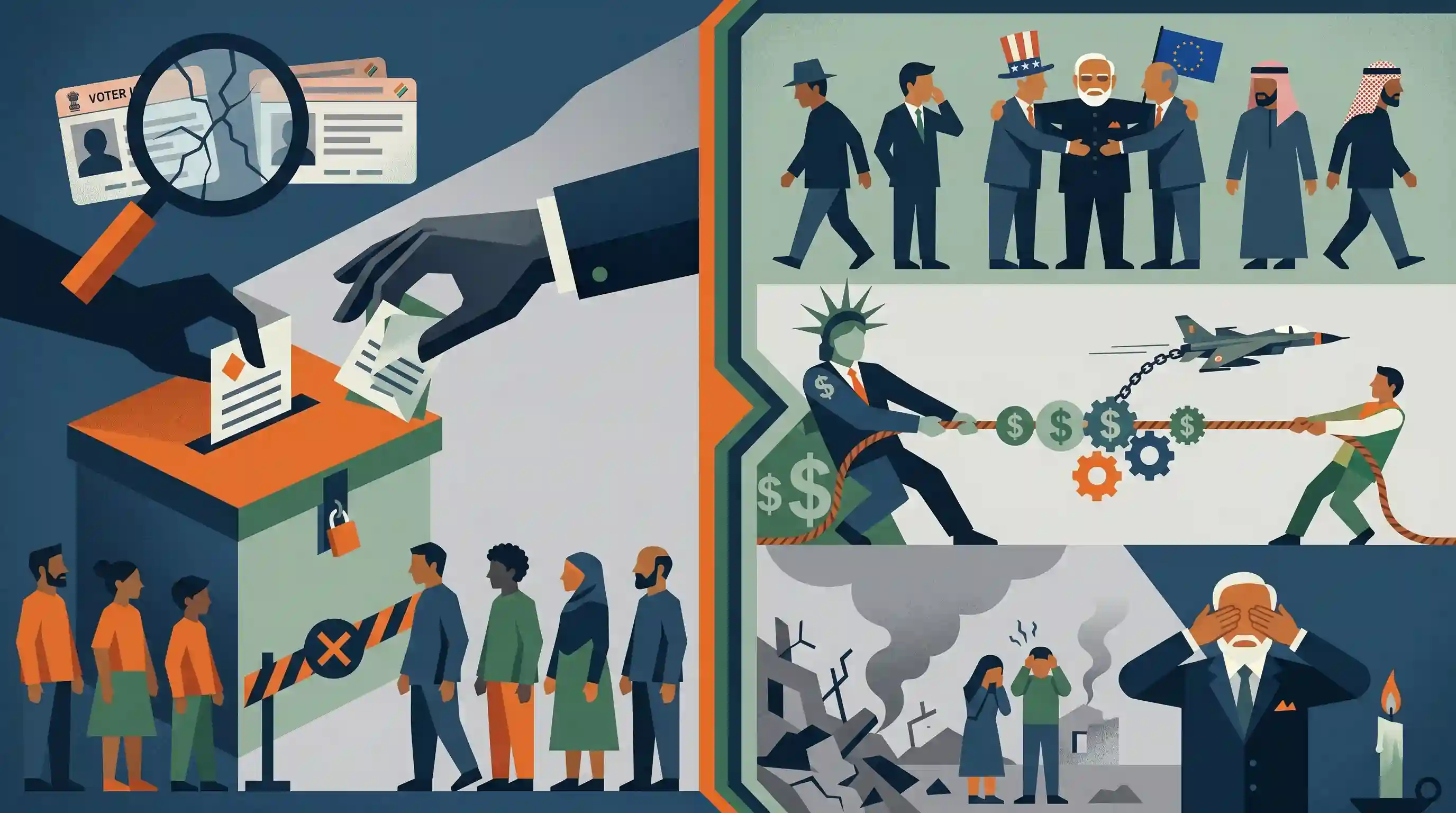
The Congress Working Committee (CWC) adopted a sweeping resolution in Patna ahead of the Bihar Assembly elections, sharply criticizing the ruling BJP government on both domestic and foreign fronts. Domestically, the CWC condemned the Special Intensive Revision (SIR) of electoral rolls as a 'vote chori' (vote theft) tactic aimed at disenfranchising marginalized communities. On the international stage, the resolution lambasted PM Narendra Modi's 'huglomacy,' asserting that India is diplomatically isolated and its foreign policy is collapsing. The party specifically pointed to US President Donald Trump's claims of leveraging trade to coerce India into halting 'Operation Sindoor' against Pakistan following the Pahalgam terror attack, raising questions about India's strategic autonomy. Furthermore, the Congress criticized the government's silence on the Gaza conflict, arguing it compromises India's historical role as a moral conscience in global affairs.
Key Points
- The Congress Working Committee (CWC) passed a resolution in Patna criticizing the BJP government ahead of the Bihar Assembly polls.
- The CWC alleged that the Special Intensive Revision (SIR) of electoral rolls in Bihar is a tool for 'vote chori' (vote theft) to disenfranchise marginalized communities.
- The resolution criticized PM Modi's foreign policy, claiming India has become diplomatically isolated.
- The Congress highlighted US President Donald Trump's claims of using trade as a bargaining chip to halt India's 'Operation Sindoor' against Pakistan after the Pahalgam terror attack.
- The party condemned the Indian government's silence on the Gaza conflict, stating it has tainted the nation's historical moral standing in international relations.
Important Terms
Special Intensive Revision (SIR)

A comprehensive door-to-door verification and update of electoral rolls conducted by the ECI to ensure accurate voter lists. The 2025 Bihar SIR faced criticism over large-scale voter deletions.
UPSC context
Relevant for GS Paper-II under Electoral Reforms and the Representation of the People Act, focusing on voter rights and election integrity.
Operation Sindoor
A 2025 Indian military counter-terror operation launched in response to the Pahalgam attack, targeting terror infrastructure in Pakistan. It reflects India's proactive "zero-tolerance" defense posture.
UPSC context
Crucial for GS Paper-III: Internal Security and GS Paper-II: India-Pakistan relations and cross-border terrorism.
Congress Working Committee (CWC)
The highest executive and decision-making body of the Indian National Congress, tasked with formulating the party's official stance on national and international policy matters.
UPSC context
Relevant for GS Paper-II under the functioning of political parties and their role in the Indian democratic process.
Election Commission of India (ECI)
An autonomous constitutional body established under Article 324, responsible for administering election processes in India at both national and state levels.
UPSC context
A core topic for GS Paper-II: Appointment to various Constitutional posts, powers, functions, and responsibilities.
Strategic Autonomy
A foreign policy doctrine where a state makes its own decisions regarding national interests without being coerced or significantly influenced by other sovereign powers.
UPSC context
Central to GS Paper-II: India’s foreign policy, bilateral relations (specifically India-US), and the impact of global politics on national interests.
Prelims Trap
The Right to Vote in India is a Fundamental Right guaranteed under Part III of the Constitution.
While universal adult suffrage is a constitutional mandate (Article 326), the Supreme Court maintains that the 'Right to Vote' is a statutory right governed by the Representation of the People Act, 1951, not a Fundamental Right.
Static Concepts Connected
How are electoral rolls prepared and revised under Indian law?
- Article 324: Vests the overarching power of superintendence, direction, and control of the preparation of electoral rolls in the Election Commission of India.
- RPA 1950: Governs the actual preparation and revision of rolls (Section 21), including Special Intensive Revision (SIR) exercises.
- Single Registration: Section 17 of RPA 1950 strictly prohibits a person from being registered as a voter in more than one constituency.
What is India's 'De-hyphenation' policy in West Asia?
- Standalone Ties: Pursuing independent, mutually beneficial relations with Israel and Palestine without viewing one through the lens of the other.
- Strategic Balance: Expanding defense and tech cooperation with Israel while concurrently maintaining historical diplomatic and humanitarian support for a sovereign Palestinian state.
Cross-Topic Patterns
Trade as Geopolitical Coercion
The alleged US use of trade leverage to influence India's security operations parallels recent debates over CAATSA waivers, strategic autonomy, and tariff friction in Indo-US relations.
Electoral Rolls + 2026 Delimitation
Political allegations of voter disenfranchisement during electoral roll revisions foreshadow the massive structural debates expected ahead of the 2026 constitutional freeze on delimitation.

A multi-statement Prelims question distinguishing RPA 1950 (electoral rolls) and RPA 1951 (voting rights) is highly probable in 2026.
Linked PYQs · 4
Linked PYQs · 4
- 2024MainsGS2
Examine the need for electoral reforms as suggested by various committees with particular reference to "one nation one election" principle.
- 2022MainsGS2
Discuss the role of the Election Commission of India in the light of the evolution of the Model Code of Conduct.
- 2019MainsGS2
‘What introduces friction into the ties between India and the United States is that Washington is still unable to find for India a position in its global strategy, which would satisfy India's national self-esteem and ambitions.’ Explain with suitable examples.
- 2018MainsGS2
“India’s relations with Israel have, of late, acquired a depth and diversity, which cannot be rolled back.” Discuss.
