Tummidihatti Barrage: CWC Convenes Inter-State Meeting on Dispute
Source:deccanchronicle ↗
Why It Matters
This current event directly links three major high-yield MPSC syllabus areas: the Wardha-Wainganga (Pranhita) river network of Eastern Vidarbha, the ecological status of Gadchiroli district (the district with Maharashtra's highest forest cover, housing the Chaprala Wildlife Sanctuary), and the constitutional mechanisms governing inter-state water sharing under Article 262.
Summary
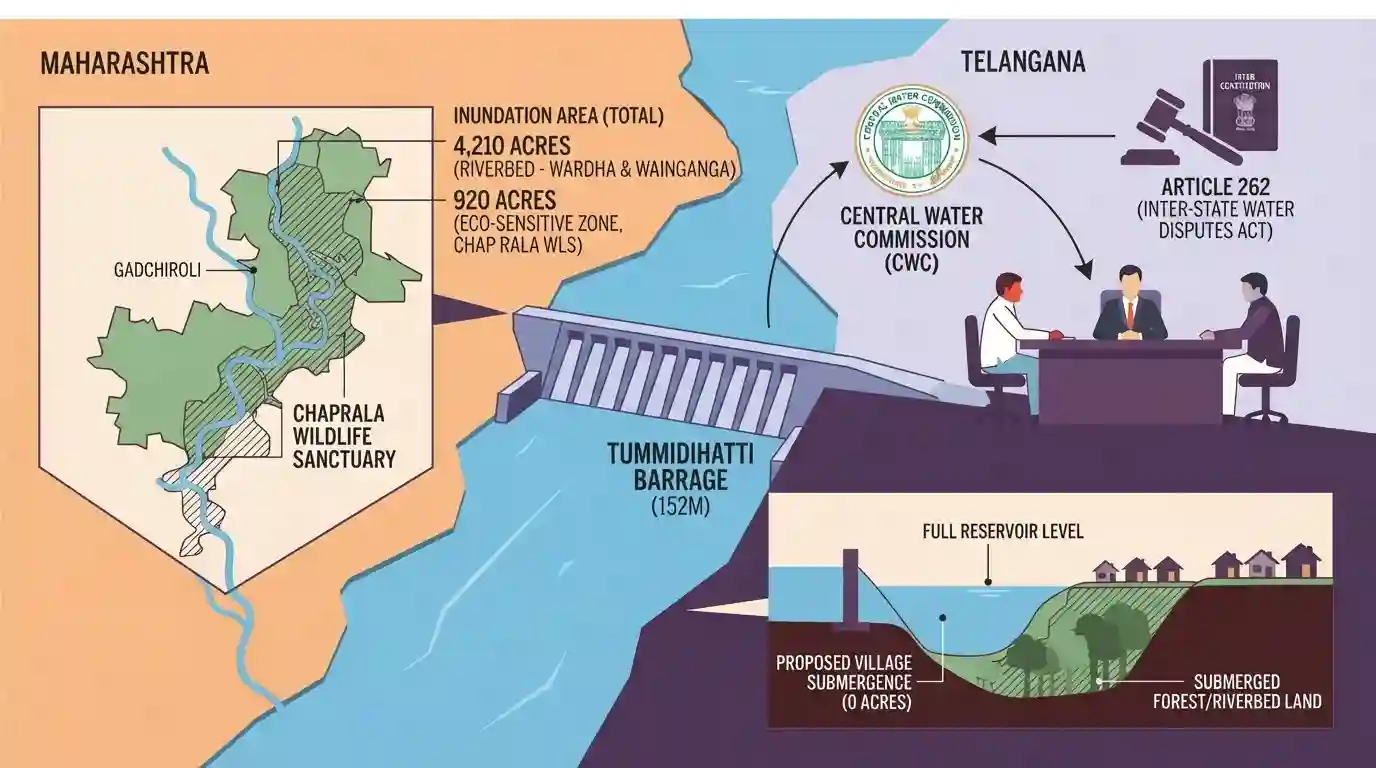
The Central Water Commission (CWC) has scheduled a meeting between the governments of Telangana and Maharashtra to address disputes surrounding the proposed 152-metre-high Tummidihatti barrage. While Telangana claims the project will not submerge any residential villages in Maharashtra, the reservoir is expected to inundate 4,210 acres of riverbed on the Wardha and Wainganga rivers and 920 acres of the Eco-Sensitive Zone in Maharashtra\'s Chaprala Wildlife Sanctuary (Gadchiroli district). This inter-state dispute involves key environmental, geographical, and constitutional dimensions critical for state services exams.
Key Points
- The Central Water Commission (CWC) has convened a high-level meeting between Telangana and Maharashtra on September 1, 2026, to resolve differences over the proposed Tummidihatti barrage.
- Telangana is pushing for a 152-metre-high barrage at Tummidihatti, situated on the Wardha and Wainganga rivers, just upstream of their confluence.
- The proposed height is expected to submerge about 4,210 acres of riverbed and 920 acres within the Eco-Sensitive Zone (ESZ) of the Chaprala Wildlife Sanctuary in Maharashtra\'s Gadchiroli district, though Telangana claims no villages will be submerged.
- In 2016, Maharashtra had agreed to a lower 148-metre height. Following this, Telangana prioritized the Kaleshwaram Lift Irrigation Scheme (KLIS), building major barrages at Medigadda, Annaram, and Sundilla on the Godavari River.
- The dispute highlights key MPSC syllabus topics, including Vidarbha\'s river drainage systems (Wardha and Wainganga), the high forest-cover ecology of Gadchiroli district, and inter-state water dispute frameworks under Article 262 of the Indian Constitution.
Important Terms
Inter-State River Water Disputes Act, 1956

A Parliamentary act enacted under Article 262 of the Constitution that empowers the Central Government to set up ad-hoc tribunals to adjudicate disputes over the sharing and control of inter-state rivers.
UPSC context
GS-II: Polity and Governance (Inter-state relations). Tests constitutional mechanisms for resolving regional water conflicts like the Godavari/Krishna disputes.
Central Water Commission (CWC)
A premier technical organization under the Ministry of Jal Shakti responsible for coordinating, initiating, and monitoring schemes for control, conservation, and utilization of water resources, including flood control and irrigation nationwide.
UPSC context
GS-I: Geography / GS-II: Government Policies. Tests knowledge of federal technical bodies regulating shared water resources and inter-state river systems.
Kaleshwaram Lift Irrigation Scheme (KLIS)
A multi-stage lift irrigation project on the Godavari River in Telangana. It lifts water from the confluence of the Pranahita and Godavari rivers to provide irrigation and drinking water to drought-prone regions.
UPSC context
GS-I: Geography of Maharashtra and India. Tests major irrigation projects, drainage basins, and cross-border river systems like the Godavari and Pranahita.
Ministry of Jal Shakti
An apex central ministry formed by merging the Ministry of Water Resources, River Development and Ganga Rejuvenation, and the Ministry of Drinking Water and Sanitation, handling all water-related policy matters.
UPSC context
GS-II: Polity and Governance. Tests knowledge of central ministries, schemes, and policy-making bodies governing water resources and sanitation in India.
Prelims Trap
The Supreme Court holds original jurisdiction over inter-state water disputes under Article 131 of the Constitution.
Article 262 explicitly allows Parliament to exclude Supreme Court jurisdiction, which Parliament did via the Inter-State River Water Disputes Act, 1956.
Static Concepts Connected
What are the features of the Wardha-Wainganga river system?
- Confluence: Wardha and Wainganga rivers merge to form the Pranhita River, the largest tributary of the Godavari River.
- Flow Direction: Unlike major east-west rivers, they flow southwards through Maharashtra's eastern Vidarbha region (Gadchiroli and Chandrapur).
- Basin Contribution: The Pranhita River basin drains approximately 34% of the entire Godavari river basin before joining it at Kaleshwaram.
How does Article 262 govern inter-state water disputes?
- Parliamentary Power: Empowers Parliament to provide for adjudication of disputes concerning inter-state rivers or river valleys.
- Jurisdiction Bar: Allows Parliament to exclude the jurisdiction of the Supreme Court or any other court over these disputes.
- Enacted Legislation: Led to the passage of the River Boards Act, 1956, and the Inter-State River Water Disputes Act, 1956.
Cross-Topic Patterns
Eco-Sensitive Zones vs Water Security
Infrastructure projects like Tummidihatti highlight the policy clash between Vidarbha's forest conservation goals and inter-state irrigation rights.
Federal Mediation Mechanisms
The Central Water Commission's intervention shows how administrative mediation is utilized before invoking formal tribunals under Article 262.

Vidarbha river geography (Wainganga-Pranhita) paired with Article 262 and Gadchiroli's protected areas likely in a multi-statement MCQ.
Linked PYQs · 4
Linked PYQs · 4
- 2017MPSC_PRELIMSGS1
Consider the following statements : a. According to Article 262 of the Indian Constitution, the Parliament may by law provide for the adjudication of interstate river water dispute. b. Article 262 empowers the President of India to set up an interstate river water dispute tribunal. Select the incorrect statement/s :
- 2020MPSC_PRELIMSGS1
Which one of the following matters stands excluded from the jurisdiction of Inter-state council in India ?
- 2026MPSC_PRELIMSGS1
Match the following forest circles with their share in percentage to total forest area of Maharashtra. | (Forest circles of Maharashtra) | (Percentage to total forest area Economic survey of Maharashtra (2024)) | |---|---| | (a) Gadchiroli | (1) 12.5 | | (b) Nagpur | (2) 20.8 | | (c) Dhule | (3) 9.5 | | (d) Thane | (4) 10.4 | Code: (a) (b) (c) (d)
- 2009MPSC_PRELIMSGS1
Which district of Maharashtra has the maximum area under forest ?
