Andhra Pradesh Launches Quantum Valley Project for Deep Tech
Source:Indian Express ↗
Why It Matters
With quantum computing emerging as a transformative technology globally, state-level initiatives like 'Quantum Valley' complement the central government's National Quantum Mission. It highlights the growing trend of states competing to build localized deep-tech ecosystems to drive economic growth, foster research, and generate future-ready employment.
Summary
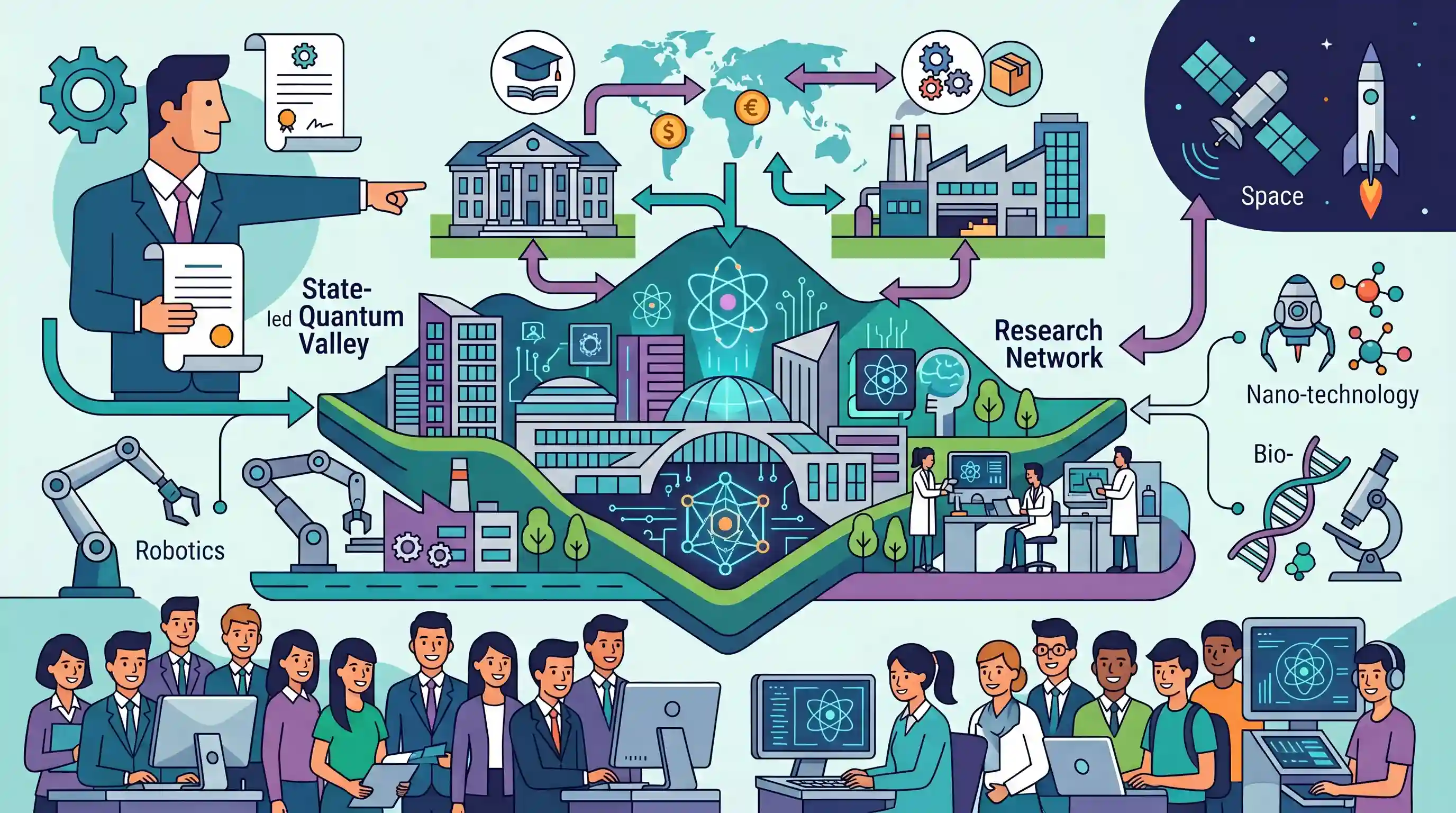
Andhra Pradesh has announced plans to establish a 'Quantum Valley', a state-led initiative championed by Chief Minister Chandrababu Naidu to drive research and innovation in cutting-edge tech domains like quantum computing. The project aims to build a robust ecosystem for deep-tech research by attracting global investments and bridging academia with industry. Ultimately, it seeks to transform the state into a prominent global tech hub while generating substantial high-end employment opportunities for the youth.
Key Points
- Andhra Pradesh Chief Minister Chandrababu Naidu has envisioned a 'Quantum Valley' project to position the state as a premier destination for cutting-edge technology and research.
- The project focuses on fostering research, innovation, and development in advanced fields such as quantum computing and other deep-tech domains.
- By establishing this technology hub, the state government aims to attract global tech investments and foster collaborations between academia and industry leaders.
- A primary objective of the initiative is the creation of large-scale, high-value employment opportunities for the youth in specialized technological sectors.
Important Terms
Amaravati Quantum Valley (AQV)

A state-led initiative in Amaravati to establish a global hub for quantum research, innovation, and manufacturing, integrating industry-academia partnerships with world-class infrastructure.
UPSC context
GS Paper III: Science & Technology; specifically regional initiatives for high-tech development and state-led deep-tech ecosystems.
National Quantum Mission (NQM)
A ₹6,003 crore Union Government mission (2023–2031) aiming to develop intermediate-scale quantum computers, secure communication, and indigenous quantum materials and sensors.
UPSC context
GS Paper III: S&T; tests knowledge of India's flagship technology missions and strategies for scientific self-reliance.
Qubit
The fundamental unit of quantum information, capable of representing 0, 1, or both simultaneously through superposition, enabling exponentially faster processing for complex problems.
UPSC context
GS Paper III: S&T; core conceptual understanding of emerging computer technologies (Quantum Computing).
QChipIN
Planned as India's largest open quantum testbed, it will provide researchers and startups access to quantum hardware and tools for piloting multi-sectoral solutions.
UPSC context
GS Paper III: S&T; infrastructure for indigenization of technology and supporting the domestic startup ecosystem.
Deep-tech
Technologies based on scientific breakthroughs or engineering innovations, requiring high R&D and capital, such as AI, quantum computing, and biotechnology.
UPSC context
GS Paper III: Indian Economy and S&T; refers to government policies driving structural economic shifts through advanced tech.
Amaravati Quantum Academy
A dedicated skilling initiative under the AQV project designed to create a specialized workforce by integrating quantum-focused programs into university curricula.
UPSC context
GS Paper III: Employment; focuses on human capital development and skill-building in futuristic technology sectors.
Prelims Trap
"India's 'Quantum Valley' is a flagship infrastructure project launched under the central National Quantum Mission."
Quantum Valley is India's first state-led deep-tech ecosystem initiated by Andhra Pradesh. It complements national goals but is not a central project under the NQM.
Static Concepts Connected
How does Quantum Computing differ from classical computing?
- Superposition: Uses quantum bits (qubits) that can exist as 0, 1, or both simultaneously, unlike classical binary bits.
- Entanglement: Qubits can be intimately linked so the state of one instantly determines the state of another, regardless of distance.
- Processing Power: Capable of solving highly complex, multi-variable problems (like molecular modeling) exponentially faster than classical computers.
What are the key targets of India's National Quantum Mission (2023-2031)?
- Computing Capacity: Develop intermediate-scale quantum computers with 50-1000 physical qubits across various platforms.
- Secure Communication: Establish satellite-based secure quantum communications spanning a 2000 km range within India.
- Nodal Agency: Implemented centrally by the Department of Science & Technology (DST).
Cross-Topic Patterns
Deep-tech funding & the 'Valley of Death'
Deep-tech startups face long R&D gestation and high costs. State-led infrastructure hubs using the 'Triple Helix' (Govt-Academia-Industry) model are crucial to bridge the 'Valley of Death' funding gap before commercialization.
Quantum leaps & Cybersecurity threats
Quantum computing's massive processing power threatens current RSA encryption frameworks. This accelerates the parallel need for 'Post-Quantum Cryptography' and Quantum Key Distribution (QKD) in national cybersecurity.

A 2026 Prelims question will likely blend quantum principles (superposition/entanglement) with specific National Quantum Mission targets.
Linked PYQs · 3
Linked PYQs · 3
- 2022PrelimsGS1
Which one of the following is the context in which the term "qubit" is mentioned ?
- 2023MainsGS2
Skill development programmes have succeeded in increasing human resources supply to various sectors. In the context of the statement analyse the linkages between education, skill and employment.
- 2015MainsGS3
What are the areas of prohibitive labour that can be sustainably managed by robots ? Discuss the initiatives that can propel research in premier research institutes for substantive and gainful innovation.
