Communal violence and internet suspension measures in Cuttack
Source:The Hindu ↗
Why It Matters
Highlights the persistent challenges administrators face during religious processions and the modern law-and-order tactic of using internet shutdowns to curb the rapid spread of misinformation and inflammatory content by non-state actors.
Summary
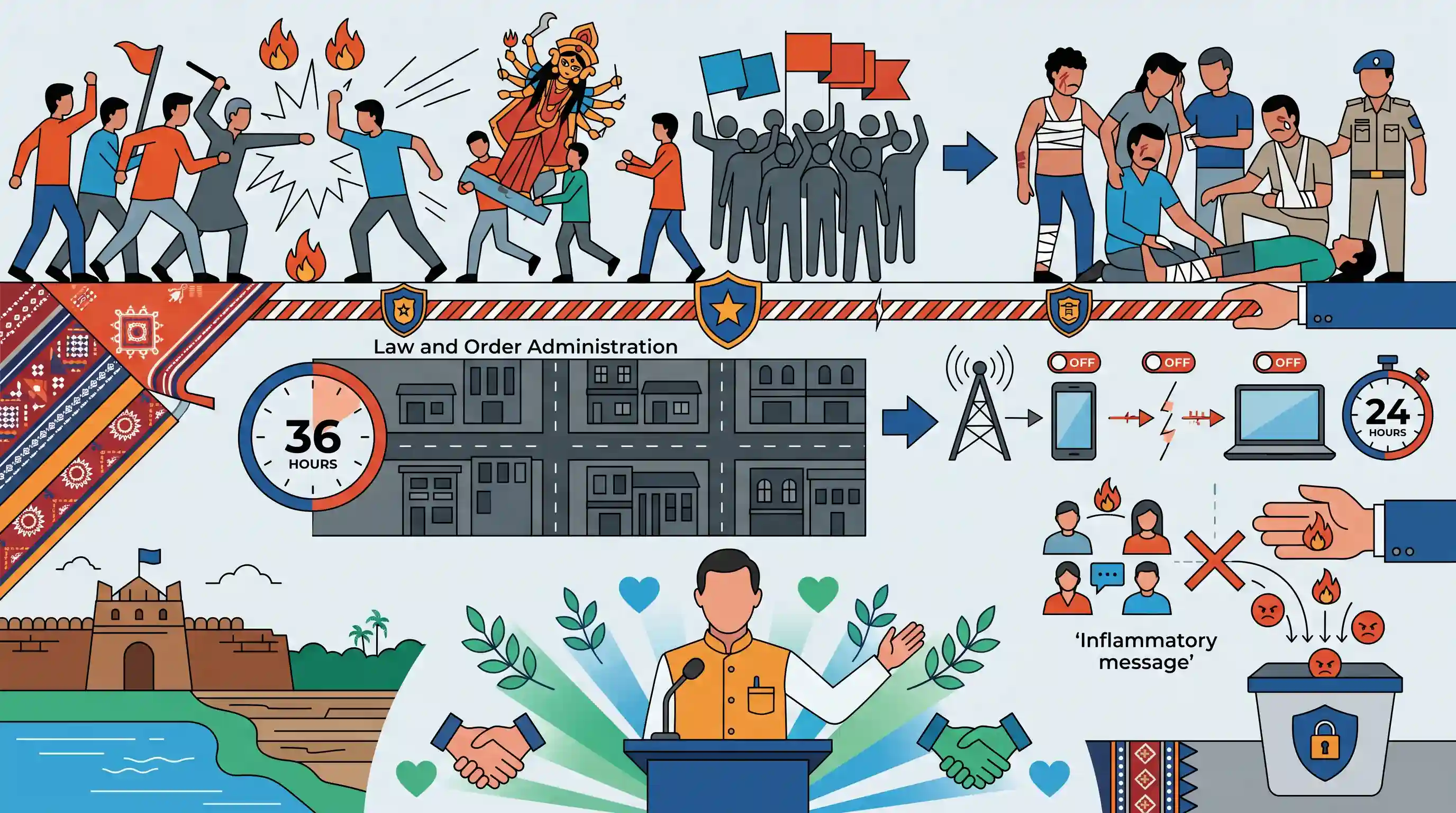
Communal tensions in Cuttack, Odisha, triggered by violence during a Durga Puja idol immersion and an unauthorized Vishva Hindu Parishad (VHP) rally, prompted authorities to impose a 36-hour curfew and a 24-hour internet suspension. The clashes resulted in injuries to 25 police personnel. In response to the unrest, the state government invoked public order measures to block the spread of inflammatory messages on social media, while Chief Minister Mohan Majhi appealed for communal harmony.
Key Points
- A 36-hour curfew was imposed in Cuttack following communal violence during a Durga Puja immersion procession and an unauthorized VHP bike rally.
- 25 police personnel were injured after facing stone-pelting from participants of the rally when authorities attempted to halt their march towards sensitive areas.
- The Odisha government suspended internet and data services for 24 hours to prevent the spread of inflammatory and false messages across social media platforms like WhatsApp, Facebook, and X.
- Chief Minister Mohan Majhi appealed for calm to preserve Cuttack's heritage of brotherhood, while the VHP announced a bandh demanding action against the culprits.
Important Terms
Commissionerate of Police

An urban policing model where a Commissioner of Police (CP) holds both policing and executive magisterial powers, enabling faster decision-making for law and order without relying on a District Magistrate.
UPSC context
GS-2 (Governance) and GS-3 (Security); tests understanding of urban administrative models and police reforms.
Section 163, BNSS
The successor to Section 144 CrPC under the Bharatiya Nagarik Suraksha Sanhita, 2023, empowering magistrates to issue preventive orders in urgent cases of nuisance or danger to public order.
UPSC context
GS-2 (Polity) and GS-3 (Internal Security); tests knowledge of legal tools for maintaining public tranquility.
Internet Shutdowns
Government-mandated disruption of internet access, currently governed by the Telecommunications (Temporary Suspension of Services) Rules, 2024, to prevent unrest or the spread of inflammatory misinformation.
UPSC context
GS-2 (Fundamental Rights) and GS-3 (Internal Security); tests digital rights and the 'Anuradha Bhasin' proportionality test.
Communal Violence
Collective violence or acts promoting enmity between groups based on religion, race, or language, prejudicial to the maintenance of social harmony and secularism.
UPSC context
GS-1 (Indian Society) and GS-3 (Internal Security); tests understanding of communalism and threats to national unity.
Vishva Hindu Parishad (VHP)
A Hindu nationalist organization founded in 1964 as part of the Sangh Parivar to consolidate Hindu society and advocate for Hindu religious and cultural rights.
UPSC context
GS-1 (Social Issues); tests awareness of socio-political organizations and their influence on communal and cultural dynamics.
State Home Department
The administrative wing of a state government responsible for internal security, police administration, and issuing statutory orders for public safety, such as internet suspensions.
UPSC context
GS-2 (Governance/State Executive); tests knowledge of the administrative hierarchy managing law and order.
Prelims Trap
Internet shutdowns are legally mandated under Section 163 of the BNSS.
Internet suspensions are legally governed by the Temporary Suspension of Telecom Services Rules, 2017 (under the Indian Telegraph Act), not BNSS Section 163.
Static Concepts Connected
How has the Supreme Court interpreted the right to access the internet?
- Fundamental Right: The SC ruled internet access is protected under Article 19(1)(a) and 19(1)(g) as a medium for freedom of speech and trade (Anuradha Bhasin case).
- Proportionality Test: Indefinite shutdowns are unconstitutional; any suspension must pass the legal test of proportionality.
- Periodic Review: Telecom suspension orders must be reviewed by a statutory state/central committee within 7 working days.
What is the legal framework governing online content blocking and physical curfews?
- Content Blocking: Section 69A of the IT Act 2000 allows the Union government to block specific URLs or accounts to maintain public order and national security.
- Internet Shutdowns: Governed specifically by the Temporary Suspension of Telecom Services Rules, 2017, issued under the Indian Telegraph Act, 1885.
- Physical Curfews: Section 163 of the Bharatiya Nagarik Suraksha Sanhita (BNSS) empowers executive magistrates to issue urgent prohibitory orders.
Cross-Topic Patterns
Communal riots + BNSS transition
Examines how physical mob control transitions from CrPC Section 144 to BNSS Section 163, assessing executive magistrate powers during public emergencies.
IT Rules + Intermediary Liability
Intersection of local clashes with IT Rules 2021, requiring significant social media intermediaries to coordinate 24x7 with law enforcement to curb inflammatory content.

Expect a Prelims question differentiating the statutory backing of internet suspensions (Telegraph Act) vs. content blocking (IT Act).
Linked PYQs · 4
Linked PYQs · 4
- 2017MainsGS3
Mob violence is emerging as a serious law and order problem in India. By giving suitable examples, analyze the causes and consequences of such violence.
- 2024MainsGS3
Social media and encrypting messaging services pose a serious security challenge. What measures have been adopted at various levels to address the security implications of social media? Also suggest any other remedies to address the problem.
- 2016MainsGS3
Use of Internet and social media by non-state actors for subversive activities is a major security concern. How have these been misused in the recent past? Suggest effective guidelines to curb the above threat.
- 2023MainsGS1
Discuss the impact of post-liberal economy on ethnic identity and communalism.
