Consumer Preference for Cashless Health Insurance Claims
Source:The Hindu ↗
Why It Matters
Understanding issues in health insurance claims and healthcare financing is crucial for GS-II (Issues relating to development and management of Social Sector/Services relating to Health). It sheds light on why out-of-pocket expenditure remains high despite increasing insurance penetration, emphasizing the need for better regulatory frameworks and wider cashless hospital networks to achieve universal health coverage.
Summary
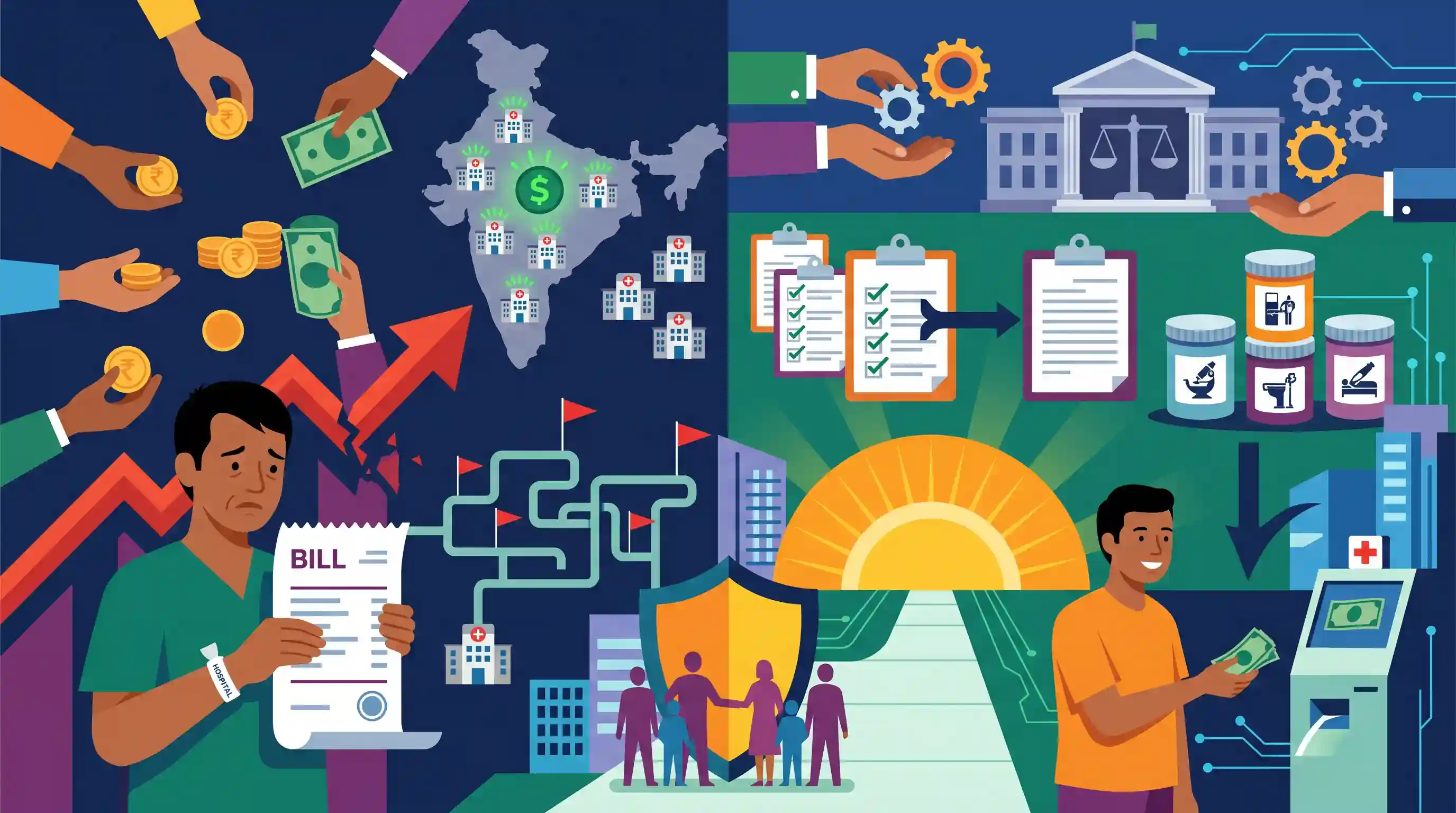
The Policybazaar Health Claims Experience (HCX) Index reveals that Indian consumers heavily favor cashless health insurance claims over reimbursement processes, which often cause financial distress. A staggering 76% of reimbursement claimants report borrowing funds to pay hospital bills, highlighting the severity of out-of-pocket healthcare expenses. Currently, only 5% of India's healthcare providers participate in cashless networks. To improve the policyholder experience and advance universal health coverage, experts are calling for regulatory reforms such as universal claim forms, standardized treatment packages, and transferring the responsibility of submitting medical bills from patients to the hospitals.
Key Points
- A new study called the Health Claims Experience (HCX) Index by Policybazaar highlights a strong preference for cashless health insurance settlements among consumers.
- About 76% of customers who opt for reimbursement claims have to borrow money to cover medical expenses, underscoring high out-of-pocket expenditure.
- A significant bottleneck is the limited network of cashless hospitals, with only around 5% of healthcare providers in India currently onboarded to cashless networks.
- Key pain points for policyholders include confusing network exclusions, cumbersome documentation, and non-transparent claim deductions by insurers.
- Experts advocate for systemic reforms such as universal claim forms, standardized health packages, and shifting the burden of document submission from patients to healthcare providers.
Important Terms
Out-of-pocket Expenditure (OOPE)

Direct household payments for healthcare services (consultations, medicines, diagnostics) at the point of care, not reimbursed by any third party.
UPSC context
GS Paper 2 & 3: Tests understanding of healthcare affordability and barriers to achieving Sustainable Development Goal 3.8.
Universal Health Coverage (UHC)
A health system goal ensuring all individuals receive quality health services they need without suffering financial hardship.
UPSC context
GS Paper 2: Central to social justice, National Health Policy 2017, and the evaluation of Ayushman Bharat.
Cashless Everywhere Initiative
A 2024 regulatory initiative allowing policyholders to access cashless treatment at any registered hospital, regardless of whether it is in the insurer’s network.
UPSC context
GS Paper 3: Relevant for insurance sector reforms, financial inclusion, and ease of living for citizens.
Health Claims Experience (HCX) Index
India’s first benchmark designed to measure customer experience during the health insurance claims journey, focusing on operational efficiency and sentiment.
UPSC context
GS Paper 3: Useful as data-driven evidence in answers regarding insurance penetration and consumer-centric regulatory reforms.
IRDAI
The statutory body under the Ministry of Finance that regulates and promotes the insurance and re-insurance industries in India.
UPSC context
GS Paper 3: Key regulatory body; tests knowledge of statutory authorities and their role in market stability.
Cashless Claim
A claims process where the insurance company settles the medical bills directly with the hospital, sparing the patient from upfront payments.
UPSC context
GS Paper 2: Relevant for discussing healthcare financing mechanisms and reducing medical impoverishment.
Prelims Trap
IRDAI's 'Cashless Everywhere' initiative mandates all healthcare providers in India to offer cashless settlements.
The initiative only applies to hospitals registered under the Clinical Establishments Act (or equivalent state acts), not universally to every unregistered local clinic or medical provider.
Static Concepts Connected
What is Out-of-Pocket Expenditure (OOPE) and its macroeconomic impact?
- Definition: Direct payments made by individuals to healthcare providers at the time of service use, excluding prepayments or health insurance premiums.
- Current Status: Despite government schemes, India's OOPE remains around 47% of Total Health Expenditure (National Health Accounts), significantly higher than the global average.
- Economic Impact: High OOPE is a primary driver of catastrophic health expenditure, pushing millions of Indian households below the poverty line annually.
What is the regulatory framework governing health insurance in India?
- IRDAI: A statutory body established under the IRDA Act, 1999, responsible for regulating, promoting, and ensuring orderly growth of the insurance and re-insurance business.
- Clinical Establishments Act: Empowers the Central Government to prescribe minimum standards of facilities and services for all clinical establishments, a prerequisite for initiatives like 'Cashless Everywhere'.
- Insurance Ombudsman: Created to facilitate the resolution of complaints regarding insurance policies in a cost-effective, efficient, and impartial manner out of the court system.
Cross-Topic Patterns
Commercial vs. Public Health Insurance
The low cashless penetration (5%) in commercial insurance contrasts with Ayushman Bharat PM-JAY's mandate for 100% cashless treatment, highlighting the disparity between India's public and private healthcare financing models.
Insurance as a formalization catalyst
IRDAI tying the 'Cashless Everywhere' initiative to the Clinical Establishments Act acts as a catalyst, forcing unorganized medical providers to formalize registration and adhere to baseline quality standards.

Expect a multi-statement question on healthcare financing, linking IRDAI's new cashless mandates with OOPE trends and PM-JAY metrics.
Linked PYQs · 2
Linked PYQs · 2
- 2015MainsGS2
Public health system has limitations in providing universal health coverage. Do you think that the private sector could help in bridging the gap? What other viable alternatives would you suggest?
- 2024MainsGS2
In a crucial domain like the public healthcare system the Indian State should play a vital role to contain the adverse impact of marketisation of the system. Suggest some measures through which the State can enhance the reach of public healthcare at the grassroots level.
