Narcotics Control Bureau suspends officers over custodial death
Source:Indian Express ↗
Why It Matters
The case highlights the persistent challenge of custodial violence and the failure of central agencies to adhere to arrest protocols. It illustrates the vital need to balance robust law enforcement with fundamental human rights, emphasizing that investigative agencies must be subject to strict institutional accountability and oversight to maintain the rule of law.
Summary
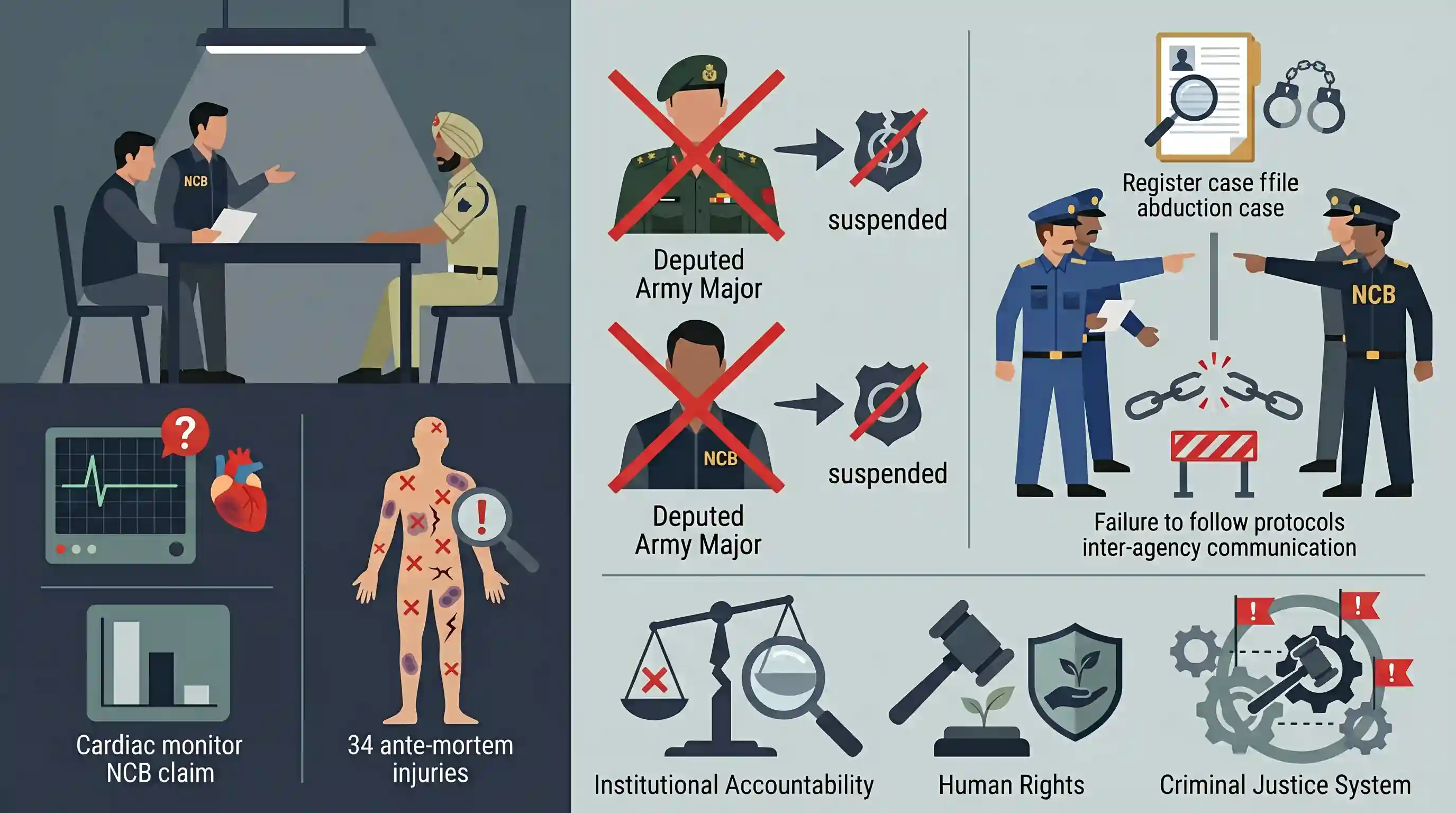
Two Narcotics Control Bureau (NCB) officers, including a deputed Army Major, have been suspended following the alleged custodial death of BSF jawan Jaswinder Singh. While the NCB initially claimed the death was due to a cardiac issue, an autopsy revealed 34 ante-mortem injuries. Furthermore, local police have registered an abduction case against the NCB officials for failing to follow protocols and inform them of the arrest. The incident raises serious concerns regarding custodial violence, inter-agency coordination, and the accountability of specialized investigative agencies in upholding human rights.
Key Points
- BSF jawan Jaswinder Singh died in NCB custody; an autopsy revealed 34 ante-mortem injuries, contradicting the agency's initial claim of a "cardiac event."
- Two NCB officers, including an Army Major on deputation, have been suspended pending investigation.
- Local police registered an abduction case against the NCB officials for failing to inform them about the arrest, violating standard operating protocols.
- The incident brings to light critical issues regarding custodial violence, human rights violations, and the misuse of coercive force during interrogations.
- Underscores the necessity for robust oversight mechanisms and strict adherence to procedural safeguards by specialized law enforcement agencies.
Important Terms
Narcotics Control Bureau (NCB)

The nodal agency for drug law enforcement and intelligence in India, established in 1986 under the Ministry of Home Affairs to enforce narcotics laws.
UPSC context
GS Paper III (Internal Security). Tests knowledge of specialized enforcement agencies and strategies against organized drug trafficking.
Border Security Force (BSF)
A Central Armed Police Force (CAPF) under the Ministry of Home Affairs, primarily responsible for guarding India’s international borders with Pakistan and Bangladesh.
UPSC context
GS Paper III (Security Forces). Essential for understanding border management, internal security, and the mandates of paramilitary forces.
Custodial Death
The death of an individual while in police or judicial detention, often serving as a key indicator of human rights violations and custodial torture.
UPSC context
GS Paper II (Governance) & GS Paper IV (Ethics). Relates to Article 21, judicial oversight, and institutional accountability.
Ante-mortem Injuries
Forensic term for injuries sustained by a person before death, critical in legal investigations to establish the cause of death and differentiate from post-mortem wounds.
UPSC context
GS Paper II (Criminal Justice Reform). Important for understanding the role of medical evidence in criminal investigations and rule of law.
NDPS Act, 1985
The primary legislation in India that prohibits the manufacture, sale, and consumption of narcotic drugs and psychotropic substances while providing strict punishment for offenders.
UPSC context
GS Paper III (Internal Security). Tests legislative frameworks used to combat the drug menace and related internal security threats.
D.K. Basu Guidelines
A set of 11 mandatory procedures established by the Supreme Court (1997) to be followed during arrest and detention to prevent custodial violence.
UPSC context
GS Paper II (Polity/Judiciary). Tests knowledge of landmark judgments aimed at protecting fundamental rights and reforming police conduct.
Prelims Trap
"Inquiries into custodial deaths and rapes are conducted by an Executive Magistrate for rapid administrative action."
Under BNSS Section 196 (formerly CrPC 176(1)), custodial deaths must be investigated by a Judicial Magistrate, not an Executive Magistrate, to ensure independence.
Static Concepts Connected
What are the core legal safeguards against custodial violence?
- Constitutional Rights: Articles 21 (right to life and dignity) and 22 (protection against arbitrary arrest; right to consult a legal practitioner).
- Judicial Inquiry: Section 196 of the BNSS 2023 (formerly CrPC Sec 176(1)) mandates that a Judicial Magistrate must investigate any case of custodial death or disappearance.
- NHRC Reporting: NHRC mandates that every custodial death be reported to the commission within 24 hours, followed by a videographed post-mortem.
What did the Supreme Court's D.K. Basu judgment mandate?
- Arrest Memo: Police must prepare a memo detailing the time and date of arrest, which must be attested by a witness or family member.
- Medical Examination: The arrested person must undergo a medical examination by a trained doctor upon arrest and every 48 hours during detention.
- Information Rights: The detaining agency must notify a relative and the local police station about the arrest to prevent secret detentions.
Cross-Topic Patterns
Army deputations in civil agencies
Deputing military officers to civilian agencies like the NCB creates complex disciplinary overlaps, pitting the Army Act against regular criminal justice procedures when procedural lapses occur.
NHRC limitations regarding Armed Forces
Under the Protection of Human Rights Act, the NHRC has restricted powers to independently investigate alleged human rights violations involving Armed Forces, severely limiting accountability.

Expect Prelims 2026 to test D.K. Basu guidelines alongside new BNSS 2023 provisions (mandatory judicial inquiries) for custodial deaths.
Linked PYQs · 3
Linked PYQs · 3
- 2014MainsGS2
National Human Rights Commission (NHRC) in India can be most effective when its tasks are adequately supported by other mechanisms that ensure the accountability of a government. In light of the above observation assess the role of NHRC as an effective complement to the judiciary and other institutions in promoting and protecting human rights standards.
- 2018MainsGS3
India's proximity to two of the world's biggest illicit opium-growing states has enhanced her internal security concerns. Explain the linkages between drug trafficking and other illicit activities such as gunrunning, money laundering and human trafficking. What counter-measures should be taken to prevent the same?
- 2017MainsGS4
Examine the relevance of the following in the context of civil service: Transparency, Accountability, Fairness and justice, Courage of conviction, Spirit of service.
