UN Report on Global Climate Pledges and Emissions Gap
Source:The Hindu ↗
Why It Matters
It highlights the global inadequacies in climate action and ambition gaps under the Paris Agreement, directly impacting international climate negotiations, policy formulations, and India's strategic stance on climate commitments.
Summary
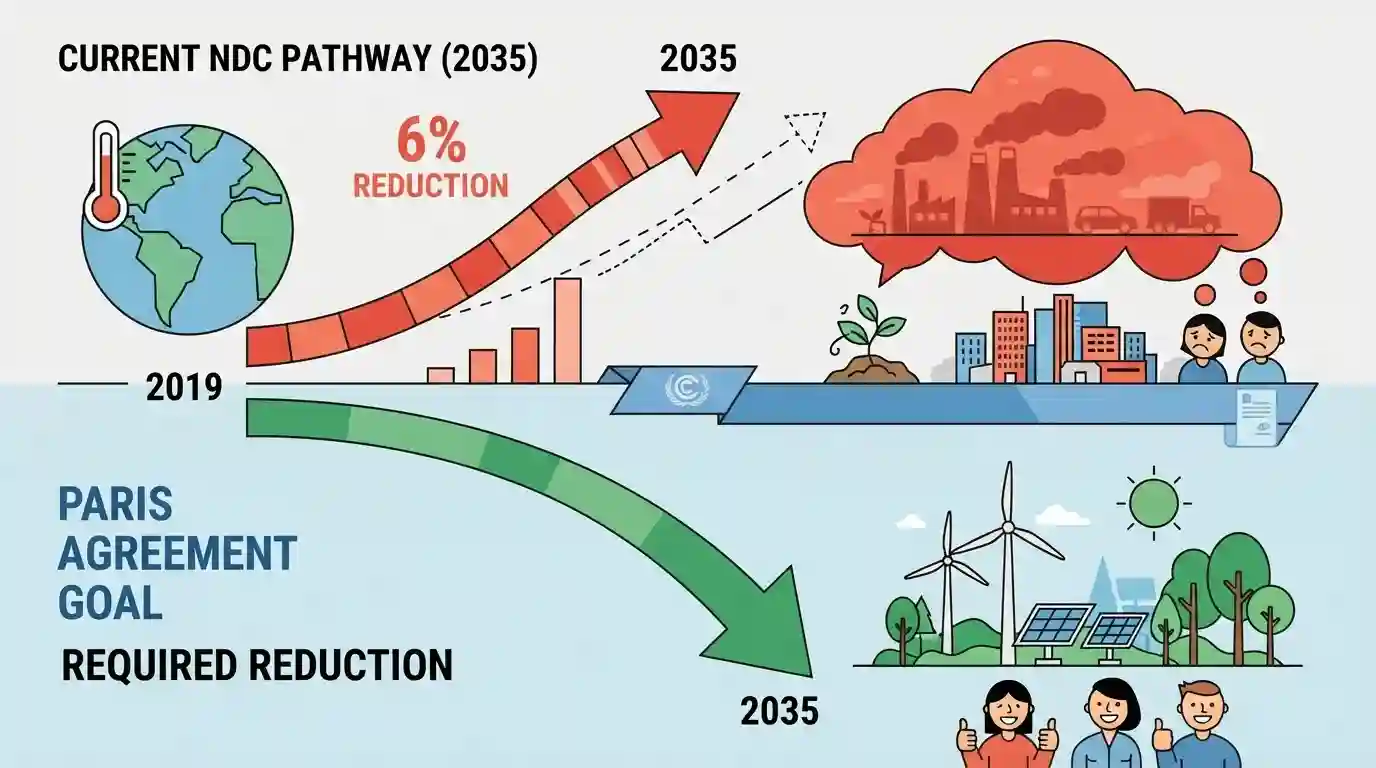
According to a UN report, current national climate pledges (Nationally Determined Contributions) will achieve only a 6% reduction in global greenhouse gas emissions by 2035 relative to 2019 levels, which is far off track from the goals of the Paris Agreement to limit global warming.
Key Points
- A UN report reveals that current national climate pledges (NDCs) will cut global greenhouse gas emissions by just 6% by 2035 compared to 2019 levels.
- This reduction falls drastically short of the emissions cuts required to limit global warming to 1.5°C or even 2°C under the Paris Agreement.
- The report underscores a major implementation and ambition gap among nations as they prepare to submit updated climate plans.
- Urgent scaling up of climate finance, technology transfer, and mitigation policies is emphasized to prevent catastrophic climate change impacts.
Important Terms
Paris Agreement

A legally binding international treaty on climate change adopted in 2015, aiming to limit global warming to well below 2°C, preferably to 1.5°C, compared to pre-industrial levels.
UPSC context
General Studies Paper III (Environment and Ecology): Core international climate architecture, targets, and global stocktake mechanisms.
Nationally Determined Contributions (NDCs)
National climate action plans submitted by countries under the Paris Agreement, outlining their intended greenhouse gas emission reductions and adaptation strategies.
UPSC context
General Studies Paper III: National commitments, climate policy implementation, and India’s updated climate goals.
UNFCCC
A United Nations treaty body established to combat climate change by stabilizing greenhouse gas concentrations in the atmosphere, serving as the parent treaty of the Paris Agreement.
UPSC context
General Studies Paper III: International environmental conventions, Conference of the Parties (COP), and institutional frameworks.
Static Concepts Connected
What are the key mechanisms and legal nature of Nationally Determined Contributions (NDCs) under the Paris Agreement?
- Binding vs Non-Binding: Legal Nature: NDCs are nationally determined and submitted every five years under the UNFCCC process; while the process is mandatory, the targets themselves are not legally binding under international law.
- Progression Principle: Baseline & Ambition: Parties are expected to progressively enhance their ambition with each successive NDC cycle, moving away from previous baseline years toward economy-wide absolute emission reduction targets.
- Global Stocktake: Global Stocktake: The GST assesses collective progress toward achieving the purpose of the Paris Agreement and its long-term goals every five years.
Cross-Topic Patterns
NDCs and Domestic Fiscal Policy Linkages
UNFCCC COP reporting cycles intersect directly with domestic fiscal allocations for energy transition and green subsidies under the Union Budget.

UNFCCC NDCs + Paris Agreement 1.5°C targets will likely be tested via a multi-statement statement on emission reduction baselines and timelines.
Linked PYQs · 2
Linked PYQs · 2
- 2025MainsGS3
Write a review on India's climate commitments under the Paris Agreement (2015) and mention how these have been further strengthened in COP26 (2021). In this direction, how has the first Nationally Determined Contribution intended by India been updated in 2022?
- 2021MainsGS3
Describe the major outcomes of the 26th session of the Conference of the Parties (COP) to the United Nations Framework Convention on Climate Change (UNFCCC). What are the commitments made by India in this conference?
