Six States Sign Accord for Kishau Dam Project on Tons River
Source:affairscloud ↗
Why It Matters
This article contains highly relevant topics for the RPSC RAS Prelims. It highlights Rajasthan's participation in the new Kishau Multi-purpose Dam Project on the Tons River (affecting water security), connects to previous RPSC questions on interstate water joint-ventures (e.g., Mahi Bajaj Sagar, Chambal, Beas), covers international environmental events like Desertification Day (crucial for Rajasthan's geographic context), and details tribal cultural instruments like the Sarinda (which aligns with RPSC's recurring focus on traditional musical instruments and GI tags).
Summary
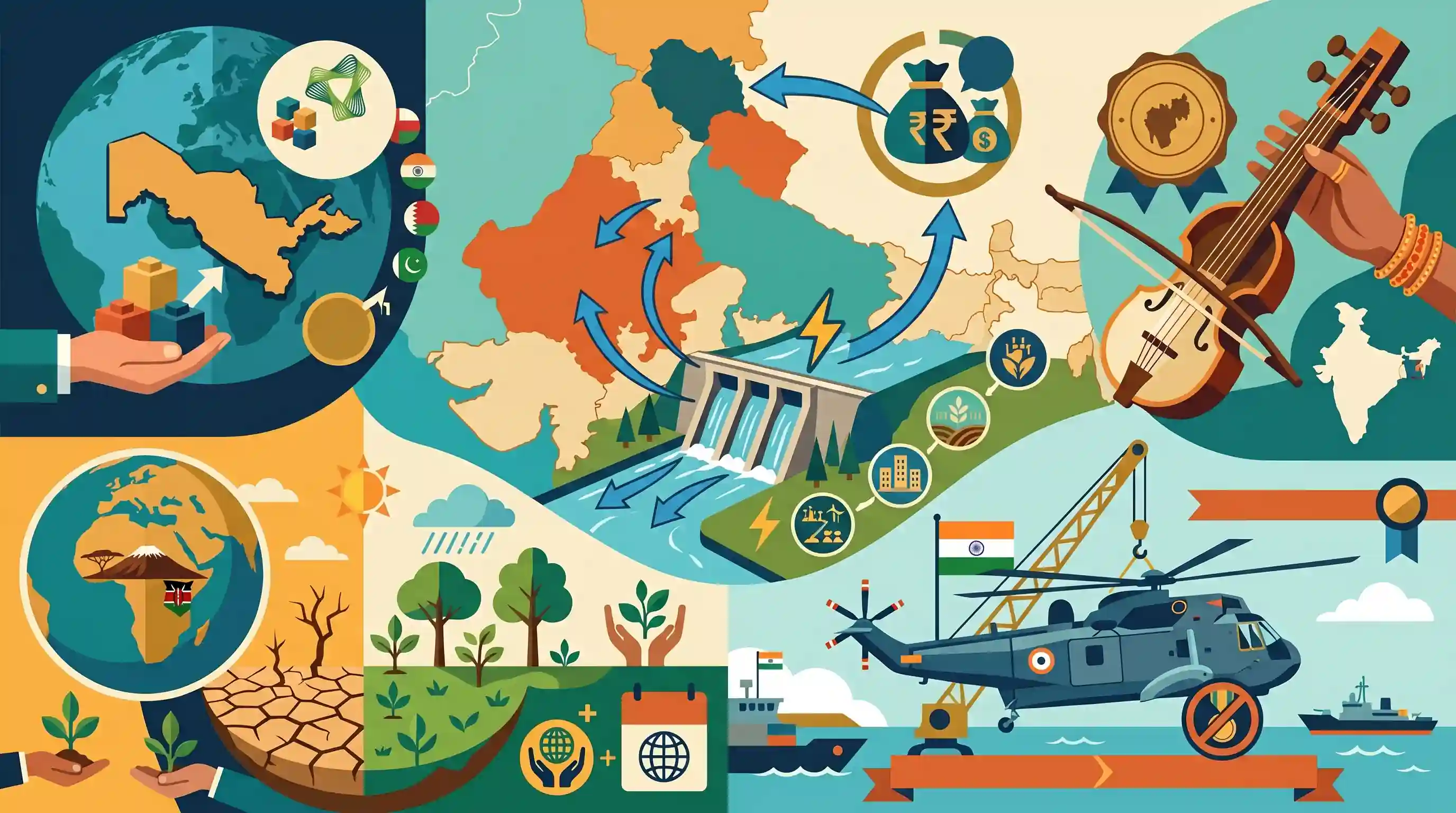
In June 2026, six northern states, including Rajasthan, signed a major MoU for the implementation of the Rs 15,000 crore Kishau Multi-Purpose Dam Project on the Tons River (a Yamuna tributary). The central government will fund 90% of the water component, and Rajasthan/Delhi will receive Himachal Pradesh's share of water in exchange for bearing its power component cost. Other key developments include Tripura's tribal string instrument 'Sarinda' receiving a GI tag, the observation of the World Day to Combat Desertification and Drought 2026 hosted by Kenya, Uzbekistan joining the New Development Bank as its 10th member, and the Indian Navy decommissioning its iconic Sea King Mk42B helicopter fleet.
Key Points
- Six northern states—Himachal Pradesh, Uttarakhand, Delhi, Uttar Pradesh, Haryana, and Rajasthan—agreed to sign a comprehensive MoU for the Kishau Multi-Purpose Dam Project under the chairmanship of Union Home Minister Amit Shah.
- The Kishau Project is a hydroelectric and water storage venture planned on the Tons River (a major tributary of the Yamuna) along the Uttarakhand-Himachal Pradesh border (Dehradun-Sirmour region) with an estimated cost of Rs 15,000 crore.
- Under the agreement, the Central Government funds 90% of the water component cost as Central Assistance, while the remaining 10% is shared by the six states. Himachal Pradesh will allocate its share of water to Delhi and Rajasthan in exchange for cost-sharing of its power component.
- Tripura's traditional tribal bowed string instrument 'Sarinda' (or Sarinda Uakhrap), made of bamboo with an oval wooden vibrating chamber, has secured a Geographical Indication (GI) tag, making it the 4th GI-tagged product from the state.
- The World Day to Combat Desertification and Drought 2026 was observed on June 17 with the theme 'Rangelands: Recognize. Respect. Restore.' led by the UNCCD Secretariat and hosted by Kenya.
- Uzbekistan became the 10th member and the first Central Asian nation to ratify and join the New Development Bank (NDB).
- The Indian Navy decommissioned its Sea King Mk42B helicopter fleet ('Flying Frigates') after 36 years of service during a ceremony at INS Shikra in Mumbai.
Important Terms
Kishau Multi-Purpose Dam Project

A 660 MW multipurpose dam project on the Tons River (Yamuna's tributary) along the Uttarakhand-Himachal Pradesh border, aimed at water storage, drinking supply, irrigation, and power generation for six northern states.
UPSC context
GS Paper II & III (Federalism/Water Sharing); tests cooperative federalism, inter-state water conflicts, and clean energy infrastructure.
UNCCD
Established in 1994, it is the sole legally binding international agreement linking environment and development to sustainable land management, focusing on combatting desertification, land degradation, and drought.
UPSC context
GS Paper III (Environment & Ecology); tests global environment conventions, SDG 15, and land degradation neutrality targets.
Geographical Indication Registry
The statutory body established under the GI Act of 1999, headquartered in Chennai, responsible for administering, evaluating, and registering Geographical Indications in India.
UPSC context
GS Paper III (Intellectual Property Rights); tests statutory bodies, intellectual property protection, and cultural heritage preservation.
DPIIT
The Department for Promotion of Industry and Internal Trade; a nodal department under the Ministry of Commerce and Industry responsible for promoting industrial growth, investments, and administering intellectual property rights.
UPSC context
GS Paper III (Economy & IPR); tests regulatory bodies, industrial policies, and administrative frameworks for intellectual property.
Ministry of Commerce and Industry
The Indian government ministry responsible for formulating trade policies, promoting domestic industry, and governing intellectual property frameworks through departments like DPIIT.
UPSC context
GS Paper III (Indian Economy); tests trade policy, industrial governance, and international treaty compliance (WTO-TRIPS).
Prelims Trap
The Yamuna River carries a significantly larger volume of water than its tributary, the Tons River, at their confluence.
In reality, the Tons River is the largest tributary of the Yamuna and actually carries more water than the Yamuna itself at their confluence near Kalsi.
Static Concepts Connected
What are the key geographical features of the Yamuna River system?
- Source and Origin: Originates from the Yamunotri Glacier on the southwestern slopes of the Bandarpunch peaks in the Mussoorie range of the Lower Himalayas.
- The Tons Tributary: The Tons is the largest Himalayan tributary, originating from Bandarpunch, joining the Yamuna near Kalsi (Dehradun) and carrying more water than the main stream.
- Other Key Tributaries: Right-bank tributaries include Chambal, Sind, Betwa, and Ken (peninsular rivers); left-bank includes Hindon, Hanumanganga, and Giri.
How is the New Development Bank (NDB) structured and expanded?
- Establishment: Established in 2015 by the BRICS nations (Brazil, Russia, India, China, and South Africa) with its headquarters located in Shanghai, China.
- Membership & Voting: All members of the United Nations can join; however, the voting power of the founding BRICS nations cannot fall below 55% of the total.
- Recent Expansion: In 2021, NDB admitted Bangladesh, UAE, Egypt, and Uruguay; Uzbekistan's ratification in 2026 makes it the 10th member and the first from Central Asia.
Cross-Topic Patterns
Inter-state water sharing vs cooperative federalism
While Article 262 governs inter-state conflicts, joint projects like Kishau showcase executive-led cooperative federalism, using central funding and resource trading (water for power) to pre-empt disputes.
Tribal ethno-musicology and IPR protection
Awarding GIs to tribal instruments like Tripura's Sarinda highlights the evolution of GI tags beyond agricultural produce to safeguard endangered tribal material culture and intellectual property.

Multi-state projects on Yamuna tributaries (Kishau, Lakhwar) are highly likely to be tested on river geography and state cost-sharing models.
Linked PYQs · 5
Linked PYQs · 5
- 2023RPSC_PRELIMSGS1
The Mahi Bajaj Sagar project is a joint venture of:
- 2013RPSC_PRELIMSGS1
Match the following – Irrigation Project – Participating States 1. Chambal Project (i) Only Rajasthan 2. Mahi-Bajasagar Project (ii) Rajasthan and Madhya Pradesh 3. Beas Project (iii) Rajasthan and Gujarat 4. Siddhmukh Project (iv) Punjab, Haryana and Rajasthan (v) Punjab and Rajasthan Code:
- 2012RPSC_PRELIMSGS1
Which of the following is NOT a cause of desertification in Rajasthan?
- 2025RPSC_PRELIMSGS1
Consider the following statements regarding the folk musical instrument ‘Chautara’ and select the correct option from the following: A. It is an instrument with four strings. B. It is generally used to sing bhajans of Ramdevji.
- 2024RPSC_PRELIMSGS1
Consider the following statements about the folk instrument 'Chautara' and choose the correct option from below: A. It is a four stringed instrument. B. It is generally used in singing bhajans of Ramdev ji.
