RBI Data on Widening Current Account Deficit and Trade Gap
Source:The Hindu ↗
ఇది ఎందుకు ముఖ్యం
Understanding the components of the Balance of Payments (BoP) and the dynamics of the Current Account Deficit (CAD) is fundamental for the UPSC examination. It reflects the health of India's external sector and directly influences the exchange rate, inflation, and overall macroeconomic stability.
సారాంశం
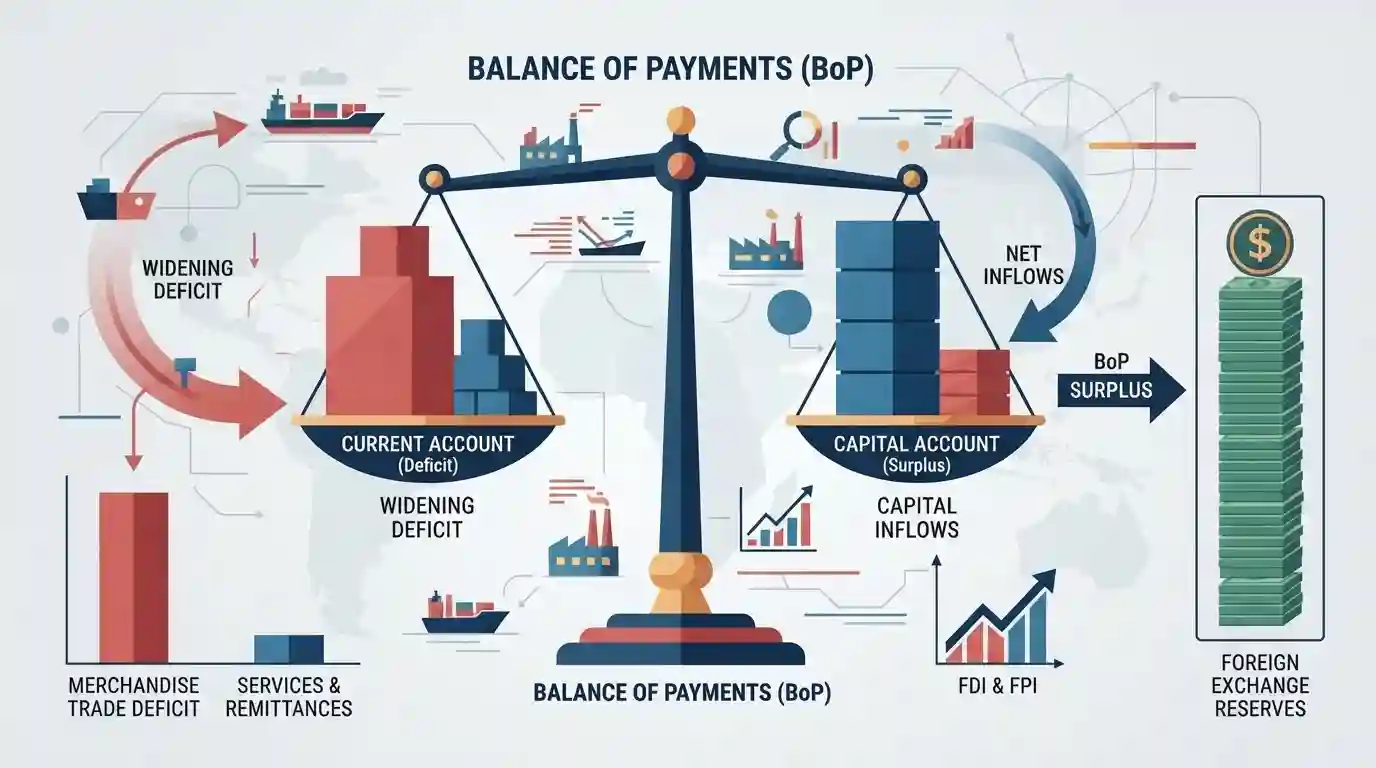
According to RBI data, India's Current Account Deficit (CAD) widened to $6.2 billion for the quarter ended June, primarily driven by a broader merchandise trade deficit of $30.2 billion. This trade gap was partially cushioned by robust net services receipts, which climbed to $17.9 billion, and an increase in net transfer receipts (remittances) to $11.9 billion. On the capital account front, net inflows stood at $9.1 billion, bolstered by both foreign direct investment (FDI) and foreign portfolio investment (FPI). Consequently, despite the widened CAD, the overall Balance of Payments (BoP) registered a positive balance of $2.9 billion, leading to an equivalent accretion in India's foreign exchange reserves.
ముఖ్య అంశాలు
- India's Current Account Deficit (CAD) widened to $6.2 billion for the quarter ended June, driven by a higher merchandise trade deficit of $30.2 billion.
- The widened trade gap was partially offset by a robust services surplus, which increased to $17.9 billion, and rising net transfer receipts (mostly remittances) of $11.9 billion.
- The capital account recorded net inflows of $9.1 billion, supported by both Foreign Direct Investment (FDI) and Foreign Portfolio Investment (FPI).
- Despite the higher CAD, the overall Balance of Payments (BoP) remained positive at $2.9 billion, leading to an accretion in foreign exchange reserves.
ముఖ్యమైన పదాలు
Reserve Bank of India (RBI)

India's central bank and apex monetary authority. It formulates monetary policy, issues currency, regulates the financial sector, and manages the country's foreign exchange reserves.
UPSC context
Essential for GS Paper 3 (Economy). Tests knowledge on monetary policy, macroeconomic stability, and banking regulation.
Current Account Deficit (CAD)
A condition where a country's total external payments for imported goods, services, and transfers exceed its total receipts from exports and incoming remittances.
UPSC context
Core GS Paper 3 concept. UPSC tests its components, impact on currency depreciation, and overall macroeconomic health.
Balance of Payments (BoP)
A systematic accounting statement summarizing all economic transactions—including trade in goods, services, and capital—between a country's residents and the rest of the world.
UPSC context
Vital for GS Paper 3 (External Sector). Questions evaluate knowledge of current and capital account components and crisis management.
Foreign Exchange Reserves
External assets managed by the RBI, comprising foreign currencies, gold, SDRs, and the IMF reserve tranche. They act as a buffer against economic shocks.
UPSC context
Key GS Paper 3 topic. Prelims frequently test its exact components and the RBI's role as their custodian.
Merchandise Trade Deficit
The specific shortfall that arises when the monetary value of a country's physical imported goods exceeds the value of its physical exported goods.
UPSC context
GS Paper 3. Crucial for understanding structural economic vulnerabilities, like India's heavy reliance on crude oil and gold imports.
Foreign Direct Investment (FDI)
Long-term cross-border capital investment where a foreign entity acquires significant ownership (usually 10% or more) and management control in a domestic enterprise.
UPSC context
GS Paper 3. Questions often contrast FDI with FPI, emphasizing FDI's role in stable capital inflow and asset creation.
Foreign Portfolio Investment (FPI)
Investment by non-residents in a country's financial assets, such as stocks and bonds, without acquiring management control. It is generally short-term and highly liquid.
UPSC context
Important for GS Paper 3. Tests focus on capital market volatility ("hot money") and its impact on exchange rates.
ప్రిలిమ్స్ ఉచ్చు
Private remittances from Indian workers abroad are classified under the Capital Account as they represent foreign currency assets.
Remittances are unilateral transfers with no future repayment obligation, placing them strictly in the Current Account (invisibles), unlike NRI deposits which are Capital Account debt liabilities.
అనుసంధానమైన స్థిర భావనలు
What are the key differences between Current and Capital Accounts in Balance of Payments?
- Current Account components: Includes export/import of goods, services (invisibles), and unilateral transfers (gifts, donations, remittances) that do not alter foreign assets or liabilities.
- Capital Account components: Tracks asset ownership changes, comprising Foreign Direct Investment (FDI), Foreign Portfolio Investment (FPI), external loans (ECBs), and banking capital like NRI deposits.
- Liability implications: Current account transactions do not create future repayment obligations, whereas capital account transactions directly affect the country's external asset-liability position.
How does a Balance of Payments surplus translate into Foreign Exchange Reserves?
- BoP identity: The overall BoP balance is the sum of the current, capital, and financial accounts, which must sum to zero in accounting terms.
- RBI reserve accretion: If net inflows from current and capital accounts are positive, the central bank buys excess foreign currency, leading to forex reserve accretion.
అంతర-అంశ నమూనాలు
Remittances + Bilateral mobility agreements
India's current account stability depends heavily on remittance inflows, linking domestic macroeconomic resilience directly to foreign policy initiatives like Migration and Mobility Partnership Agreements with partner nations.
CAD + Global energy geopolitics
India's structural merchandise trade deficit is heavily driven by crude oil and coal, making the CAD highly sensitive to global geopolitical tensions and the domestic renewable energy transition.

UPSC 2026 will likely test BoP structural accounting: distinguishing NRI deposits from remittances and how capital inflows offset CAD.
అనుసంధాన PYQలు · 5
అనుసంధాన PYQలు · 5
- 2014PrelimsGS1
With reference to Balance of Payments, which of the following constitutes/constitute the Current Account? 1. Balance of trade 2. Foreign assets 3. Balance of invisibles 4. Special Drawing Rights Select the correct answer using the code given below.
- 2013PrelimsGS1
The balance of payments of a country is a systematic record of
- 2013PrelimsGS1
Which of the following constitute Capital Account? 1. Foreign Loans 2. Foreign Direct Investment 3. Private Remittances 4. Portfolio Investment Select the correct answer using the codes given below.
- 2020PrelimsGS1
With reference to Foreign Direct Investment in India, which one of the following is considered its major characteristic?
- 2018MainsGS3
How would the recent phenomena of protectionism and currency manipulations in world trade affect macroeconomic stability of India?
