RBI Data on Second Quarter Current Account Deficit Moderation
Source:Indian Express ↗
Why It Matters
Current Account Deficit (CAD) is a critical indicator of an economy's health, directly impacting currency valuation, inflation, and monetary policy decisions. For UPSC aspirants, understanding the components of the Balance of Payments and how the RBI manages external sector risks is essential for both Prelims and Mains (GS-3).
Summary
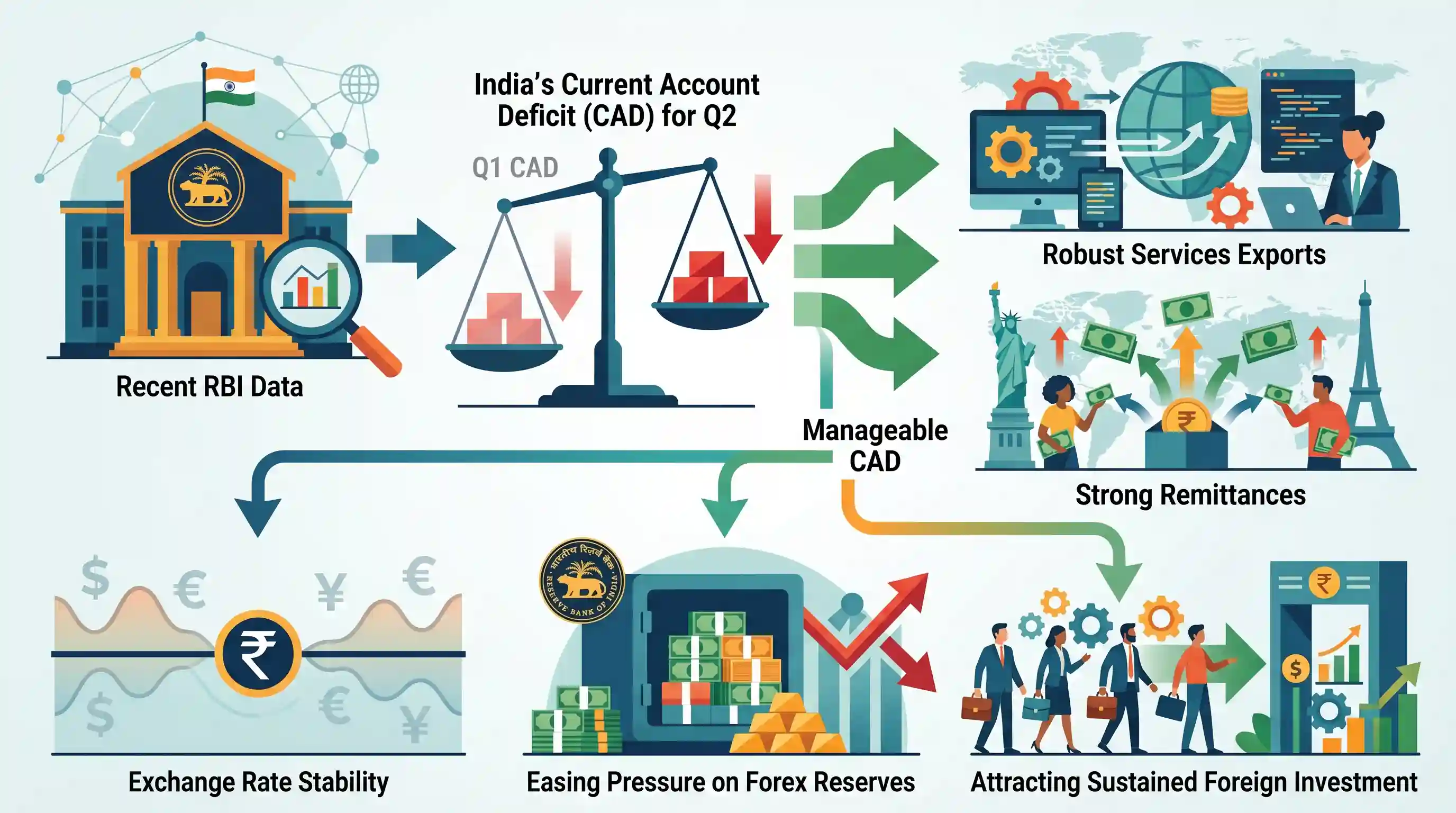
The Reserve Bank of India's recent data shows a moderation in India's Current Account Deficit (CAD) to $12.3 billion for the second quarter. This narrowing of the CAD is a positive macroeconomic indicator, often driven by robust services exports and strong remittances, which helps buffer the balance of payments. A manageable CAD is crucial for maintaining exchange rate stability, easing pressure on the country's foreign exchange reserves, and attracting sustained foreign investment.
Key Points
- India's Current Account Deficit (CAD) narrowed to $12.3 billion in the second quarter (Q2), according to the latest RBI data.
- A moderating CAD implies a reduction in the gap between the value of imports and exports of goods and services, easing the country's external sector vulnerabilities.
- Lower CAD generally supports the Indian rupee by easing the demand for foreign currency and reducing pressure on foreign exchange reserves.
Important Terms
Current Account Deficit (CAD)

The negative difference between a nation's total earnings from exports and its total spending on imports of goods, services, and transfers.
UPSC context
GS-III Indian Economy; essential for analyzing external sector stability and its impact on the Rupee's value.
Balance of Payments (BoP)
A systematic record of all economic transactions between residents of a country and the rest of the world over a specific period.
UPSC context
GS-III Indian Economy; fundamental indicator of a country's global financial health and trade position.
Remittances
Funds transferred by expatriates to their home country. India is the world's leading recipient, significantly buffering its current account.
UPSC context
GS-III Economy; acts as a vital 'invisible' receipt that offsets India's chronic merchandise trade deficit.
Foreign Exchange Reserves
Assets held by a central bank in foreign currencies, gold, and SDRs to manage exchange rates and meet external obligations.
UPSC context
GS-III Economy; tested as a measure of a country's ability to withstand external economic shocks.
Reserve Bank of India (RBI)
India's central bank and regulatory body responsible for monetary policy, currency issuance, and managing foreign exchange reserves.
UPSC context
GS-III Economy; primary institution for maintaining financial stability, controlling inflation, and overseeing the banking sector.
Services Exports
Earnings from international trade in intangible assets like IT, consulting, and tourism, where India typically maintains a significant surplus.
UPSC context
GS-III Economy; a key structural strength of India’s current account that helps mitigate trade deficits.
Prelims Trap
"A narrowing Current Account Deficit indicates that India has achieved a surplus in its balance of trade."
This confuses the balance of trade (merchandise) with the current account. India's merchandise trade remains in deep deficit; the CAD narrows primarily due to robust services exports and remittances.
Static Concepts Connected
What are the key components of the Current Account in India's Balance of Payments?
- Visible Trade: Export and import of physical goods, often referred to as the balance of trade.
- Invisible Trade: Trade in services (e.g., IT, software, travel, transport), where India typically runs a strong surplus.
- Net Income: Investment income (interest, profits, dividends). India usually sees a net outflow in this segment.
- Net Transfers: Unilateral transfers such as remittances from the diaspora, grants, and gifts.
How is a Current Account Deficit structurally financed?
- Capital Account Surplus: Primarily financed by net inflows in the Capital Account, including FDI, FPI, External Commercial Borrowings, and NRI deposits.
- Forex Drawdown: If capital inflows fall short of the CAD, the RBI bridges the gap by selling foreign exchange reserves.
- Currency Depreciation: An unfinanced CAD increases demand for foreign currency, exerting downward (depreciating) pressure on the domestic currency.
Cross-Topic Patterns
Gulf Geopolitics + Remittance Dependency
India's CAD relies heavily on inward remittances. Geopolitical shocks in the Gulf or tightened Western visa norms directly threaten India's external sector stability by shrinking this vital cushion.
Merchandise Deficit + FTA Strategy
India's structural merchandise trade deficit drives the CAD, pushing policymakers to negotiate newer FTAs (like CEPA and ECTA) with a focus on integrating into global manufacturing value chains.

Expect a 2026 Prelims multi-statement question blending Current Account components, rupee depreciation mechanics, and RBI interventions.
Linked PYQs · 3
Linked PYQs · 3
- 2014PrelimsGS1
With reference to Balance of Payments, which of the following constitutes/constitute the Current Account? 1. Balance of trade 2. Foreign assets 3. Balance of invisibles 4. Special Drawing Rights Select the correct answer using the code given below.
- 2022PrelimsGS1
With reference to the Indian economy, consider the following statements: 1. If the inflation is too high, Reserve Bank of India (RBI) is likely to buy government securities. 2. If the rupee is rapidly depreciating, RBI is likely to sell dollars in the market. 3. If interest rates in the USA or European Union were to fall, that is likely to induce RBI to buy dollars. Which of the statements given above are correct?
- 2018MainsGS3
How would the recent phenomena of protectionism and currency manipulations in world trade affect macroeconomic stability of India?
