BRICS New Delhi Declaration and global de-dollarization debate
Source:The Hindu ↗
ఇది ఎందుకు ముఖ్యం
It provides critical insights into India's multilateral diplomacy, foreign economic policy, and the strategic pushback against Western financial dominance within platforms like BRICS.
సారాంశం
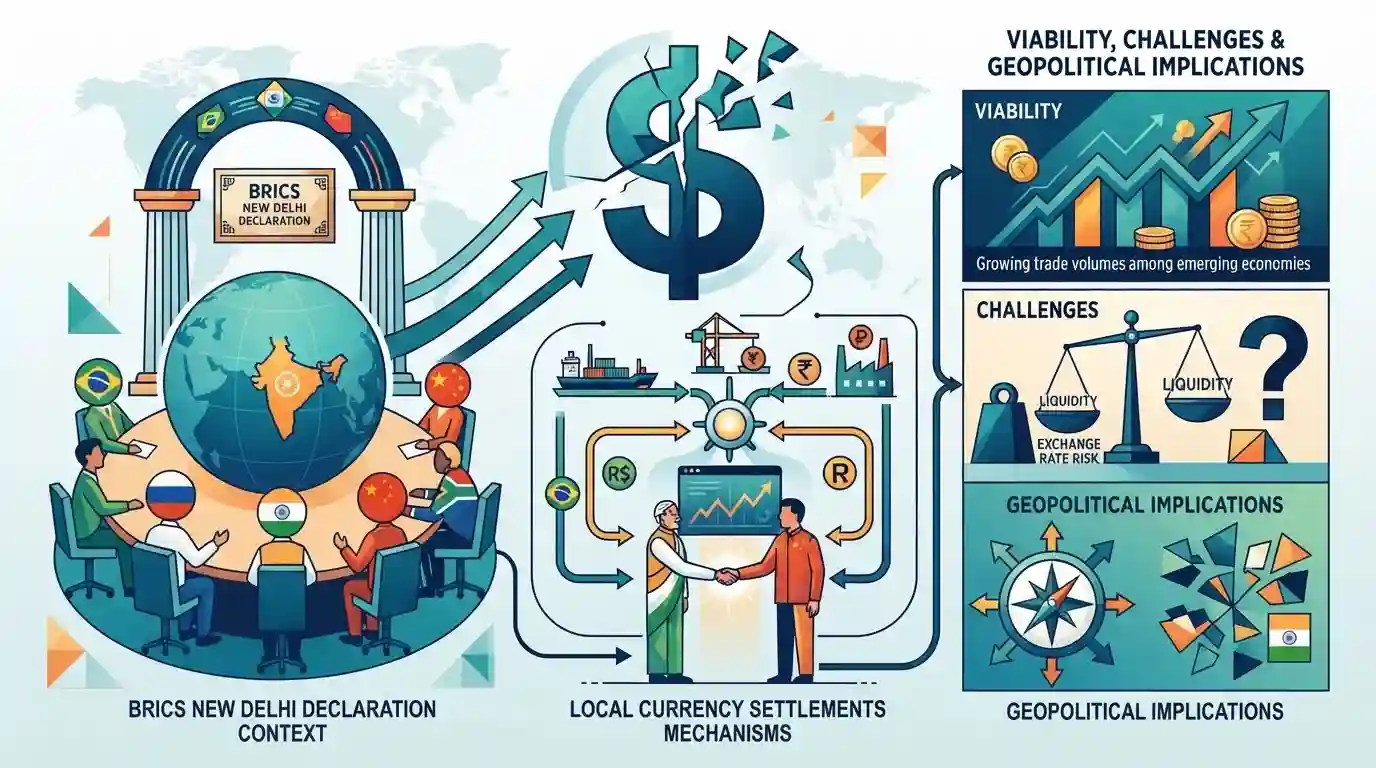
An analysis of the currency conundrum discussed in the context of the BRICS New Delhi Declaration, examining the viability, challenges, and geopolitical implications of local currency settlements and de-dollarization for emerging economies like India.
ముఖ్య అంశాలు
- The BRICS New Delhi Declaration highlights the ongoing debates and complexities surrounding currency choices, specifically de-dollarization and the promotion of local currency settlements in international trade.
- While several BRICS nations push for alternative financial architectures to counter Western economic hegemony and sanctions, achieving a unified currency or moving away entirely from the US dollar poses significant practical economic hurdles.
- India faces a strategic conundrum within BRICS: balancing its interests in multilateral economic diversification with its cautious approach toward initiatives heavily driven or dominated by specific geopolitical agendas (such as rapid de-dollarization).
- The discussion underscores broader systemic challenges in the global financial architecture, including exchange rate volatility, liquidity management, and trust in alternative payment systems.
ముఖ్యమైన పదాలు
BRICS New Delhi Declaration

An international declaration adopted by the BRICS bloc that shifts focus away from a common currency, prioritizing cross-border payment interoperability and local currency settlements instead.
UPSC context
GS Paper II (International Relations - Groupings and Agreements involving India). Tests understanding of shifting geopolitical dynamics and alternative financial architectures.
BRICS
An intergovernmental organization of major emerging economies designed to promote economic cooperation, reform global governance, and advocate for the Global South.
UPSC context
GS Paper II (International Relations - Bilateral, regional and global groupings involving India and affecting India's interests). Tests multilateral diplomacy and strategic autonomy.
ప్రిలిమ్స్ ఉచ్చు
The BRICS New Delhi Declaration mandates the immediate establishment of a unified common BRICS currency to replace the US dollar.
Aspirants often assume BRICS has officially launched or committed to a single common currency (like the Euro), whereas declarations emphasize local currency settlements and resilient national payment systems.
అనుసంధానమైన స్థిర భావనలు
What are the key structural challenges associated with local currency trade settlements in international economics?
- Trade Imbalances: Persistent trade imbalances lead to accumulation of surplus local currency by one partner with limited avenues for deployment.
- Convertibility Limits: Lack of full convertibility and deep capital markets makes non-anchor currencies less attractive for invoicing and global hedging.
- Liquidity Gaps: Absence of deep, liquid domestic bond markets hinders central banks from providing safe assets for foreign reserve holders.
అంతర-అంశ నమూనాలు
De-dollarization vs Rupee Internationalization
De-dollarization debates overlap directly with capital convertibility norms and RBI's rupee internationalization roadmap, testing India's macroeconomic stability frameworks.
Alternative Payment Systems and CBDCs
BRICS alternative payment initiatives connect with CBDC interoperability tests and multilateral clearing unions, bridging international relations and central banking policy.

BRICS de-dollarization + India's strategic balancing act likely to be tested via statement-based Mains/Prelims questions.
అనుసంధాన PYQలు · 2
అనుసంధాన PYQలు · 2
- 2012MainsGS2
Compare the significance of IBSA and BRICS in the context of India's multilateral diplomacy.
- 2025MainsGS3
What are the challenges before the Indian economy when the world is moving away from free trade and multilateralism to protectionism and bilateralism? How can these challenges be met?
