Kashmir security restrictions and West Asia geopolitical spillovers
Source:The Hindu ↗
Why It Matters
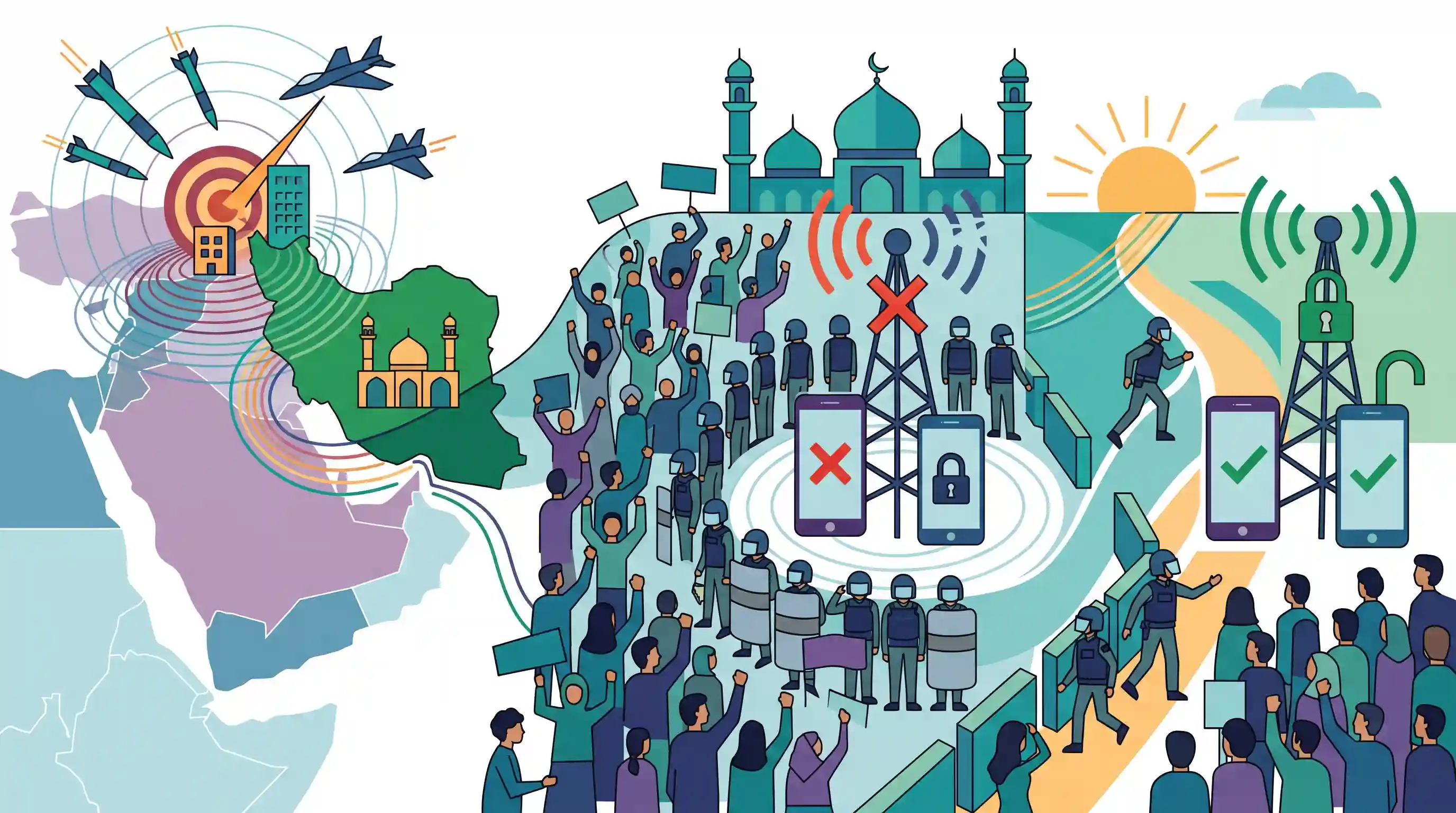
Demonstrates how international geopolitical events (Middle East conflicts) can directly trigger domestic law and order challenges in sensitive regions like Jammu and Kashmir, highlighting the administrative use of communication blockades to maintain public order.
Summary
Authorities have lifted restrictions, including a mobile internet ban, in Jammu and Kashmir after a week of protests sparked by the killing of Iran's Supreme Leader Ayatollah Ali Khamenei in a joint U.S.-Israel strike. With a significant Shia population, Kashmir witnessed massive demonstrations against the assassination, though the situation remained largely peaceful with only minor clashes reported, prompting security forces to prioritize law and order.
Key Points
- Restrictions on movement and a mobile internet ban have been lifted in Jammu and Kashmir, restoring normalcy to the region.
- The curbs were initially imposed to manage large-scale protests triggered by the killing of Iran's Supreme Leader Ayatollah Ali Khamenei in a joint U.S.-Israel strike.
- Kashmir's significant Shia population staged massive demonstrations across the valley, including in Srinagar, Budgam, and Pulwama.
- Security forces, including the CRPF, used minimal force to maintain law and order during minor clashes, though the protests remained largely peaceful.
Important Terms
Central Reserve Police Force (CRPF)

India's largest Central Armed Police Force under the Ministry of Home Affairs. It assists states in maintaining law and order, controlling crowds, and conducting counter-insurgency operations, particularly in Jammu and Kashmir.
UPSC context
GS Paper 3: Internal Security. Tests knowledge of various security forces and their specific mandates in conflict zones.
Internet Shutdown
The intentional disruption of internet services by government authorities to prevent unrest. In India, these are governed by the Telecommunications Act 2023 (formerly the Telegraph Act 1885).
UPSC context
GS Paper 2: Fundamental Rights. Crucial for understanding the balance between national security and the right to freedom of speech.
Ayatollah
A high-ranking religious title for Shia clerics who are experts in Islamic law and jurisprudence. The term translates to "Sign of God" and carries significant spiritual and political authority in Iran.
UPSC context
GS Paper 2: International Relations. Relevant for understanding West Asian geopolitical dynamics and their socio-religious impact on India.
Public Order
A State List subject under the Seventh Schedule referring to the maintenance of peace and community tranquility. Courts distinguish it from "law and order" by its broader impact on society.
UPSC context
GS Paper 2: Governance/Polity. Tests the legal threshold for state-imposed restrictions on constitutional freedoms.
Anuradha Bhasin v. Union of India (2020)
The landmark 2020 Supreme Court judgment ruling that indefinite internet shutdowns are unconstitutional. It mandated that all suspension orders be published, temporary, and subject to the "test of proportionality."
UPSC context
GS Paper 2: Polity. Key case law regarding digital rights, freedom of press, and executive accountability.
Proportionality Test
A judicial principle requiring that government restrictions on fundamental rights must have a legitimate aim, be necessary, and be the least intrusive measure possible to achieve the objective.
UPSC context
GS Paper 2: Judiciary. Essential for evaluating the constitutionality of executive actions like internet bans or preventive detentions.
Shia Islam
One of the two main branches of Islam. In Jammu and Kashmir, the Shia population is a significant minority whose religious and cultural ties to Iran influence local socio-political responses.
UPSC context
GS Paper 1: Indian Society. Important for understanding social demographics and communal dynamics in internal security management.
Internal Security
The maintenance of peace and the rule of law within a nation's borders by addressing domestic threats such as terrorism, insurgency, and civil unrest.
UPSC context
GS Paper 3: Internal Security. A core syllabus topic focusing on challenges to national integrity and the role of security agencies.
Prelims Trap
Internet shutdowns in India are legally executed under Section 144 of the CrPC.
Following the Temporary Suspension of Telecom Services Rules, 2017 (under the Indian Telegraph Act, 1885), Section 144 is no longer the primary legal tool for internet bans.
Static Concepts Connected
How is the right to access the internet constitutionally protected in India?
- Anuradha Bhasin Case (2020): The Supreme Court ruled that internet access is integral to the freedom of speech [19(1)(a)] and freedom of trade [19(1)(g)].
- Reasonable Restrictions: Internet rights are not absolute. They are subject to reasonable restrictions under Articles 19(2) and 19(6), based on sovereignty, security, and public order.
- Proportionality & Duration: Bans cannot be indefinite. Under amended 2017 Telecom Suspension Rules, a single suspension order is capped at 15 days and must pass the proportionality test.
What is the primary mandate of the CRPF in India's internal security?
- Nodal Internal Security Force: It is the lead Central Armed Police Force (CAPF) responsible for assisting States and Union Territories in maintaining public order and managing internal unrest.
- Dual Mandate in J&K: In regions like J&K, it executes a dual role: conducting active counter-insurgency operations alongside local police and managing crowd control during volatile public demonstrations.
Cross-Topic Patterns
West Asia Geopolitics + Domestic Security
External geopolitical shocks, like U.S.-Israel strikes in Iran, trigger localized domestic protests in India, showing how demographic and sectarian affinities blur the line between foreign policy and internal security.
Proportionality Doctrine + Digital Rights
State responses to protests using internet blackouts are increasingly tested against the proportionality doctrine, linking internal security measures directly to constitutional fundamental rights debates.

Expect a 2026 prelims question contrasting the Temporary Suspension of Telecom Rules (Telegraph Act) with Section 144 for internet bans.
Linked PYQs · 3
Linked PYQs · 3
- 2023MainsGS3
Winning of 'Hearts and Minds' in terrorism-affected areas is an essential step in restoring the trust of the population. Discuss the measures adopted by the Government in this respect as part of the conflict resolution in Jammu and Kashmir.
- 2017MainsGS3
Mob violence is emerging as a serious law and order problem in India. By giving suitable examples, analyze the causes and consequences of such violence.
- 2022MainsGS2
How will I2U2 (India, Israel, UAE and USA) grouping transform India's position in global politics?
