Cuba Implements Emergency Measures to Address Severe Energy Crisis
Source:The Hindu ↗
Why It Matters
The article provides a practical case study of how economic sanctions and embargoes by a global superpower (the U.S.) can severely cripple the economy and energy security of a developing nation (Cuba). It is relevant for understanding the geopolitical dynamics of the Americas, the extraterritorial impact of unilateral sanctions, and the broader challenges of energy security in international relations.
Summary
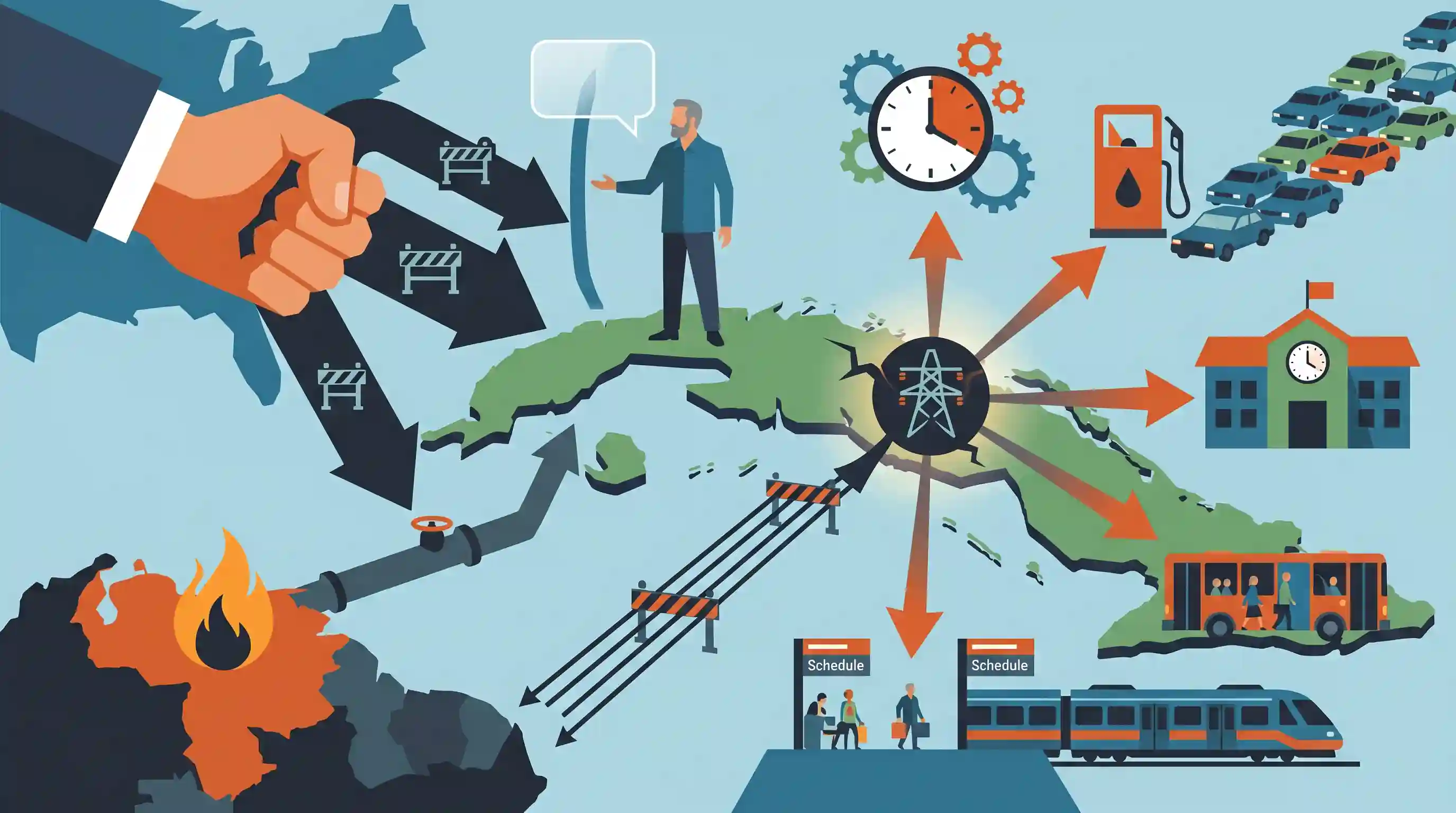
Cuba has introduced urgent emergency measures to combat a debilitating energy crisis. These include moving state-owned companies to a four-day work week, rationing fuel, shortening school hours, and reducing public transit services. The Cuban government blames the crisis largely on the decades-old U.S. economic embargo, which was recently intensified by measures such as cutting off oil deliveries from Venezuela and threatening tariffs against countries supplying oil to Havana. Despite the pressure, Cuban leadership remains open to dialogue with the U.S., provided it is not coerced.
Key Points
- Cuba has implemented emergency measures, including a four-day work week for state-owned companies, to address a severe energy crisis.
- Additional measures involve fuel sale restrictions, shortened school days, and reduced public transportation services.
- The crisis is heavily attributed to the U.S. economic embargo, in place since 1962, and recent intensified actions by the U.S. government.
- The U.S. has cut off oil deliveries from Cuba's key ally, Venezuela, and threatened tariffs on countries like Mexico that sell oil to Havana.
- Cuban President Miguel Diaz-Canel indicated a willingness to engage in talks with the U.S., but rejected doing so under pressure.
Prelims Trap
The United Nations Security Council mandates the ongoing economic embargo against Cuba.
The US embargo is a unilateral policy, not UN-mandated. India consistently votes at the UN General Assembly against these unilateral, extraterritorial blockades.
Static Concepts Connected
How do unilateral extraterritorial sanctions differ from UN-mandated sanctions?
- UN Sanctions: Authorized by the UNSC under Chapter VII of the UN Charter; legally binding on all member states.
- Unilateral Sanctions: Imposed by individual countries (like the US on Cuba) without UN authorization. India historically opposes these.
- Extraterritoriality: Laws like the US Helms-Burton Act that penalize third-party nations or foreign companies for trading with the sanctioned country.
What is the "Resource Curse" in the context of resource-rich nations like Venezuela?
- Definition: A paradox where countries with abundant natural resources experience lower economic growth, less democracy, and worse development outcomes.
- Dutch Disease: Resource exports appreciate the national currency, making other vital sectors (like manufacturing and agriculture) globally uncompetitive.
- Vulnerability: High dependence on a single export makes the national economy highly susceptible to global price shocks and geopolitical disruptions.
Cross-Topic Patterns
Helms-Burton to CAATSA parallels
The U.S. using secondary sanctions (e.g., tariffs on Mexico) mirrors CAATSA’s mechanisms against Russian arms buyers, a persistent concern for India's strategic autonomy and non-alignment.
Single-source energy import vulnerabilities
Cuba’s crisis highlights the peril of relying on a single ally (Venezuela) for energy. This connects directly to India's push for diversified crude imports and expanded Strategic Petroleum Reserves.

Expect a 2026 Prelims statement testing India's official stance on extraterritorial vs. UN-mandated sanctions using CAATSA/Cuba as context.
Linked PYQs · 3
Linked PYQs · 3
- 2024PrelimsGS1
Consider the following statements : Statement-I : Recently, Venezuela has achieved a rapid recovery from its economic crisis and succeeded in preventing its people from fleeing/emigrating to other countries. Statement-II : Venezuela has the world's largest oil reserves. Which one of the following is correct in respect of the above statements?
- 2025MainsGS2
"Energy security constitutes the dominant kingpin of India's foreign policy, and is linked with India's overarching influence in Middle Eastern countries.” How would you integrate energy security with India's foreign policy trajectories in the coming years?
- 2017MainsGS2
The question of India's Energy Security constitutes the most important part of India's economic progress. Analyze India's energy policy cooperation with West Asian countries.
