Museum Study Galleries and Experiential History Education
Source:Indian Express ↗
Why It Matters
Understanding the evolving role of museums from mere repositories of artifacts to active educational spaces is crucial for GS1 topics on safeguarding Indian art heritage. It also aligns with GS2 themes regarding educational reforms and holistic pedagogies (like NEP 2020).
Summary
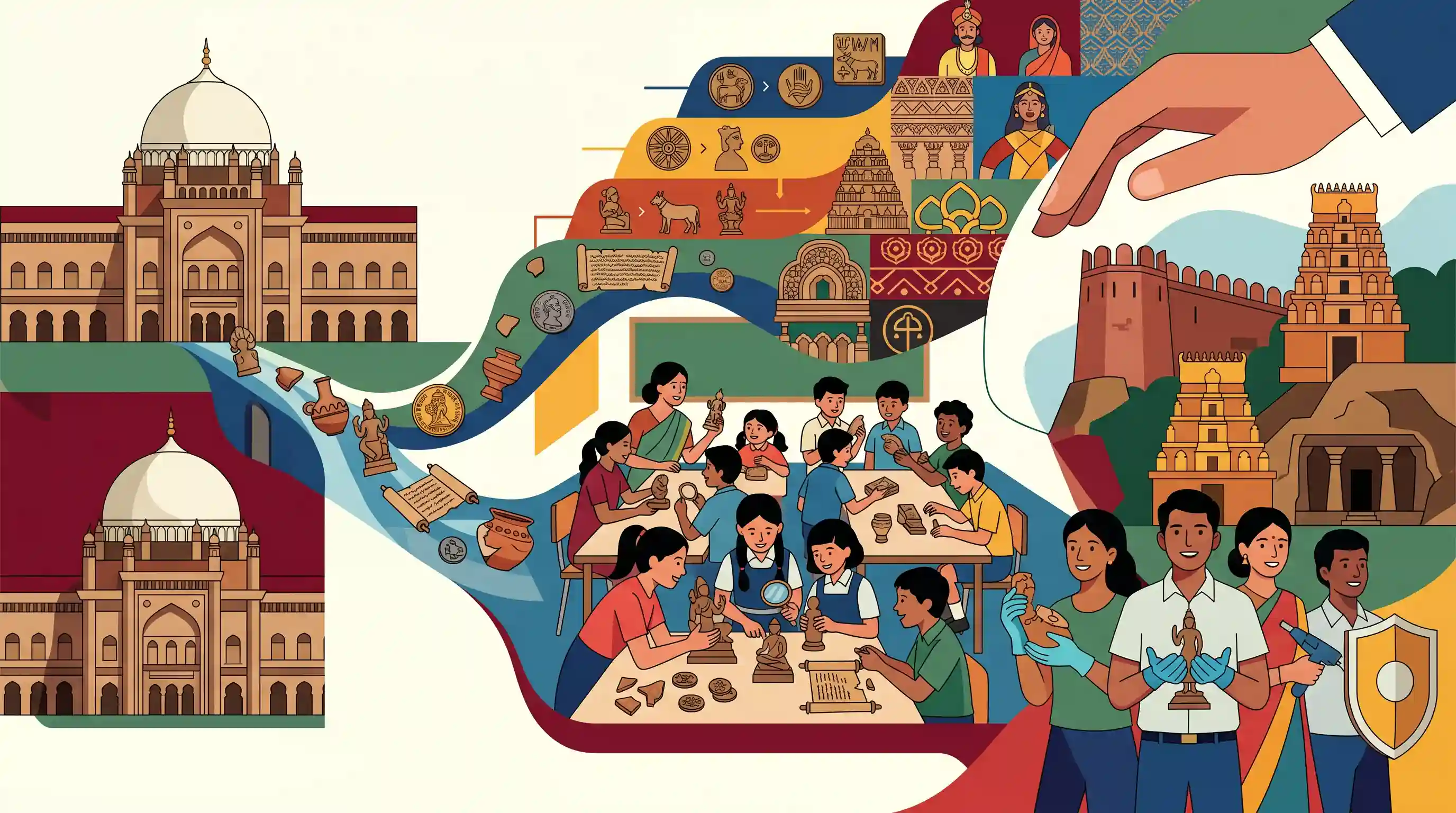
The Chhatrapati Shivaji Maharaj Vastu Sangrahalaya (CSMVS) in Mumbai has launched a dedicated 'study gallery' designed to bring ancient history directly into the classroom. The initiative aims to transform history education by making it more interactive and tangible for students, bridging the gap between museum collections and formal school curricula. By enabling students to engage with artifacts and historical concepts experientially, the project supports modern pedagogical shifts—such as those emphasized in the National Education Policy (NEP) 2020—while fostering a deeper appreciation and commitment to safeguarding India's cultural heritage.
Key Points
- CSMVS in Mumbai has launched a 'study gallery' to integrate ancient history with classroom education.
- The initiative aims to provide students with tangible, experiential learning by connecting them with historical artifacts.
- This approach shifts history education from traditional rote memorization to immersive, interactive pedagogy.
- By bridging museums and schools, the gallery fosters early awareness of heritage conservation among the youth.
Important Terms
National Education Policy (NEP) 2020

India’s first 21st-century education framework replacing the 1986 policy. It introduces a 5+3+3+4 structure, emphasizing holistic, multidisciplinary, and experiential learning to foster critical thinking and 21st-century skills.
UPSC context
GS Paper II: Social Justice (Education). Relevant for questions on pedagogical reforms, human resource development, and educational inclusivity.
Chhatrapati Shivaji Maharaj Vastu Sangrahalaya (CSMVS)
A premier Mumbai museum (est. 1922) housed in a Grade I heritage building. It features 70,000+ artifacts and is part of a UNESCO World Heritage Site ensemble.
UPSC context
GS Paper I: Indian Culture. Important for institutional roles in heritage conservation and Indo-Saracenic architectural history.
Experiential Learning
A pedagogical approach where students learn by doing and reflecting on experiences. NEP 2020 prioritizes this over rote memorization to bridge the gap between theoretical knowledge and practical application.
UPSC context
GS Paper II: Education. Tests understanding of modern teaching methodologies and curriculum revamping under NEP 2020.
Indo-Saracenic Architecture
A revivalist architectural style used by British architects in India, blending Indo-Islamic, Gothic, and Neo-Classical elements. CSMVS is a prominent example of this style.
UPSC context
GS Paper I: Art and Culture. A recurring theme in questions about colonial-era architecture and its synthesis with Indian styles.
Heritage Conservation
The profession and practice of protecting cultural property (artifacts, monuments, traditions) from decay or destruction. Institutions like CSMVS play a vital role in this through restoration and education.
UPSC context
GS Paper I: Indian Culture. Relevant for topics on the preservation of historical monuments and the role of cultural institutions.
UNESCO Asia-Pacific Awards for Cultural Heritage Conservation
A regional recognition program that honors private individuals and organizations for successfully restoring and conserving structures of heritage value. CSMVS received the 'Award of Excellence' in 2022.
UPSC context
GS Paper I: Indian Culture/International Bodies. Tests knowledge of international standards and accolades in heritage management.
Prelims Trap
"Protecting monuments and places of national importance is a Fundamental Duty of every citizen."
Protecting monuments of national importance is a DPSP (Art 49). Valuing and preserving the rich heritage of our composite culture is a Fundamental Duty (Art 51A-f). UPSC frequently swaps these exact phrases.
Static Concepts Connected
What are the key features of Indo-Saracenic architecture?
- Architectural Synthesis: Blends Indian (Hindu, Mughal, Rajput) decorative elements with Western (Gothic, Victorian) architectural forms.
- Traditional Elements: Utilized traditional Indian domes, arches, minarets, and overhanging eaves (chhajjas) to create a distinctly 'native' aesthetic.
- Modern Engineering: Incorporated advanced British structural engineering, utilizing materials like steel, iron, and poured concrete.
- Key Examples: CSMVS (Mumbai), Gateway of India (Mumbai), Victoria Memorial (Kolkata), and Rashtrapati Bhavan.
How does the Indian Constitution mandate heritage conservation?
- DPSP (Article 49): Directs the State to protect every monument, place, or object of artistic or historic interest of national importance.
- Fundamental Duty (Article 51A-f): Makes it a duty of every citizen to value and preserve the rich heritage of our composite culture.
- Seventh Schedule: Places ancient/historical monuments of national importance in the Union List, and others in State/Concurrent Lists.
Cross-Topic Patterns
NEP 2020 + Art-integrated education
Connecting museum artifacts to classroom learning implements NEP 2020's mandate for experiential, art-integrated education, bridging static culture with active pedagogical tools.
Mumbai's UNESCO Architectural Ensembles
CSMVS is part of the Victorian Gothic and Art Deco Ensembles of Mumbai, reflecting the 19th-20th century urban modernization and architectural evolution of India's commercial capital.

Expect a Prelims question confusing Art 49 (DPSP) and Art 51A(f) (FD) on heritage, or a match-the-following on museum architecture.
Linked PYQs · 3
Linked PYQs · 3
- 2018MainsGS1
Safeguarding the Indian art heritage is the need of the moment. Discuss.
- 2020MainsGS1
The rock-cut architecture represents one of the most important sources of our knowledge of early Indian art and history. Discuss.
- 2020MainsGS2
National Education Policy 2020 is in conformity with the Sustainable Development Goal-4 (2030). It intends to restructure and reorient education system in India. Critically examine the statement.
