CSIR NGRI study projects severe climate shifts for Telangana
Source:The Hindu ↗
Why It Matters
This localized study provides excellent, concrete case-study material for GS3 Mains answers on the impacts of climate change on agriculture and water resources, the necessity of crop diversification (especially millets), and changing river basin hydrology in India.
Summary
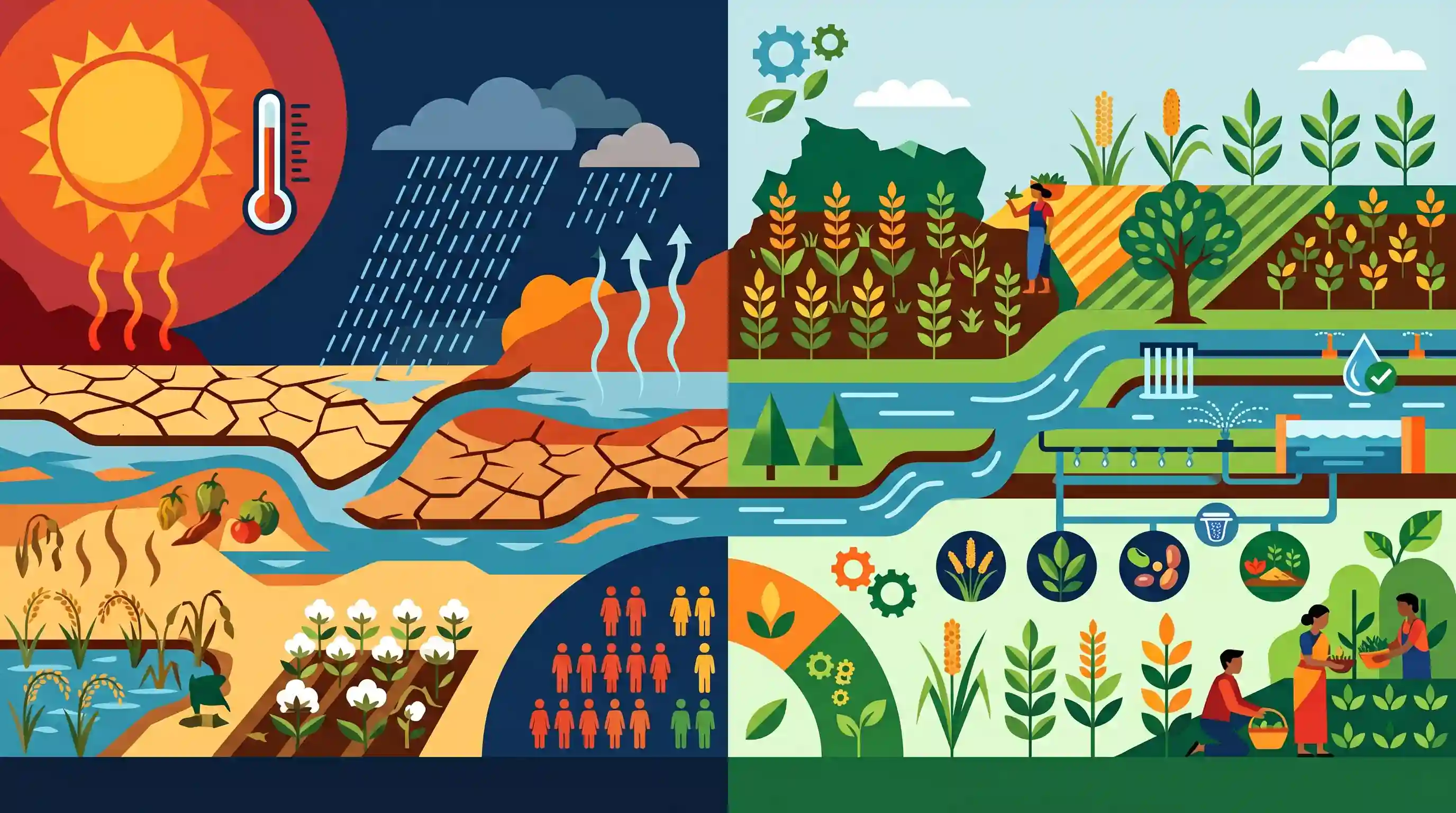
A study by the CSIR-National Geophysical Research Institute (NGRI) projects severe climate change impacts for Telangana by 2050, including a 2.94°C temperature spike and up to a 50% increase in rainfall under a high-emission scenario. This will exacerbate evapotranspiration, deplete freshwater availability, and disrupt the hydrological cycles of the Godavari and Krishna river basins. Consequently, the state's vulnerable population is expected to surge to 59%. The study warns that cultivating water-intensive crops like rice and cotton may become unsustainable, necessitating an urgent shift toward climate-resilient agriculture, including millets, crop diversification, and efficient water management techniques.
Key Points
- A CSIR-NGRI study using the high-emission SSP5-8.5 scenario projects a 2.94°C temperature rise and a 15% to 50% increase in precipitation for Telangana by the mid-21st century.
- The state's climate-vulnerable population is expected to grow from 43% to 59%, primarily threatening agricultural communities.
- Peak water flow in the Godavari and Krishna river basins is predicted to extend from September into November, increasing the risk of late-season floods.
- Elevated temperatures will intensify evapotranspiration, leading to the rapid depletion of surface freshwater and an increased water demand for agriculture.
- The findings cast doubt on the sustainability of water-intensive crops like rice and cotton, emphasizing an urgent transition toward millets, crop diversification, micro-irrigation, and water recycling.
Important Terms
CSIR-National Geophysical Research Institute (NGRI)

A constituent laboratory of CSIR (est. 1961, Hyderabad) focused on geodynamics, natural resource management, and geological hazard preparedness.
UPSC context
GS Paper III (Science & Tech); tests knowledge of key Indian R&D institutions and their role in disaster/resource management.
Evapotranspiration
The sum of water lost to the atmosphere through evaporation from the soil/surfaces and transpiration from plant tissues.
UPSC context
GS Paper I/III (Geography/Agriculture); crucial for understanding water cycle changes and irrigation requirements under global warming.
Hydrological Cycle
The natural cycle of water evaporation, condensation, and precipitation; climate change alters its intensity, affecting river flow and groundwater.
UPSC context
GS Paper I (Physical Geography); fundamental for questions on water resource management and river basin dynamics (e.g., Godavari, Krishna).
Climate-Resilient Agriculture (CRA)
Farming practices (e.g., heat-tolerant seeds, micro-irrigation) designed to sustain productivity and food security amid climate-induced stresses like droughts or floods.
UPSC context
GS Paper III (Agriculture); essential for topics on sustainable farming, food security, and adaptation strategies (e.g., NICRA).
Crop Diversification
Adding new crops or cropping systems to a farm to mitigate risks, enhance soil fertility, and reduce dependence on water-intensive staples.
UPSC context
GS Paper III (Agriculture/Economy); a recurring theme in agricultural reforms to double farmers' income and conserve water resources.
Millets
Nutrient-rich, water-efficient, and drought-resistant 'nutri-cereals' (e.g., Ragi, Jowar) suited for rainfed areas and climate-resilient farming.
UPSC context
GS Paper III (Agriculture/Food Security); high priority due to India's leadership in the International Year of Millets.
Prelims Trap
A projected 50% increase in rainfall under climate models will proportionally increase surface freshwater availability in peninsular river basins.
Increased rainfall is offset by a massive spike in evapotranspiration due to rising temperatures, which rapidly depletes surface water and soil moisture, paradoxically worsening water scarcity.
Static Concepts Connected
How do the Godavari and Krishna river basins differ from Himalayan rivers?
- Flow Regime: They are primarily rain-fed and seasonal, heavily dependent on the South-West Monsoon, lacking any perennial snowmelt contribution.
- Catchment Profile: They flow through mature, graded, shallow valleys on the Deccan plateau, making them less prone to meandering but highly susceptible to seasonal flow variations.
- Delta Agriculture: Both rivers form extensive, fertile deltas on the East Coast, which historically encouraged the cultivation of water-intensive crops like paddy.
What role does Evapotranspiration play in agricultural drought?
- Definition: It is the combined process of water evaporation from the soil surface and transpiration from plant leaves.
- Temperature Link: Higher global temperatures increase atmospheric evaporative demand, aggressively drying out soil and depleting surface water even if absolute rainfall increases.
- Mitigation Strategy: Mitigation requires shifting to crops with lower water footprints (millets, sorghum) and utilizing micro-irrigation to minimize surface evaporation losses.
Cross-Topic Patterns
SSP scenarios and IPCC framework
UPSC has shifted towards testing specific climate terminology. The SSP5-8.5 high-emission pathway mentioned here aligns with recent Mains questions on IPCC Assessment Reports and global climate modeling.
Crop Diversification for Water Security
The forced shift from rice/cotton to millets connects directly to the International Year of Millets legacy and MSP policy debates concerning water-stressed regions like the Deccan Plateau.

Expect a multi-statement question linking high-emission SSP models to evapotranspiration paradoxes and delayed peninsular river flooding.
Linked PYQs · 5
Linked PYQs · 5
- 2017MainsGS3
What are the major reasons for declining rice and wheat yield in the cropping system? How crop diversification is helpful to stabilise the yield of the crops in the system?
- 2021MainsGS3
What are the present challenges before crop diversification? How do emerging technologies provide an opportunity for crop diversification?
- 2024MainsGS3
Explain the role of millets for ensuring health and nutritional security in India.
- 2020MainsGS3
Suggest measures to improve water storage and irrigation system to make its judicious use under depleting scenario.
- 2025MainsGS3
Examine the factors responsible for depleting groundwater in India. What are the steps taken by the government to mitigate such depletion of groundwater?
