CSIR CCMB Open Day Highlights Careers in Scientific Research
Source:The Hindu ↗
Why It Matters
Understanding the role of premier Indian research institutes like CSIR-CCMB is crucial for UPSC aspirants, as questions frequently cover India's R&D ecosystem, the application of biotechnology in agriculture and medicine, and institutional efforts to address scientific and societal challenges.
Summary
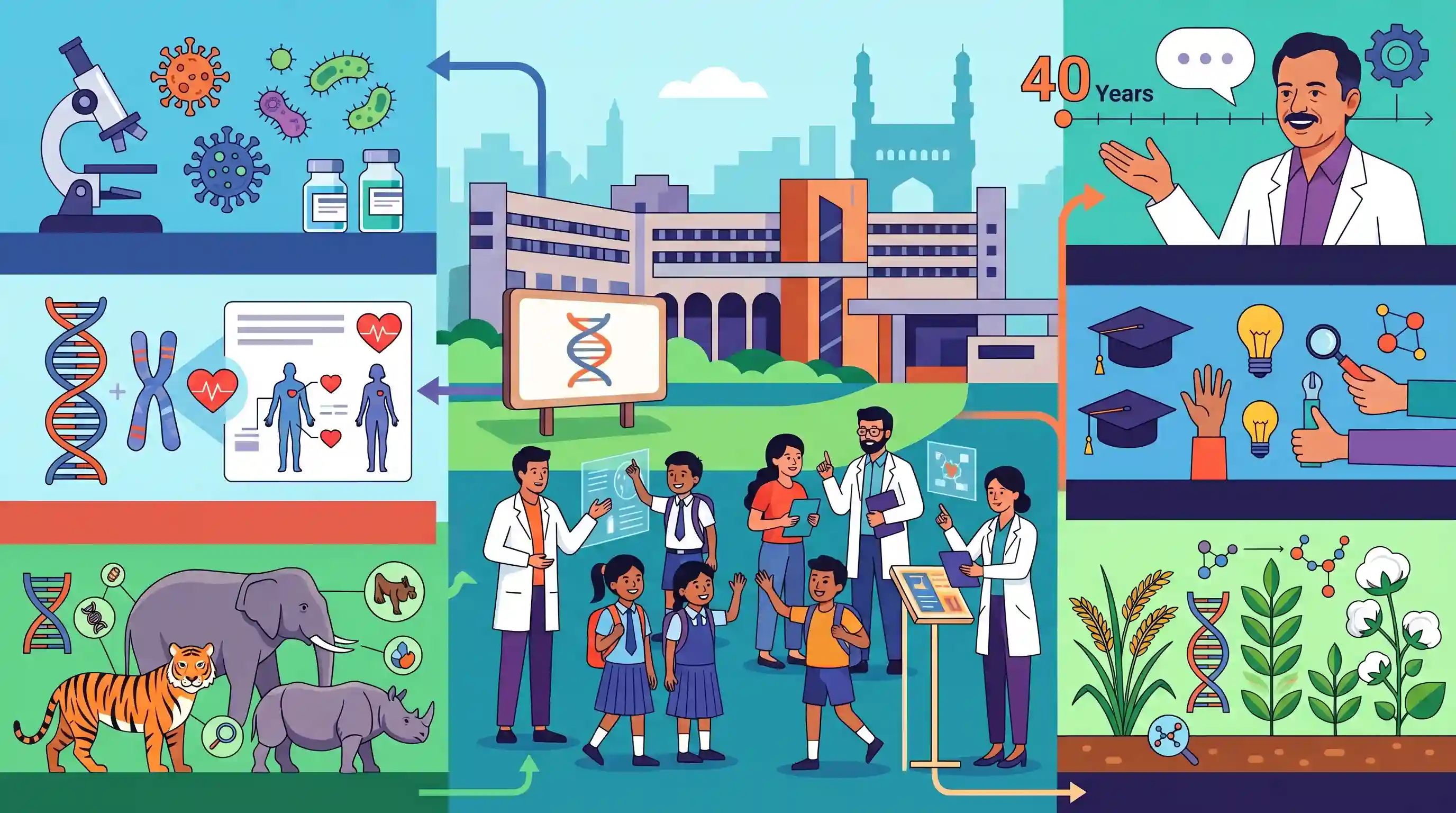
CSIR-Centre for Cellular and Molecular Biology (CCMB) hosted an Open Day in Hyderabad, celebrating 40 years at its Habsiguda campus. The event provided a platform for schoolchildren and college students to engage with scientists and explore research on infectious, genetic, and lifestyle diseases. Highlighting the institute's contributions to wildlife conservation and agricultural biotechnology, CCMB Director Vinay K. Nandicoori spoke on the scientific and societal impact of their research over the decades, encouraging youth to consider careers in basic and applied sciences.
Key Points
- CSIR-CCMB organized an Open Day in Hyderabad to commemorate its 40th anniversary at the Habsiguda campus, inviting students to interact with scientists.
- Exhibits and talks focused on the fundamental cellular and molecular mechanisms underlying infectious, genetic, and lifestyle diseases.
- The institute highlighted its broad scope of scientific research, which includes wildlife conservation and agricultural biotechnology.
- CCMB Director Vinay K. Nandicoori emphasized the societal impact of CCMB's applied and basic science contributions since 1987, aiming to inspire young minds to pursue scientific careers.
Important Terms
CSIR (Council of Scientific and Industrial Research)

India's largest public-funded R&D organization, established in 1942, comprising 37 national laboratories. It operates under the Ministry of Science and Technology.
UPSC context
GS-III (S&T Institutions). Tests knowledge of India's scientific infrastructure and its role in indigenous innovation and Atmanirbhar Bharat.
CCMB (Centre for Cellular and Molecular Biology)
A premier research organization in Hyderabad specializing in modern biology, genomics, and biotechnology. It is a constituent laboratory of CSIR.
UPSC context
GS-III (S&T). Relevant for advancements in healthcare (DNA fingerprinting), agriculture, and molecular biology.
LaCONES (Laboratory for the Conservation of Endangered Species)
A dedicated CCMB facility in Hyderabad that uses modern biotechnologies for the conservation and preservation of endangered wildlife species.
UPSC context
GS-III (Environment/S&T). Focuses on ex-situ conservation, genetic resource banking, and using DNA markers for wildlife tracking.
Agricultural Biotechnology
Scientific techniques, including genetic engineering and molecular markers, used to improve crop yield, pest resistance, and climate resilience in agriculture.
UPSC context
GS-III (Agriculture/S&T). Tests understanding of the "Gene Revolution" and biotechnology's impact on food security.
Genetic Resource Bank
A facility for cryopreserving living cell lines, gametes, and embryos of endangered species to support artificial reproduction and biodiversity protection.
UPSC context
GS-III (Environment). Essential for ex-situ biodiversity conservation; India's first was established at LaCONES, Hyderabad.
Translational Research
Research focused on turning basic scientific discoveries into practical applications, such as new medical diagnostics or commercial industrial products.
UPSC context
GS-III (S&T). Crucial for evaluating the socio-economic impact of R&D and bridging the gap between laboratories and industry.
Prelims Trap
"The Centre for Cellular and Molecular Biology focuses exclusively on researching human genetic and lifestyle diseases."
Aspirants often assume CCMB is strictly a human-medical lab, completely missing its pioneering role in wildlife conservation (LaCONES) and agricultural biotechnology (disease-resistant rice).
Static Concepts Connected
What is Environmental DNA (eDNA) and how is it utilized in conservation?
- Non-invasive tracking: Analyzes trace genetic material (like shed skin cells, feces, or mucus) released by organisms into environmental samples like water, soil, or air.
- Biodiversity monitoring: Enables researchers to detect specific endangered or invasive species in an ecosystem without requiring physical capture or visual confirmation.
What is DNA Barcoding and what are its main applications?
- Species identification: Matches a short, standardized DNA sequence from an organism against a known reference database to accurately identify its species.
- Authentication & Anti-trafficking: Helps detect mislabeled processed products (like herbal medicines or seafood) and identifies protected species or contraband in the illegal wildlife trade.
Cross-Topic Patterns
Biotech applications in wildlife conservation
CCMB's LaCONES links biotechnology to biodiversity by managing the National Wildlife Genetic Resource Bank, preserving gametes of endangered species, and utilizing eDNA for ecological monitoring.
Marker-assisted selection vs GM crops
CCMB’s development of 'Improved Samba Mahsuri' rice showcases how DNA markers can accelerate conventional breeding for disease resistance, avoiding the regulatory hurdles of genetically modified (GM) crops.

Expect 2026 questions to fuse environment and biotech, testing CCMB's eDNA tools and cryopreservation methods for wildlife conservation.
Linked PYQs · 3
Linked PYQs · 3
- 2021MainsGS3
What are the research and developmental achievements in applied biotechnology? How will these achievements help to uplift the poorer sections of the society?
- 2017PrelimsGS1
With reference to agriculture in India, how can the technique of 'genome sequencing', often seen in the news, be used in the immediate future? 1. Genome sequencing can be used to identify genetic markers for disease resistance and drought tolerance in various crop plants. 2. This technique helps in reducing the time required to develop new varieties of crop plants. 3. It can be used to decipher the host-pathogen relationships in crops. Select the correct answer using the code given below:
- 2022PrelimsGS1
DNA Barcoding can be a tool to: 1. assess the age of a plant or animal. 2. distinguish among species that look alike. 3. identify undesirable animal or plant materials in processed foods. Which of the statements given above is/are correct?
