CSIR CCMB Develops Indigenous Tool for Sickle Cell Prediction
Source:The Hindu ↗
Why It Matters
This development marks a significant step toward precision medicine tailored to India's distinct genetic landscape, aiding government initiatives to eradicate sickle cell anaemia among vulnerable tribal populations.
Summary
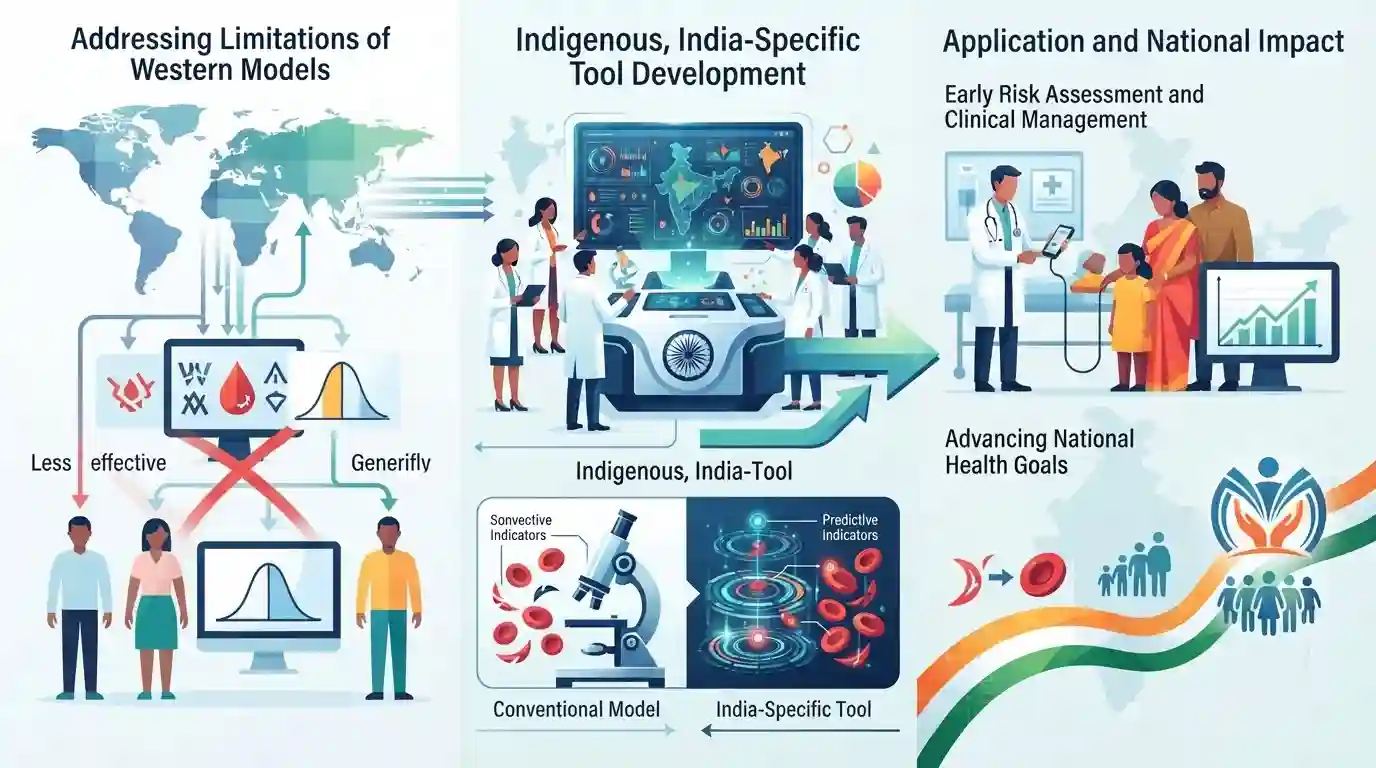
CSIR-CCMB has developed an indigenous, India-specific tool to predict the severity of sickle cell disease, addressing the limitations of Western diagnostic models. This tool is vital for early risk assessment, personalized clinical management, and advancing India's public health goals under the National Sickle Cell Anaemia Elimination Mission.
Key Points
- Researchers at the CSIR-Centre for Cellular and Molecular Biology (CCMB) have developed a novel, India-specific prognostic tool to predict the severity of sickle cell disease (SCD).
- Sickle cell anaemia disproportionately affects tribal and marginalized populations in India, which accounts for a massive share of the global disease burden.
- Traditional Western prognostic models often fail to accurately capture clinical outcomes in Indian patient cohorts due to unique genetic modifiers and phenotypic variations.
- The newly developed indigenous tool enables early risk stratification, allowing clinicians to tailor personalized treatments and interventions, thereby supporting the objectives of the National Sickle Cell Anaemia Elimination Mission.
Important Terms
National Sickle Cell Anaemia Elimination Mission

A flagship national health initiative launched by the Government of India to eliminate sickle cell disease as a public health problem by 2047, focusing extensively on tribal populations.
UPSC context
UPSC GS Paper 2 (Health & Vulnerable Sections): Tests knowledge of government welfare schemes targeting tribal health and disease elimination.
CSIR-CCMB
A premier research organization under the Council of Scientific and Industrial Research specializing in modern biology and advanced cellular research in India.
UPSC context
UPSC GS Paper 3 (Science & Technology): Evaluates indigenous scientific developments, biotechnology applications, and public health innovations.
Prelims Trap
The National Sickle Cell Anaemia Elimination Mission aims to eliminate the disease by 2047.
Aspirants may confuse the 2047 elimination target year with India's broader 2070 net-zero goal or other health mission timelines.
Static Concepts Connected
What are the key objectives and implementation strategy of the National Sickle Cell Anaemia Elimination Mission?
- Target Year: Target Year aims to eliminate sickle cell disease as a public health problem in India by 2047.
- Focus Population: Focus Population prioritizes 17 high-burden states with large tribal populations, ensuring universal screening and counselling.
- Implementation Approach: Implementation uses a lifecycle approach integrating grassroots screening via Ayushman Bharat and National Health Mission channels.
Cross-Topic Patterns
Tribal Health Missions and Genetic Screening Portals
The Sickle Cell Mission intersects with vulnerable tribal health interventions, requiring coordinated tracking across tribal welfare grants and national health vertical allocations.
Atmanirbhar Bharat in Healthcare and Indigenous Diagnostics
Indigenous biotech innovations by CSIR labs highlight India's push for Atmanirbhar Bharat in diagnostics, reducing import dependence for clinical testing tools.

Sickle Cell Mission targets (2047 goal, tribal focus) combined with indigenous CCMB diagnostic tools will feature in Prelims/Mains.
Linked PYQs · 3
Linked PYQs · 3
- 2026PrelimsGS1
Which of the following statements with regard to genetic medicine is/are correct ? 1. Genetic medicines correct/compensate for the faulty genes responsible for disease. 2. Engineered viruses and lipid nanoparticles are used as carriers of the genetic medicine. 3. Genetic medicines alter the entire DNA sequence. Select the answer using the code given below :
- 2023PrelimsGS1
Consider the following statements in the context of interventions being undertaken under Anaemia Mukt Bharat Strategy: 1. It provides prophylactic calcium supplementation for pre-school children, adolescents and pregnant women. 2. It runs a campaign for delayed cord clamping at the time of child-birth. 3. It provides for periodic deworming to children and adolescents. 4. It addresses non-nutritional causes of anaemia in endemic pockets with special focus on malaria, hemoglobinopathies and fluorosis. How many of the statements given above are correct?
- 2017MainsGS3
Stem cell therapy is gaining popularity in India to treat a wide variety of medical conditions including Leukaemia, Thalassemia, damaged cornea and severe burns. Describe briefly what stem cell therapy is and what advantages it has over other treatments?
