Digital Health Cards and State Employee Welfare Initiatives
Source:The Hindu ↗
Why It Matters
Provides a practical case study of a state government implementing e-governance tools (digital health cards) and managing public personnel administration through institutional grievance redressal platforms like the Joint Staff Council. Useful for answers on e-governance and civil service reforms.
Summary
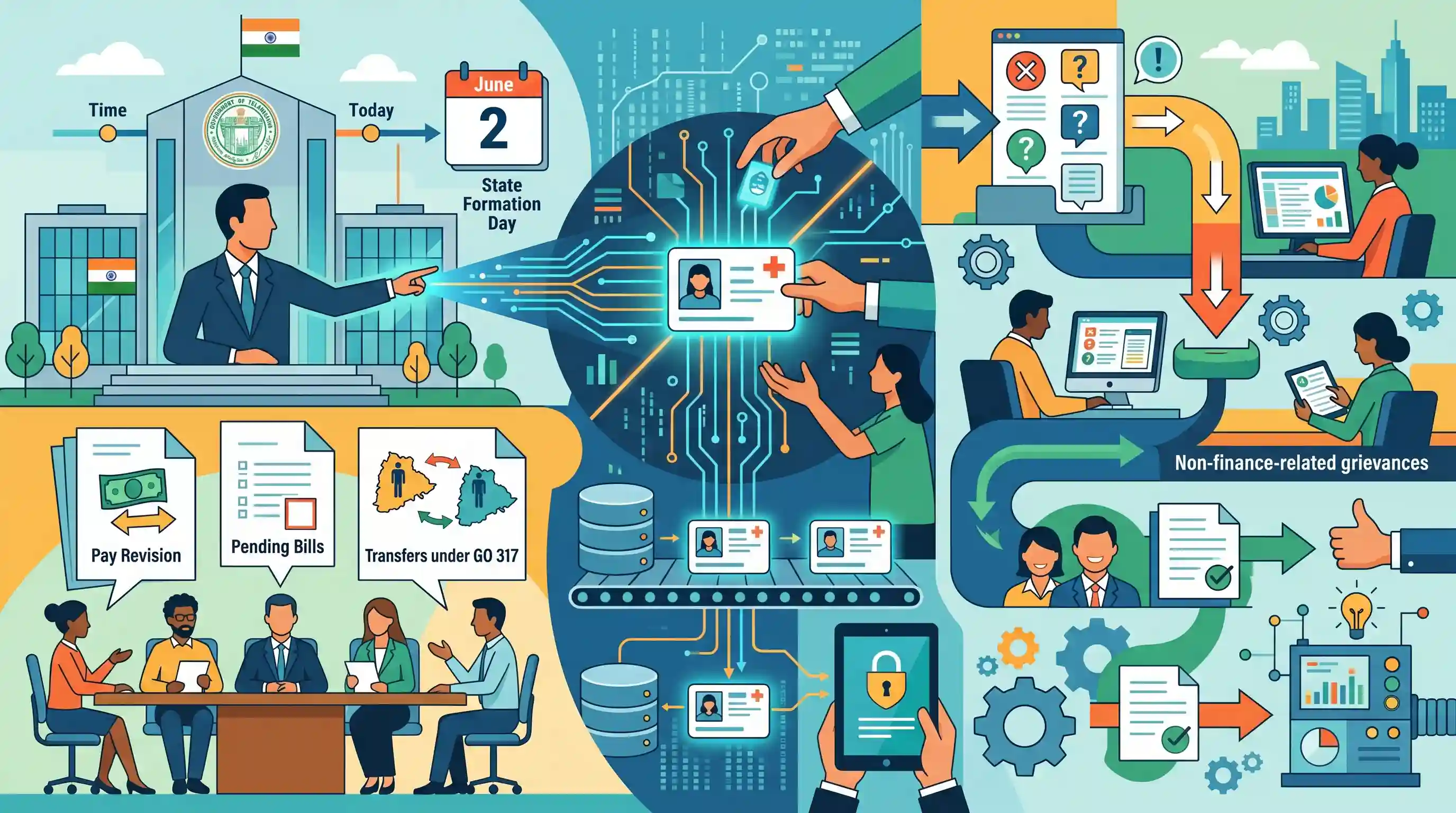
Telangana's Chief Secretary K. Ramakrishna Rao has directed officials to expedite the groundwork for launching digital health cards for government employees on June 2, coinciding with State Formation Day. During a Joint Staff Council meeting with employee unions, discussions focused on resolving various personnel issues, including the Pay Revision Commission (PRC) recommendations, pending bills, and transfer grievances under GO 317. The government underscored the importance of swiftly resolving non-finance-related employee grievances and urged the bureaucracy to leverage technology for efficient public problem-solving.
Key Points
- The Telangana government is preparing to launch digital health cards for state employees and pensioners on June 2, the State Formation Day.
- A Joint Staff Council meeting was held to address employee grievances, including pending bills, transfer issues under GO 317, and the upcoming Pay Revision Commission (PRC) report.
- The Chief Secretary directed officials to ensure speedy redressal of non-finance-related employee grievances.
- Government employees were urged to increasingly leverage technology to resolve public problems and improve service delivery.
Important Terms
Chief Secretary

The highest-ranking civil servant in a state, serving as the administrative head of the state government, principal advisor to the Chief Minister, and head of all state civil services.
UPSC context
GS II (Governance): Essential for understanding state executive machinery, the role of bureaucracy, and center-state administrative relations.
Digital Health Cards
A secure digital identity providing a unified view of an individual's medical history, facilitating cashless treatment and seamless data sharing across the healthcare ecosystem under e-governance initiatives.
UPSC context
GS II (Social Justice/Health): Tests knowledge of digital infrastructure in healthcare and the implementation of the Ayushman Bharat Digital Mission.
GO 317
A Telangana government order for allocating local cadres and transfers following district reorganization, intended to implement a new zonal system for public employment and recruitment.
UPSC context
GS II (Governance): Significant for understanding administrative reorganization, local status rules (Art. 371-D), and public service delivery challenges.
Pay Revision Commission (PRC)
An institutional body constituted to review and recommend changes to the salary, pensions, and benefits of government employees based on inflation, economic conditions, and fiscal capacity.
UPSC context
GS III (Economy): Relevant for fiscal management, budgetary impact of employee remuneration, and public sector administrative reforms.
Joint Staff Council
A formal platform for structured dialogue between the government and recognized service associations to resolve personnel grievances, welfare issues, and service conditions through collaborative problem-solving.
UPSC context
GS II (Governance): Evaluates institutional mechanisms for grievance redressal and employer-employee relations within state administration.
Prelims Trap
"The Ayushman Bharat Health Account (ABHA) is a mandatory requirement for availing benefits under state and central health schemes."
ABHA creation is strictly voluntary. UPSC often falsely frames digital health IDs as mandatory for accessing state or central government welfare schemes.
Static Concepts Connected
What are the primary roles and features of a State Chief Secretary?
- Appointment: Chosen by the Chief Minister from senior IAS officers, though not strictly bound by seniority.
- Key Roles: Acts as the principal advisor to the CM, secretary to the State Cabinet, and the head of the state civil services apparatus.
- Tenure: Unlike the Cabinet Secretary at the Centre, there is generally no fixed tenure for a Chief Secretary, though the Supreme Court has recommended minimum tenures.
How does Article 3 govern the creation of new states (e.g., Telangana)?
- Parliamentary Power: Parliament can form new states or alter boundaries via an ordinary bill requiring only a simple majority.
- Presidential Recommendation: The bill requires prior recommendation of the President before being introduced in Parliament.
- State Views: The President must refer the bill to the concerned state legislature for its views within a specified period, though these views are not binding on Parliament.
Cross-Topic Patterns
State Health Cards + ABDM Integration
State-specific digital health schemes for employees and citizens are increasingly integrating with the Ayushman Bharat Digital Mission (ABDM) to ensure nationwide, cross-platform interoperability of health records.
Grievance Redressal + JCM Mechanism
State Joint Staff Councils mirror the Union government's Joint Consultative Machinery (JCM), a non-statutory forum introduced in 1966 for structured consultation and civil service dispute resolution.

Expect a Prelims question testing the voluntary nature of ABHA under the Ayushman Bharat Digital Mission and its interoperability features.
Linked PYQs · 3
Linked PYQs · 3
- 2024MainsGS2
e-governance is not just about the routine application of digital technology in service delivery process. It is as much about multifarious interactions for ensuring transparency and accountability. In this context evaluate the role of the 'Interactive Service Model' of e-governance.
- 2025MainsGS2
e-governance projects have a built-in bias towards technology and back-end integration than user-centric designs. Examine.
- 2023MainsGS2
e-governance, as a critical tool of governance, has ushered in effectiveness, transparency and accountability in governments. What inadequacies hamper the enhancement of these features ?
