Political debate over cloud seeding intervention for Delhi pollution
Source:The Hindu ↗
Why It Matters
Highlights the debate over technological interventions (like cloud seeding) versus expert scientific consensus in addressing complex environmental issues like Delhi's winter smog. Relevant for evaluating pollution mitigation strategies in GS3.
Summary
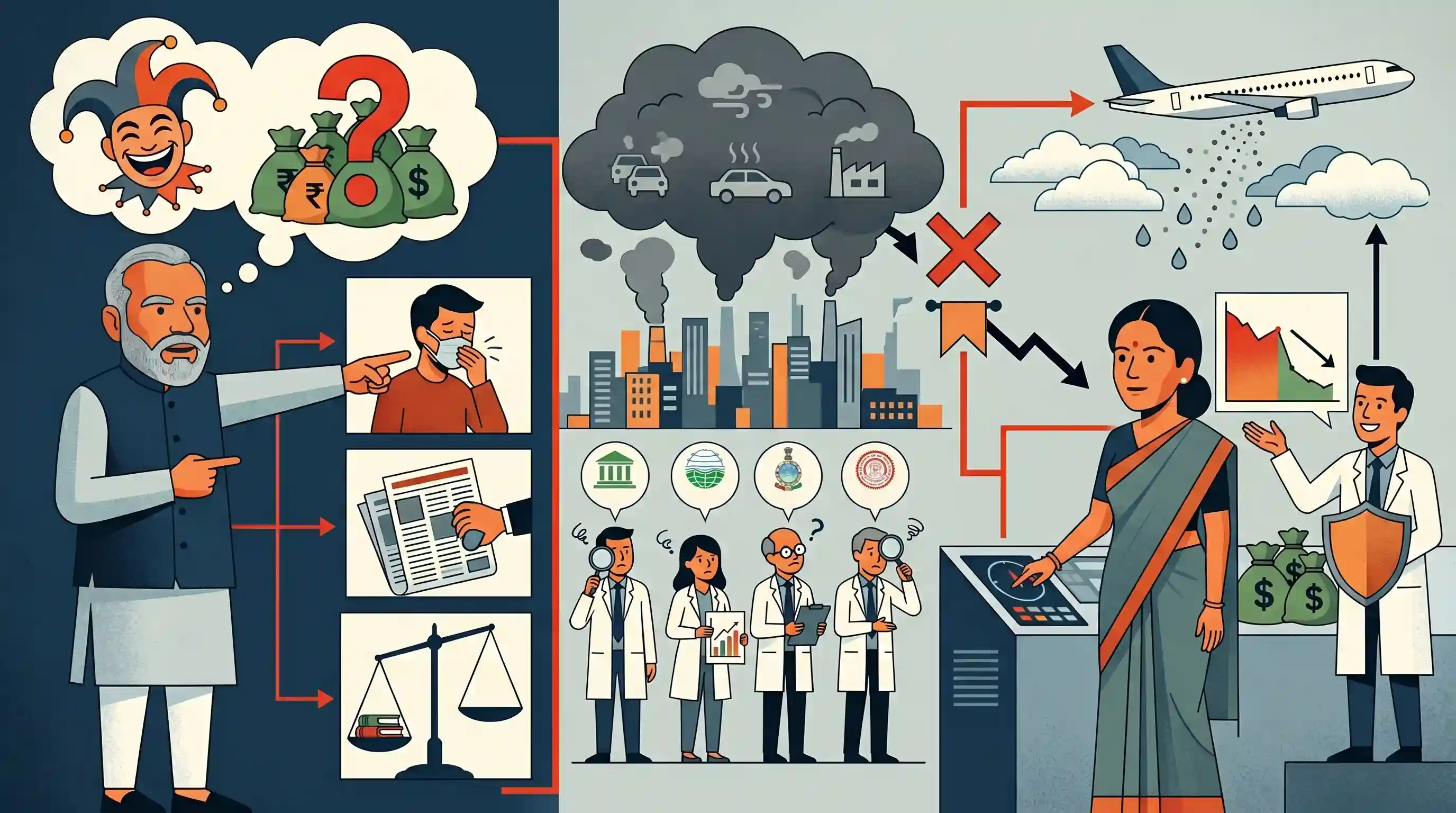
Congress leader Jairam Ramesh sharply criticized the BJP-led Delhi government for spending ₹34 crore on winter cloud seeding to mitigate air pollution, labeling the effort a "cruel joke." He highlighted that expert bodies like CAQM, CPCB, IMD, and IIT Delhi advised against the experiment, concluding it would not yield significant long-term improvements in winter air quality. While the Delhi government, led by CM Rekha Gupta, defended its actions as science-driven and denied allegations of tampering with Air Quality Index (AQI) data, the Opposition dismissed the cloud seeding project as a superficial "headline-grabbing measure."
Key Points
- Congress leader Jairam Ramesh criticized the Delhi government for spending ₹34 crore on winter cloud seeding to combat air pollution.
- Specialized agencies like CAQM, CPCB, and IMD, alongside a report from IIT Delhi, advised against winter cloud seeding, noting it wouldn't significantly improve air quality.
- The Opposition accused the BJP-led Delhi government of using the experiment as a headline-grabbing measure and manipulating AQI data.
- Delhi Chief Minister Rekha Gupta and Environment Minister Manjinder Singh Sirsa defended the strategy, citing science-driven action and denying data tampering.
Important Terms
Commission for Air Quality Management (CAQM)

A statutory body established in 2021 to coordinate, research, and resolve air quality issues across the National Capital Region (NCR) and adjoining states like Punjab and Haryana.
UPSC context
GS Paper-3 (Environment/Pollution); tests knowledge of institutional frameworks for regional environmental governance.
Central Pollution Control Board (CPCB)
India's apex statutory organization under the Ministry of Environment, established in 1974 to monitor and set standards for air and water pollution control.
UPSC context
GS Paper-2 (Governance) and GS Paper-3 (Environment); core body for environmental regulations and standard-setting.
Indian Meteorological Department (IMD)
The principal government agency under the Ministry of Earth Sciences responsible for meteorological observations, weather forecasting, and disaster warnings for phenomena like cyclones.
UPSC context
GS Paper-1 (Geography) and GS Paper-3 (Disaster Management); critical for understanding weather patterns and emergency preparedness.
Cloud Seeding
A weather modification technique that involves dispersing substances like silver iodide or dry ice into clouds to induce precipitation by acting as condensation nuclei.
UPSC context
GS Paper-3 (Science & Tech/Environment); tests knowledge of scientific interventions for environmental mitigation and their limitations.
IIT-Kanpur
The primary technical institution leading research and pilot trials for winter cloud seeding in Delhi to wash away atmospheric pollutants.
UPSC context
GS Paper-3 (Science & Tech); highlights the collaboration between premier academic institutions and government for public policy solutions.
Air Quality Index (AQI)
A standardized numerical scale used by the government to communicate the daily air quality status and its associated health risks to the public.
UPSC context
GS Paper-3 (Environment); fundamental metric for monitoring urban pollution levels and assessing environmental health.
Prelims Trap
Cloud seeding technology can independently induce artificial rain in Delhi during peak winter even under clear, dry sky conditions.
Cloud seeding only accelerates precipitation from pre-existing moisture-bearing clouds. It cannot artificially generate clouds or rain out of a completely dry winter atmosphere.
Static Concepts Connected
What is the mechanism of Cloud Seeding and what agents are used?
- Mechanism: Involves dispersing substances into the air that serve as cloud condensation or ice nuclei, altering cloud microphysical processes to stimulate precipitation.
- Chemical Agents: Silver Iodide (AgI), Potassium Iodide (KI), and Dry Ice (solid carbon dioxide) are the most widely used seeding agents.
- Meteorological Prerequisite: It strictly requires the presence of pre-existing moisture-bearing clouds (like those brought by Western Disturbances) to function.
What is the mandate and jurisdiction of the Commission for Air Quality Management (CAQM)?
- Statutory Origin: Established under the CAQM Act, 2021, replacing the Supreme Court-mandated Environment Pollution (Prevention and Control) Authority (EPCA).
- Airshed Jurisdiction: Holds exclusive jurisdiction over the National Capital Region (NCR) and adjoining areas in Punjab, Haryana, UP, and Rajasthan for airshed management.
- Overriding Powers: Its directives supersede those of the CPCB and respective State Pollution Control Boards in matters specifically concerning NCR air quality.
Cross-Topic Patterns
Geo-engineering limits in local climates
UPSC often contrasts high-tech interventions like smog towers or cloud seeding with structural geographic realities, such as winter temperature inversion and the land-locked nature of the NCR.
Airshed governance: CAQM vs CPCB overlap
The creation of CAQM reflects a shift from general pollution boards (CPCB) to specific 'airshed management' authorities. This structural evolution is a high-yield theme for GS-2 and GS-3 governance.

Expect a Prelims 2026 statement-based question linking cloud seeding chemicals (AgI) with winter temperature inversion dynamics in Delhi.
Linked PYQs · 3
Linked PYQs · 3
- 2025PrelimsGS1
Artificial way of causing rainfall to reduce air pollution makes use of
- 2022MainsGS3
Discuss in detail the photochemical smog emphasizing its formation, effects and mitigation. Explain the 1999 Gothenburg Protocol.
- 2022PrelimsGS1
In the context of WHO Air Quality Guidelines, consider the following statements: 1. The 24-hour mean of PM2.5 should not exceed 15 µg/m³ and annual mean of PM2.5 should not exceed 5 µg/m³. 2. In a year, the highest levels of ozone pollution occur during the periods of inclement weather. 3. PM10 can penetrate the lung barrier and enter the bloodstream. 4. Excessive ozone in the air can trigger asthma. Which of the statements given above are correct?
