West Asia Crisis Spikes Global Crude Tanker Freight Rates
Source:Indian Express ↗
Why It Matters
The article is highly relevant for UPSC aspirants as it bridges International Relations (West Asia conflict) with Economy (inflation, import bill) and Energy Security. It illustrates how regional instability directly impacts global supply chains, maritime chokepoints, and India's economic resilience, directly linking to Mains GS2 (IR) and GS3 (Economy/Infrastructure) themes.
Summary
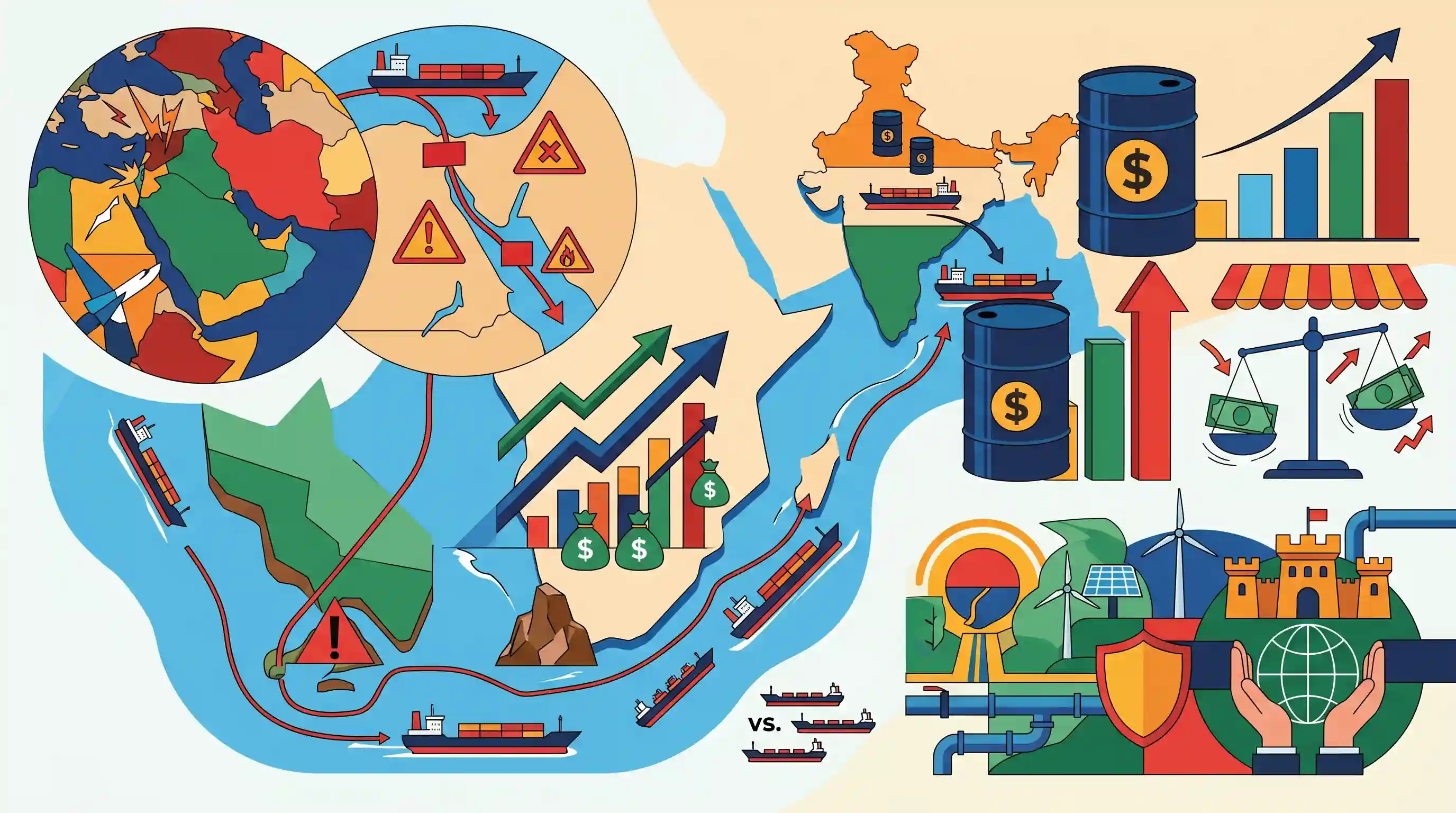
Geopolitical escalations in West Asia have triggered severe disruptions in global maritime trade, notably driving crude tanker freight rates through the roof. As vessels avoid conflict hotspots like the Red Sea, they are forced into longer detours around the Cape of Good Hope, drastically reducing available shipping capacity and spiking transportation costs. For India, which relies heavily on imported crude oil, these soaring freight rates threaten to inflate the import bill, posing risks to domestic inflation and macroeconomic stability. The crisis highlights the profound intersection of regional geopolitics, global supply chains, and India's critical need for resilient energy security strategies.
Key Points
- Escalating conflicts in West Asia have disrupted critical maritime trade routes, particularly around the Red Sea and Gulf of Aden.
- The need to avoid high-risk zones has forced crude oil tankers to take much longer alternative routes, such as navigating around the Cape of Good Hope.
- This detour has stretched global shipping capacity, leading to a dramatic surge in crude tanker freight rates.
- For an import-dependent nation like India, rising freight costs threaten to inflate the crude oil import bill, exacerbating inflationary pressures and posing macroeconomic challenges.
- The situation underscores the vulnerability of global energy supply chains to geopolitical shocks, highlighting the need for strategic petroleum reserves and diversified energy sourcing.
Prelims Trap
India stores its Strategic Petroleum Reserves (SPRs) exclusively in underground salt caverns.
India’s currently operational Phase-I SPRs are unlined underground rock caverns, not salt caverns. Salt caverns (like in the US) are only planned for Phase-II in Rajasthan.
Static Concepts Connected
What are the key maritime chokepoints around the Arabian Peninsula?
- Bab el-Mandeb: Connects the Red Sea to the Gulf of Aden and the Arabian Sea, acting as the critical gateway for Suez Canal traffic.
- Strait of Hormuz: Connects the Persian Gulf to the Gulf of Oman, serving as the world's most important oil transit chokepoint.
- Suez Canal: An artificial sea-level waterway connecting the Mediterranean Sea to the Red Sea, separating Africa from Asia.
How do maritime supply shocks impact India's macroeconomic indicators?
- Widening CAD: Inflated freight and crude costs increase the trade deficit, directly widening the Current Account Deficit (CAD).
- Imported Inflation: Higher domestic fuel and transport costs cascade into the broader economy, driving up both WPI and CPI.
- Currency Depreciation: A higher import bill increases the demand for US Dollars, putting downward pressure on the Indian Rupee.
Cross-Topic Patterns
Red Sea crisis & IMEC viability
The Red Sea disruption underscores the strategic urgency of the India-Middle East-Europe Economic Corridor (IMEC) to bypass volatile maritime chokepoints like Bab el-Mandeb and the Suez Canal.
Energy imports & Rupee settlement
Surging dollar-denominated import bills due to freight shocks strengthen the RBI's structural push for cross-border energy trade settlements in Indian Rupees via Special Rupee Vostro Accounts.

Map questions linking Red Sea/Gulf of Aden chokepoints with trade disruption impacts (like CAD and inflation) are highly likely in 2026.
Linked PYQs · 3
Linked PYQs · 3
- 2025MainsGS2
"Energy security constitutes the dominant kingpin of India's foreign policy, and is linked with India's overarching influence in Middle Eastern countries.” How would you integrate energy security with India's foreign policy trajectories in the coming years?
- 2017MainsGS2
The question of India's Energy Security constitutes the most important part of India's economic progress. Analyze India's energy policy cooperation with West Asian countries.
- 2024PrelimsGS1
Consider the following statements : Statement-I : Sumed pipeline is a strategic route for Persian Gulf oil and natural gas shipments to Europe. Statement-II : Sumed pipeline connects the Red Sea with the Mediterranean Sea. Which one of the following is correct in respect of the above statements?
