Crude Oil Price Shocks and Macroeconomic Stability
Source:Indian Express ↗
Why It Matters
The macroeconomic transmission mechanism of global crude oil shocks is a foundational concept for UPSC aspirants. It elegantly connects external geopolitical events (West Asia crises) with domestic economic challenges (inflation, fiscal deficit, forex management, and economic growth), which frequently feature in GS3 and Prelims.
Summary
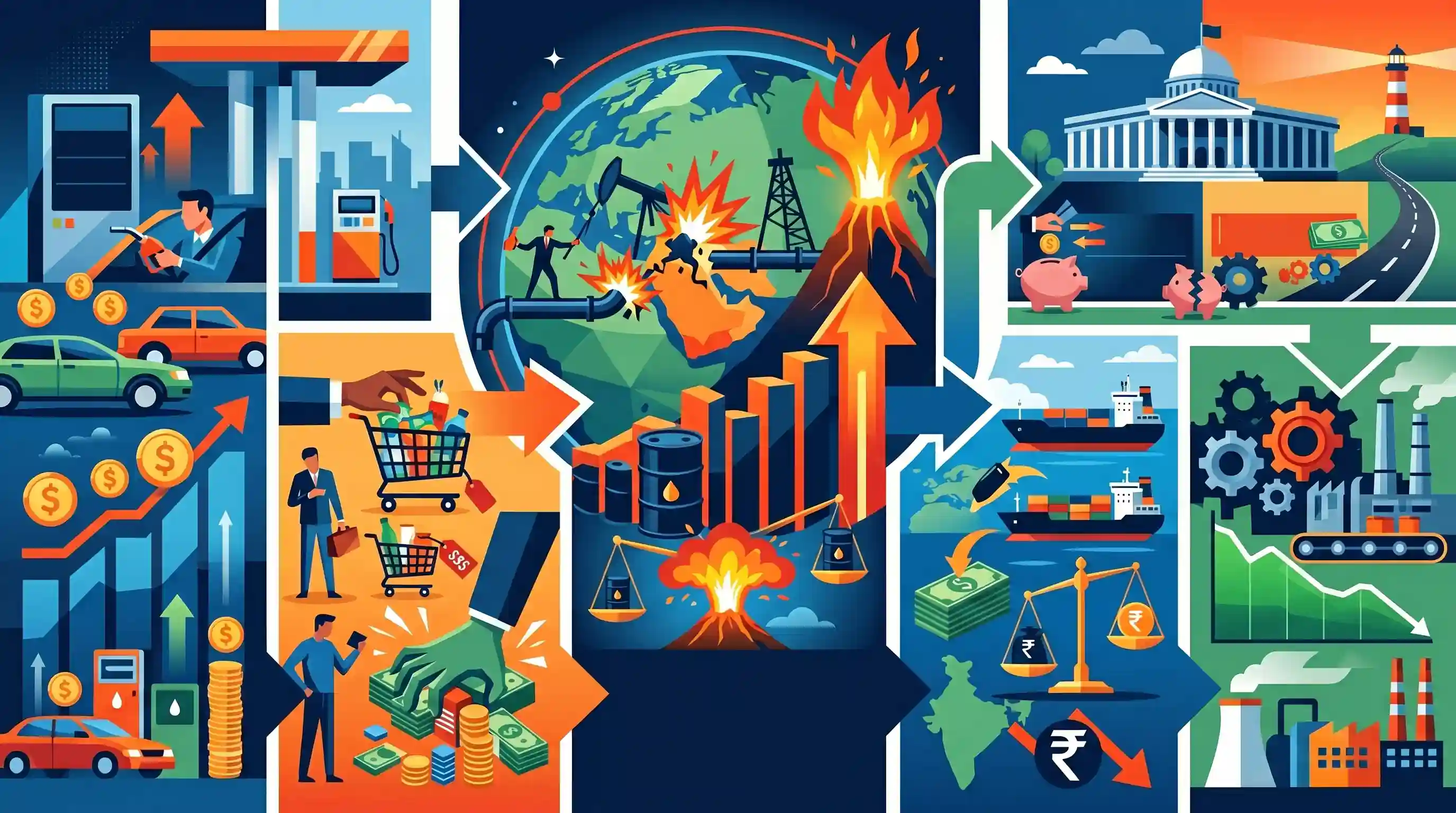
The article analyzes the profound macroeconomic implications of a potential crude oil price spike driven by escalating geopolitical crises in West Asia. High international crude prices threaten to disrupt the Indian economy across five critical dimensions: increasing retail fuel prices, stoking both wholesale and retail inflation, dampening real GDP growth, worsening the trade deficit and weakening the rupee, and straining government finances. As India imports the vast majority of its crude oil, price shocks force the government into difficult trade-offs between sacrificing tax revenues to shield consumers and allowing inflation to erode purchasing power, thereby jeopardizing long-term fiscal consolidation goals like those set under the FRBM Act.
Key Points
- Escalating geopolitical tensions in West Asia (like a US-Iran conflict) threaten to spike crude oil prices back to the $100-$115 per barrel levels seen during 2011-2014.
- As India imports over 80% of its crude oil, international price shocks transmit directly to the domestic economy via five main macroeconomic channels: retail fuel prices, inflation, GDP growth, external balance, and fiscal deficit.
- A soaring import bill widens India's trade deficit and current account deficit (CAD), placing depreciative pressure on the Rupee and depleting foreign exchange reserves as the RBI intervenes.
- Elevated crude prices fuel broad-based inflation (both WPI and CPI) by increasing transportation and production costs across the economy.
- Economic growth suffers because high fuel costs erode household disposable incomes and squeeze corporate profit margins.
- The government faces a fiscal dilemma: absorb the price shock by cutting excise duties and increasing subsidies (which widens the fiscal deficit) or pass it onto consumers (which hurts growth and stokes inflation). This vulnerability challenges the fiscal consolidation targets mandated under the FRBM Act.
Important Terms
Fiscal Responsibility and Budget Management (FRBM) Act

A legislative framework enacted in 2003 to ensure fiscal discipline by setting targets for reducing fiscal deficits, revenue deficits, and public debt to sustainable levels.
UPSC context
GS Paper 3: Fiscal Policy. Tests understanding of fiscal discipline, deficit targets (3% GDP), and the 'escape clause' during crises.
Fiscal Consolidation
The process of reducing government deficits and debt accumulation through enhanced revenue generation (taxes) and rationalized expenditure to achieve long-term macroeconomic stability.
UPSC context
GS Paper 3: Indian Economy. Key for questions on budgetary reforms and the government's fiscal glide path toward a 4.5% deficit by 2025-26.
Current Account Deficit (CAD)
A broad measure of a country's international transactions, representing the difference between total receipts and payments for goods, services, income, and transfers.
UPSC context
GS Paper 3: External Sector. Tests knowledge of the Balance of Payments (BoP) and how oil imports impact currency stability.
Cost-Push Inflation
Inflation triggered by a substantial increase in the cost of important goods or services where no suitable alternative is available, such as rising crude oil prices.
UPSC context
GS Paper 3: Inflation Dynamics. Crucial for analyzing supply-side shocks and their cascading effect on the Wholesale (WPI) and Consumer (CPI) indices.
Reserve Bank of India (RBI)
India's central bank responsible for monetary policy, managing inflation via the repo rate, and intervening in forex markets to stabilize the rupee during external shocks.
UPSC context
GS Paper 3: Monetary Policy. Tests the bank's mandate to balance price stability with growth and manage foreign exchange reserves.
Trade Deficit
The gap between the value of a country's merchandise imports and its exports. India typically runs a deficit due to heavy reliance on imported crude oil.
UPSC context
GS Paper 3: Indian Economy. Relevant for discussing trade policy and the structural vulnerability of the Indian economy to global energy prices.
Prelims Trap
"Global crude oil price spikes impact CPI more heavily and immediately than WPI."
Crude oil directly impacts WPI faster due to the 13.15% weightage of 'Fuel & Power'. CPI is heavily weighted toward food, experiencing oil shocks mostly via secondary transport costs.
Static Concepts Connected
How do global crude oil price shocks impact India's Balance of Payments?
- Widening Trade Deficit: Highly inelastic demand for crude oil means price spikes immediately inflate the import bill, drastically widening the merchandise trade deficit.
- Current Account Deficit: The expanded merchandise trade deficit directly cascades into a higher Current Account Deficit (CAD), threatening broader external sector stability.
- Rupee Depreciation: Increased demand for US dollars to settle massive oil import bills exerts severe downward pressure on the Indian Rupee.
What is the FRBM Act's mechanism for managing sudden macroeconomic shocks?
- Escape Clause: Allows the Centre to breach the fiscal deficit target by up to 0.5% of GDP during national security events, structural reforms, or unforeseen economic shocks.
- Revenue Forgone: Governments often cut fuel excise duties during oil spikes to control inflation. This sacrifices tax revenue, necessitating adjustments under the FRBM glide path.
Cross-Topic Patterns
Oil shocks vs FRBM consolidation targets
Price spikes force the state to cut fuel taxes to shield consumers. This sacrifices revenue, directly complicating the fiscal deficit consolidation paths mandated by the FRBM Act.
Strategic Petroleum Reserves & IEA Norms
High import dependency accelerates India's push to meet the International Energy Agency's (IEA) 90-day stockpile norm through the expansion of its Strategic Petroleum Reserves (SPRs) in Padur and Chandikhol.

A combined prelims question testing WPI/CPI weightages of fuel alongside the 'escape clause' of the FRBM Act is highly likely for 2026.
Linked PYQs · 5
Linked PYQs · 5
- 2022PrelimsGS1
With reference to the Indian economy, consider the following statements: 1. An increase in Nominal Effective Exchange Rate (NEER) indicates the appreciation of rupee. 2. An increase in the Real Effective Exchange Rate (REER) indicates an improvement in trade competitiveness. 3. An increasing trend in domestic inflation relative to inflation in other countries is likely to cause an increasing divergence between NEER and REER. Which of the above statements are correct?
- 2022PrelimsGS1
With reference to the Indian economy, consider the following statements: 1. If the inflation is too high, Reserve Bank of India (RBI) is likely to buy government securities. 2. If the rupee is rapidly depreciating, RBI is likely to sell dollars in the market. 3. If interest rates in the USA or European Union were to fall, that is likely to induce RBI to buy dollars. Which of the statements given above are correct?
- 2025PrelimsGS1
A country's fiscal deficit stands at ₹50,000 crores. It is receiving ₹10,000 crores through non-debt creating capital receipts. The country's interest liabilities are ₹1,500 crores. What is the gross primary deficit?
- 2013MainsGS3
What were the reasons for the introduction of Fiscal Responsibility and Budget Management (FRBM) Act, 2003 ? Discuss critically its salient features and their effectiveness.
- 2018MainsGS3
How would the recent phenomena of protectionism and currency manipulations in world trade affect macroeconomic stability of India?
