Vedanta Pipeline Crude Oil Leak Contaminates Barmer Farmland
Source:the-times-of-india ↗
Why It Matters
Rajasthan's Barmer-Sanchore Basin is the second-largest producer of crude oil in India. Well pads like Bhagyam, Mangala, and Aishwarya are frequently asked in the Geography and Economy sections of the RPSC RAS Prelims. Tracking infrastructure issues and locations (like Bothiya and Kavas in Barmer) is essential for mapping-based and resource-based questions.
Summary
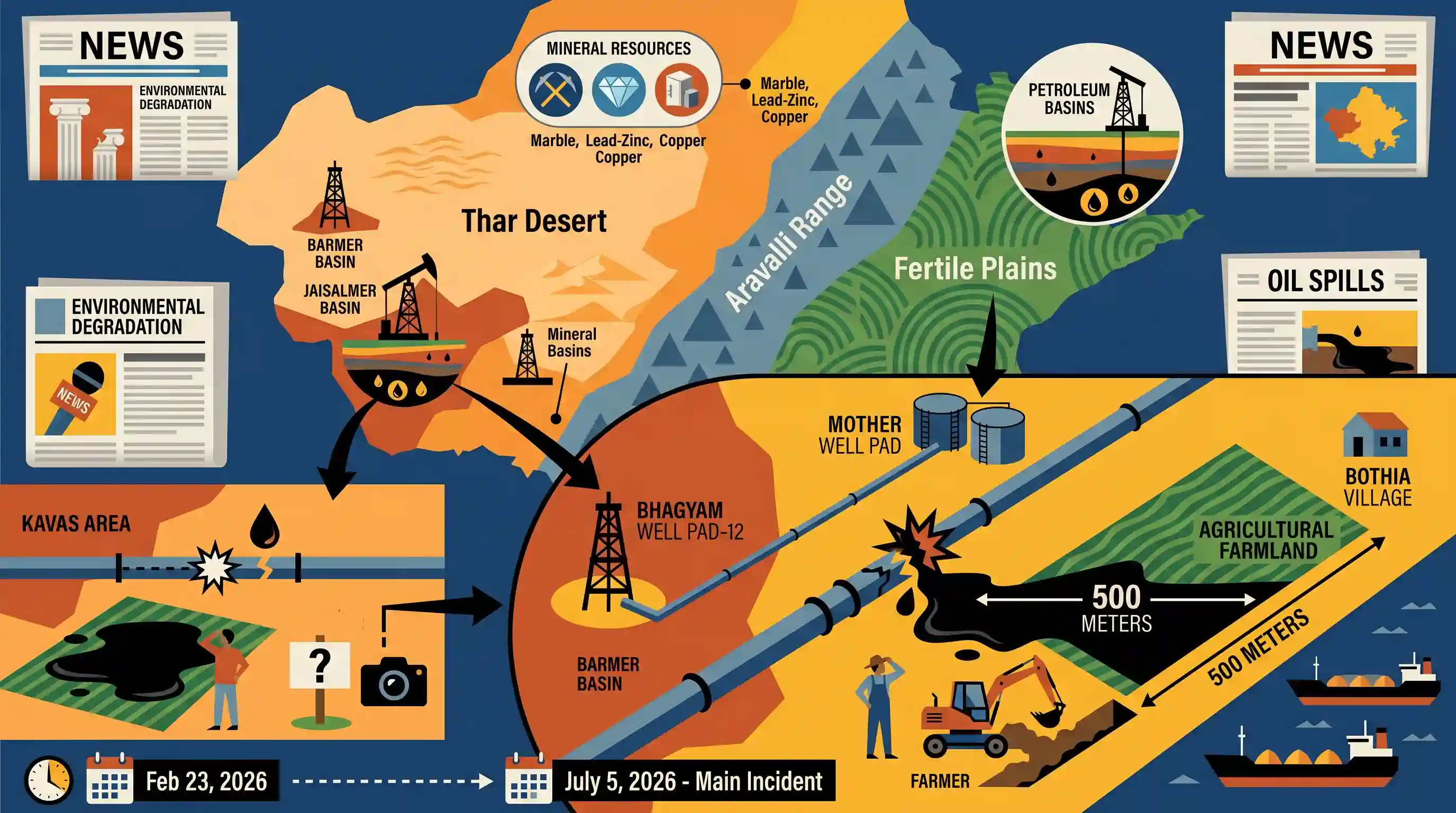
On July 5, 2026, a major crude oil leak from a Vedanta Cairn pipeline running from Bhagyam Well Pad-12 to the Mother Well Pad contaminated farmland near Bothiya village in Rajasthan's Barmer district. The spill covered approximately 500 meters of agricultural fields. This was the second pipeline leakage in Barmer in 2026, following an earlier incident on February 23 near Aishwarya Well Pad-08 in the Kavas area.
Key Points
- A major crude oil leak occurred from an onshore pipeline operated by Vedanta Cairn Oil & Gas near Bothiya village in the Barmer district of Rajasthan on July 5, 2026.
- The leak occurred on a pipeline running from Bhagyam Well Pad-12 to the Mother Well Pad, spreading crude oil across nearly 500 meters of agricultural farmland.
- This represents the second major pipeline leak in the region in 2026, following a similar leak on February 23, 2026, near Aishwarya Well Pad-08 in the Kavas area of Barmer.
- Cairn Vedanta suspended pipeline supply and excavated containment pits to prevent further spreading while tankers were deployed to transport the spilled crude oil for safe disposal.
Important Terms
Cairn Oil & Gas

India's largest private upstream oil and gas exploration and production company, a division of Vedanta Limited, responsible for producing approximately 25 percent of India's domestic crude oil.
UPSC context
GS Paper 3: Energy Security and Infrastructure; tests domestic oil production and private sector contributions.
Barmer-Sanchore Basin
A prolific Tertiary-age rift basin in western Rajasthan that contains extensive onshore hydrocarbon reserves, hosting major oil fields like Mangala, Bhagyam, and Aishwariya.
UPSC context
GS Paper 1: Geography of India; tests knowledge of key mineral/energy distribution and major petroleum basins.
Mangala, Bhagyam, and Aishwariya (MBA) Fields
A major cluster of three prolific onshore oil fields in Rajasthan's Barmer Basin, discovered by Cairn, representing a significant portion of India's domestic petroleum resources.
UPSC context
GS Paper 1: Mineral Resources; tests knowledge of significant domestic oil and gas production hubs.
Enhanced Oil Recovery (EOR)
Advanced industrial techniques (including chemical, gas, or thermal injection) used to recover additional crude oil from mature or declining reservoirs where standard extraction methods have become uneconomical.
UPSC context
GS Paper 3: Science and Technology; tests understanding of technological advancements to prolong the life of oilfields.
Oil Spill
The accidental release of liquid petroleum hydrocarbons into the environment, causing severe soil contamination, agricultural damage, and ecological degradation in terrestrial or marine ecosystems.
UPSC context
GS Paper 3: Environment & Disaster Management; tests awareness of environmental pollution, its mitigation, and hazards.
Prelims Trap
Oilzapper is a chemical surfactant spray used to dissolve onshore oil spills by breaking them down into micro-droplets.
Oilzapper is a biological consortium of five natural bacteria that digest crude oil hydrocarbons, not a chemical solvent or synthetic dispersant.
Static Concepts Connected
What is India's petroleum basin categorization and Rajasthan's domestic contribution?
- Basin taxonomy: India has 26 sedimentary basins categorized into three tiers based on commercial production maturity, with Barmer being Category-I.
- Rajasthan's share: Rajasthan is India’s second-largest crude producer (~20-25% of domestic output), trailing only the offshore Mumbai High fields.
- Mangala pipeline: Uses Skin Effect Heat Tracing (SEHT) to transport Barmer's highly viscous, waxy crude over 700 km to Gujarat.
How does 'Oilzapper' bioremediation technology treat terrestrial oil spills?
- Biological composition: Developed by TERI, it is a consortium of five eco-friendly bacterial strains that specifically degrade hazardous hydrocarbon chains.
- Chemical breakdown: The bacteria feed on crude oil, converting toxic alkanes and aromatic compounds into harmless carbon dioxide, water, and biomass.
- Soil restoration: It restores agricultural productivity of oil-soaked land far more effectively than physical excavation or chemical surfactant applications.
Cross-Topic Patterns
Energy corridors vs. agrarian land rights
Heated pipelines crossing arid Rajasthan zones highlight the ongoing policy tension between national energy security corridors and rural community land degradation risks.
Bioremediation and NGT liability
Onshore oil spills trigger strict National Green Tribunal penalties under the 'polluter pays' doctrine, driving corporate adoption of biological tools like Oilzapper.

Onshore oil spill remediation (Oilzapper) and India's sedimentary basin classifications are highly probable for 2026 GS-3/GS-1.
Linked PYQs · 2
Linked PYQs · 2
- 2018RPSC_PRELIMSGS1
Which of the following is NOT an oil field in Rajasthan?
- 2018RPSC_PRELIMSGS1
According to 2017-18 (up to December 2017), from which area of Rajasthan was the highest production of crude oil obtained?
