Security Thresholds and Strategic Red Lines in Border Terrorism
Source:Indian Express ↗
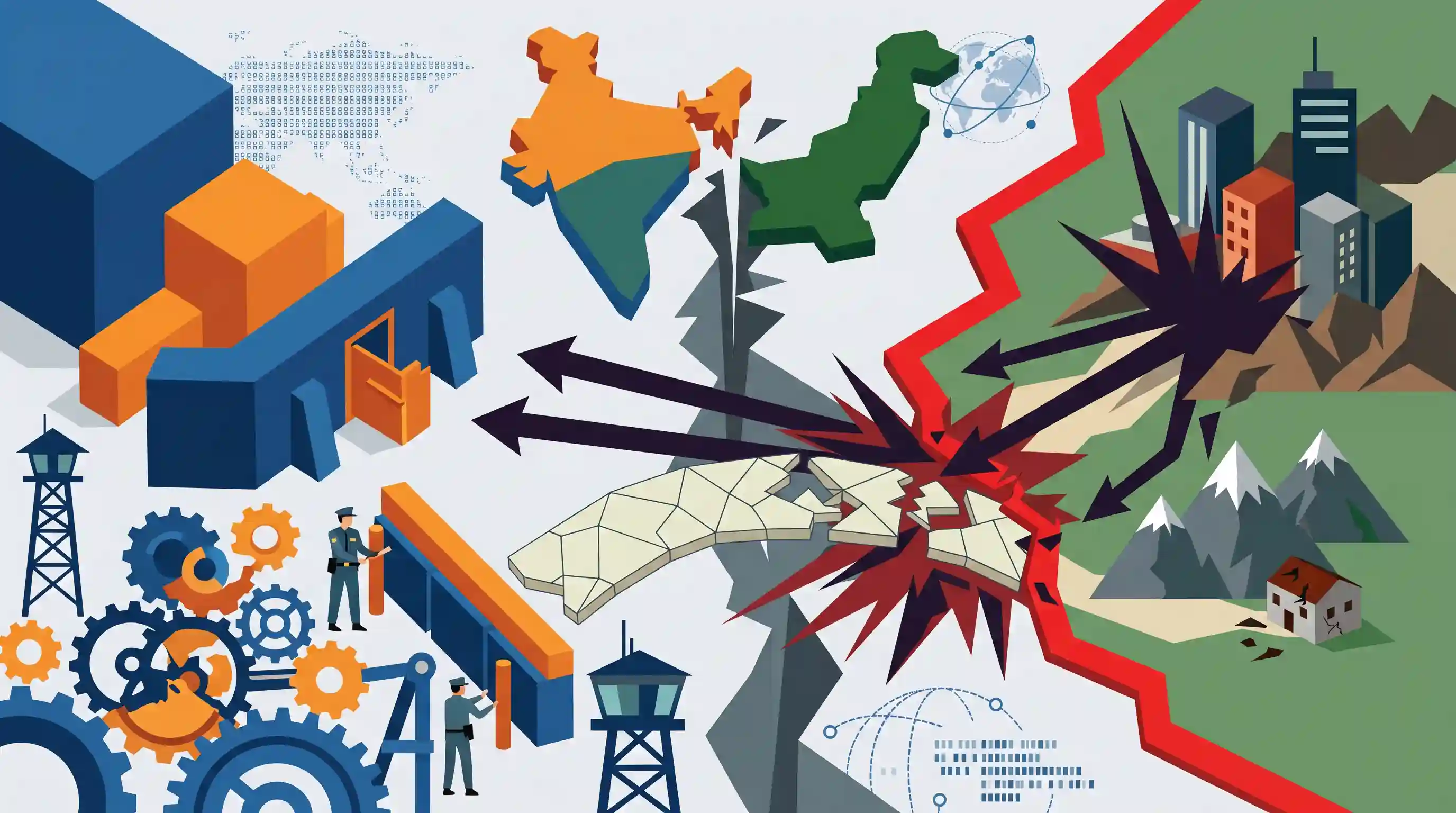
Why It Matters
Understanding the dynamics of India-Pakistan relations and internal security in Jammu & Kashmir is crucial for both GS2 (International Relations) and GS3 (Internal Security). The concept of 'red lines' in state-sponsored terrorism shapes India's foreign and defense policies.
Summary
The article analyzes the strategic implications of the recent terror attack in Pahalgam, Jammu and Kashmir. It argues that the attack crosses a critical threshold or 'red line' that may fundamentally redefine India-Pakistan relations. The persistence of cross-border terrorism continues to obstruct diplomatic engagement, forcing India to potentially recalibrate its security posture and bilateral approach towards Pakistan.
Key Points
- The Pahalgam terror attack represents a significant escalation of violence in Jammu and Kashmir, severely impacting regional stability.
- The incident is viewed as crossing a diplomatic and security 'red line', potentially leading to a paradigm shift in how India deals with cross-border terrorism.
- Continued state-sponsored terrorism from Pakistan remains the primary obstacle to any normalization of bilateral relations.
- India may need to recalibrate its counter-terrorism strategies and border management along the Line of Control to prevent future incursions.
Prelims Trap
The Line of Control (LoC) in J&K is exclusively guarded by the Border Security Force (BSF).
The LoC is primarily under the operational control of the Indian Army, whereas the BSF independently guards the International Boundary (IB) and assists on the LoC.
Static Concepts Connected
Which Central Armed Police Forces (CAPFs) guard India's respective borders?
- BSF: Guards the Indo-Pakistan and Indo-Bangladesh borders.
- ITBP: Secures the Indo-China border along the Line of Actual Control (LAC).
- SSB: Guards the open and porous borders with Nepal and Bhutan.
- Assam Rifles: Responsible for securing the challenging Indo-Myanmar border.
What is the Comprehensive Integrated Border Management System (CIBMS)?
- Core Objective: To integrate technology with human resources to create an invisible electronic barrier along vulnerable border terrains.
- Key Technologies: Includes CCTV cameras, thermal imagers, night vision devices, ground sensors, and laser barriers to detect infiltration.
- Strategic Application: Currently deployed in pilot phases along highly sensitive stretches of the Indo-Pak and Indo-Bangladesh borders.
Cross-Topic Patterns
Economic destabilization via terror
Terror groups targeting soft civilian centers like Pahalgam aims to actively derail J&K's post-Article 370 economic revival, linking internal security directly to regional economic development.
Diplomatic isolation and FATF leverage
India's strategy to counter such "red line" attacks relies heavily on multilateral forums like the FATF to financially choke state sponsors of terrorism, moving beyond mere bilateral reprimands.

Expect Mains GS3 questions linking tourist-targeted terror in J&K to economic destabilization, and the role of CIBMS in border management.
Linked PYQs · 4
Linked PYQs · 4
- 2015MainsGS2
Terrorist activities and mutual distrust have clouded India-Pakistan relations. To what extent the use of soft power like sports and cultural exchanges could help generate goodwill between the two countries? Discuss with suitable examples.
- 2016MainsGS2
Increasing cross-border terrorist attacks in India and growing interference in the internal affairs of several member-states by Pakistan are not conducive for the future of SAARC (South Asian Association for Regional Cooperation)." Explain with suitable examples.
- 2020MainsGS3
For effective border area management, discuss the steps required to be taken to deny local support to militants and also suggest ways to manage favourable perception among locals.
- 2023MainsGS3
Winning of 'Hearts and Minds' in terrorism-affected areas is an essential step in restoring the trust of the population. Discuss the measures adopted by the Government in this respect as part of the conflict resolution in Jammu and Kashmir.
