Maharashtra Rains Damage Crops Across Sixty Lakh Hectares
Source:Indian Express ↗
Why It Matters
Highlights the interplay of extreme weather events with agricultural distress and disaster response mechanisms. The debate around recognizing new forms of disasters (like "wet drought") and policy interventions such as halting loan recoveries reflect on crisis management in the rural economy and Centre-State funding frameworks.
Summary
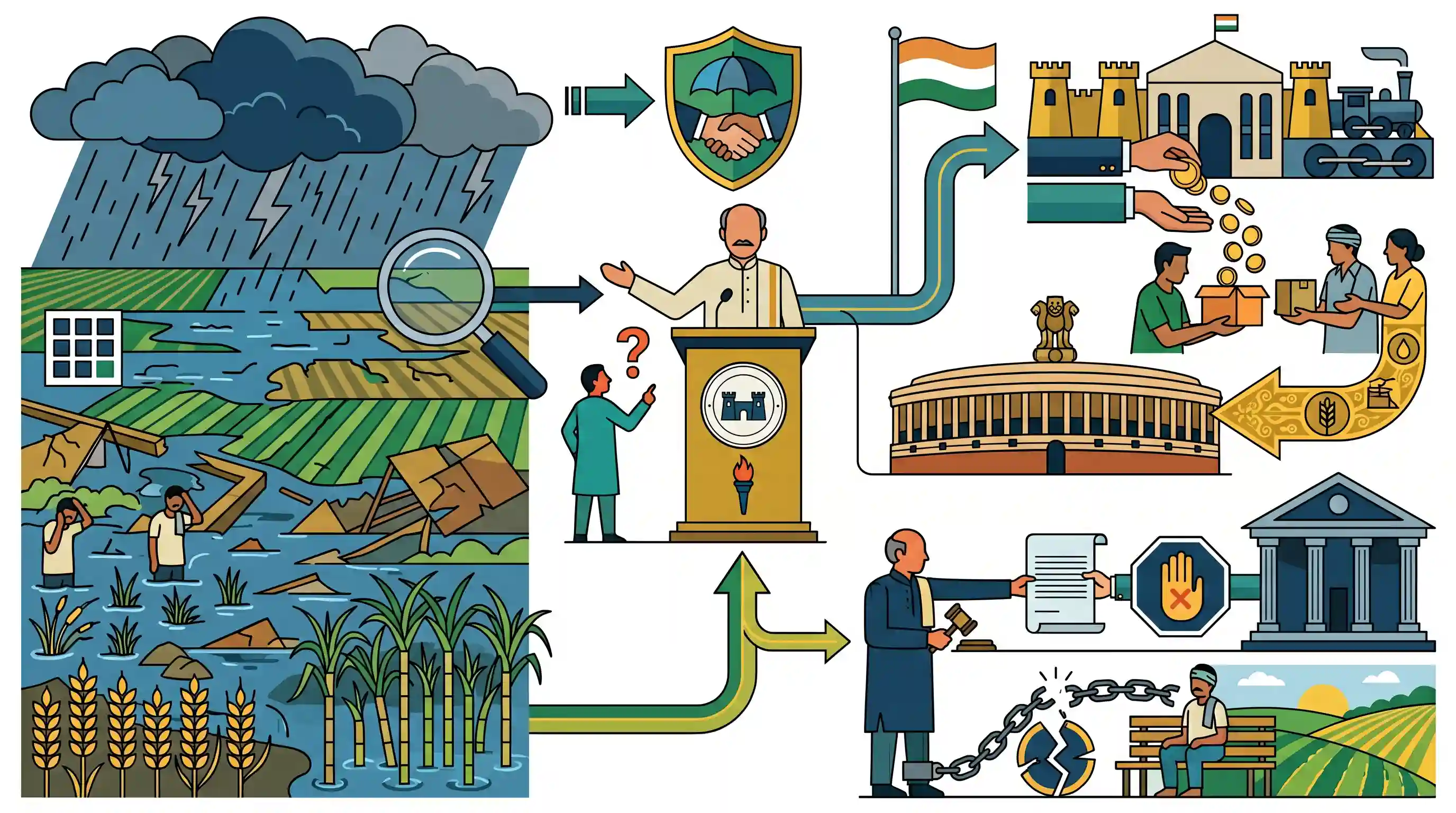
Heavy unseasonal rains and floods in Maharashtra have severely damaged crops across nearly 60 lakh hectares. Chief Minister Devendra Fadnavis announced that while the opposition's term "wet drought" has no official disaster-management standing, affected farmers will receive all standard natural calamity relief. The state has released initial aid, sought a substantial relief package from the Centre, and directed banks to halt farm loan recoveries to ease rural distress.
Key Points
- Unseasonal heavy rains and floods in Maharashtra have caused massive agricultural distress, damaging crops over nearly 60 lakh hectares.
- The state government has requested the Centre for a comprehensive flood relief package and is preparing to disburse financial assistance to farmers.
- CM Devendra Fadnavis rejected the opposition's demand to declare a "wet drought," clarifying that no such official terminology exists, but assured that standard natural calamity relief will apply.
- To protect distressed farmers from immediate financial ruin, the government directed banks to temporarily halt farm loan recovery processes.
Important Terms
Wet Drought (Gila Akal)

A colloquial term for crop destruction caused by excessive unseasonal rain or flooding, mirroring the economic impact of a standard drought but through waterlogging rather than water scarcity.
UPSC context
Relevant for GS Paper I (Geography/Monsoon) and Paper III (Disaster Management/Agriculture) regarding erratic weather patterns and non-notified disaster terminology.
State Disaster Response Fund (SDRF)
A statutory fund established under Section 48 of the Disaster Management Act, 2005, serving as the primary resource for state governments to provide immediate relief for notified disasters.
UPSC context
Critical for GS Paper II (Federalism) and Paper III (Disaster Management) regarding the fiscal framework of center-state disaster assistance.
National Disaster Response Fund (NDRF)
A fund managed by the Central Government under Section 46 of the DM Act, 2005, providing supplementary relief to states for disasters of 'severe nature' beyond SDRF capacity.
UPSC context
Tests understanding of the institutional mechanisms for large-scale disaster relief and central assessment processes in GS Paper III.
Moratorium
A legally authorized period of delay in the performance of an obligation, such as halting farm loan recoveries, to prevent rural bankruptcy during agricultural crises.
UPSC context
Significant for GS Paper III (Indian Economy/Agriculture) as a tool for managing agrarian distress and credit flow to farmers.
Agricultural Distress
A multifaceted crisis in the farming sector characterized by low yields, high indebtedness, and crop failures, often leading to socioeconomic instability and farmer suicides.
UPSC context
A core theme in GS Paper III (Agriculture) related to food security, rural development, and policy interventions.
Disaster Management Act, 2005
The primary legislation in India providing the legal and institutional framework for disaster response, including the creation of the NDMA, SDMAs, and specialized response funds.
UPSC context
Foundational legal knowledge for GS Paper II (Governance) and Paper III (Disaster Management).
Prelims Trap
"'Wet drought' is an officially notified natural calamity eligible for NDRF/SDRF assistance."
No official standing exists for "wet drought." Crop damage from excessive rain is assessed under recognized categories like "floods" or "continuous rain."
Static Concepts Connected
How is disaster relief financed under SDRF and NDRF?
- Primary Fund: SDRF is the primary state fund. The Centre contributes 75% for general category states and 90% for special category states.
- Supplementary Fund: NDRF is purely supplementary, accessed only for "calamities of a severe nature" when state SDRF resources are exhausted.
- 33% Threshold: Crop loss must be officially assessed at a minimum of 33% to qualify for agricultural input subsidies.
How does PMFBY cover unseasonal rains and floods?
- Localized Calamities: Insurance specifically covers localized risks like hailstorm, landslide, and inundation affecting isolated farms rather than entire blocks.
- Post-Harvest Losses: Covers crops that must be cut and spread in the field to dry, valid for up to 14 days after harvesting.
Cross-Topic Patterns
RBI norms & Disaster Management
Official calamity declarations trigger RBI master directions, mandating banks to restructure short-term crop loans and offer repayment moratoriums without demanding extra collateral.
Climate shifts & Actuarial risk
Increasing unseasonal rainfall tests PMFBY viability, bridging GS3 Climate Change with GS3 Agriculture financing and insurance sustainability.

Expect a tricky 2026 Prelims statement mixing PMFBY’s 14-day post-harvest loss window and the 33% SDRF crop-loss threshold.
Linked PYQs · 3
Linked PYQs · 3
- 2014MainsGS3
Drought has been recognized as a disaster in view of its spatial expanse, temporal duration, slow onset and lasting effects on vulnerable sections. With a focus on the September 2010 guidelines from the National Disaster Management Authority (NDMA), discuss the mechanisms for preparedness to deal with likely El Niño and La Niña fallouts in India.
- 2017MainsGS3
How do subsidies affect the cropping pattern, crop diversity and economy of farmers? What is the significance of crop insurance, minimum support price and food processing for small and marginal farmers?
- 2024MainsGS3
What is disaster resilience? How is it determined? Describe various elements of a resilience framework. Also mention the global targets of Sendai Framework for Disaster Risk Reduction (2015–2030).
