Crop Diversification and Agricultural Policy Shifts in Telangana
Source:The Hindu ↗
Why It Matters
The article provides real-world policy examples of crop diversification—a critical topic in the GS3 syllabus concerning sustainable agriculture and changing cropping patterns. It also highlights governance friction over agriculture (a state subject) versus overarching central legislation like the Central Seed Act, as well as the practical management of fertilizer supplies.
Summary
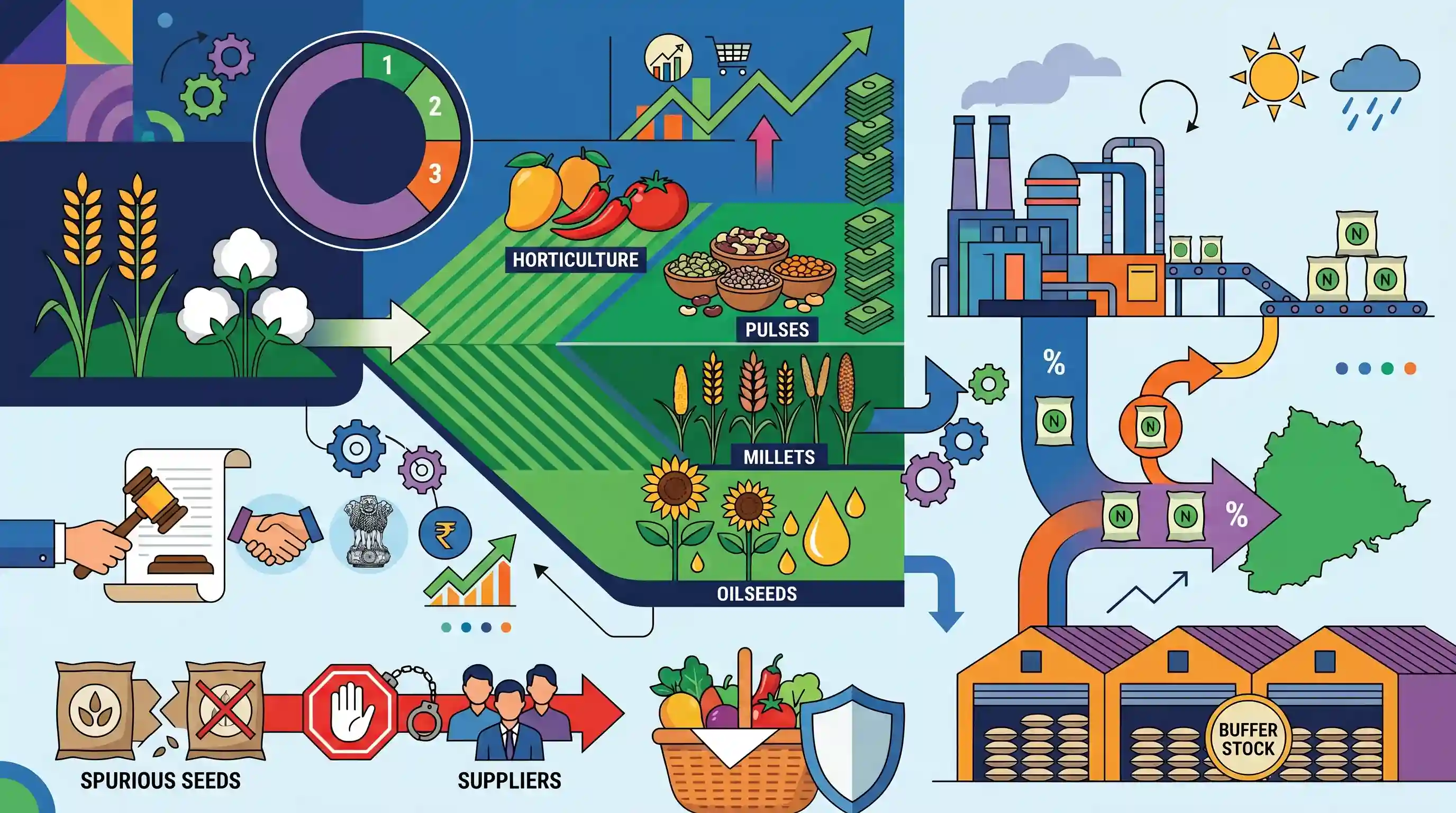
The Telangana government has outlined a strategic shift toward crop diversification, aiming to transition 13 lakh acres of paddy and cotton fields to horticulture, pulses, millets, and oilseeds over the next three years to align with changing market demands. Concurrently, Agriculture Minister Tummala Nageswara Rao emphasized the need for structural agricultural reforms, demanding amendments to the Central Seed Act to penalize suppliers of spurious seeds and enhance state-level regulatory powers. The administration is also securing urea buffer stocks for the upcoming Kharif season, specifically requesting the Centre to allocate 90% of the urea output from the Ramagundam fertilizer plant to the state.
Key Points
- Telangana plans to shift 13 lakh acres of land currently used for paddy and cotton cultivation to alternative crops like horticulture, pulses, millets, and oilseeds over the next three years.
- The State government is emphasizing the expansion of oil palm cultivation, targeting 45,000 acres this year and scaling up to 1 lakh acres next year.
- State authorities have demanded amendments to the Central Seed Act to provide clarity on compensating farmers for losses due to spurious seeds and to grant states equal regulatory powers.
- Telangana has requested the Central government to allocate 90% of the urea produced at the Ramagundam Fertilizers and Chemicals Limited plant to the state to meet its agricultural needs.
Important Terms
Seeds Act, 1966

1966 legislation regulating seed quality in India. It mandates notification of varieties and quality standards, but relies largely on voluntary certification, leading to modern calls for stricter regulatory amendments.
UPSC context
GS Paper III (Agriculture/Statutory bodies); tests understanding of seed regulation, breeder rights, and reforms needed for farmer protection.
Crop Diversification
The agricultural practice of growing a variety of crops rather than a single monoculture (e.g., shifting from paddy to pulses). It improves soil health and mitigates climate/market risks.
UPSC context
GS Paper I (Geography) and III (Cropping patterns); central to discussions on doubling farmer income and sustainable agriculture.
Ramagundam Fertilizers and Chemicals Limited (RFCL)
A public sector joint venture in Telangana producing neem-coated urea. It is critical for South India's fertilizer security, utilizing natural gas as its primary feedstock.
UPSC context
GS Paper III (Infrastructure/Fertilizer sector); relevant for questions on industrial location and domestic self-sufficiency in agricultural inputs.
Spurious Seeds
Counterfeit, misbranded, or sub-standard seeds that fail to meet purity or germination benchmarks, often causing severe crop loss and financial distress for farmers.
UPSC context
GS Paper III (Agriculture/Regulatory issues); tests knowledge of supply chain integrity and the impact of poor inputs on food security.
Buffer Stock
Strategic reserves of agricultural inputs (like urea) or produce (like grain) maintained by the government to ensure availability and price stability during peak demand or scarcity.
UPSC context
GS Paper III (Food Security/Subsidies); important for understanding government interventions in the agricultural market.
Agriculture Commission
An advisory body established by state governments (e.g., Telangana) to recommend agricultural reforms, monitor seed quality, and address farmer grievances through policy advocacy.
UPSC context
GS Paper II (Statutory/Quasi-judicial bodies) and III (Agriculture); focuses on institutional mechanisms for rural development.
Kharif Season
The summer cropping season in India, typically from June to October, coinciding with the Southwest monsoon. Major crops include paddy, cotton, maize, and soybean.
UPSC context
GS Paper I (Climatology/Geography); fundamental to understanding Indian agriculture cycles and the impact of monsoons on the economy.
Prelims Trap
"The Seeds Act, 1966 mandates compulsory statutory compensation to farmers in case of crop failure due to spurious seeds."
The 1966 Act is outdated and actually lacks a direct, statutory mechanism for compensating farmers for spurious seeds, which is the primary reason states are demanding amendments.
Static Concepts Connected
What are the core limitations of the Seeds Act, 1966?
- Scope limitation: It largely applies only to "notified kinds/varieties" of seeds, leaving a vast segment of private, un-notified hybrids effectively unregulated.
- No compensation clause: It lacks a direct, statutory mechanism to guarantee compensation to farmers if poor-quality or spurious seeds result in total crop failure.
- Centralized regulatory power: States lack independent regulatory teeth to penalize fraudulent seed companies efficiently, relying on outdated Central penalty structures.
How does the NMEO-OP incentivize farmers to adopt Oil Palm cultivation?
- Viability Price assurance: The Centre guarantees a 'Viability Price' (via Viability Gap Payment) to shield domestic farmers from extreme volatility and crashes in international crude palm oil prices.
- Input and gestation support: Provides substantial direct financial assistance to farmers for planting material, farm maintenance, and inter-cropping during the initial 4-5 year gestation period.
- Special regional focus: Geographically focuses heavily on the North East and Andaman & Nicobar islands due to their favorable agro-climatic conditions.
Cross-Topic Patterns
Fertilizer self-sufficiency + Gas grids
Ramagundam urea plant highlights the shift to gas-based fertilizer production, linking India's agricultural input self-sufficiency directly to natural gas pipeline infrastructure expansions.
Federalism + Concurrent List in Agri
Demands to amend the Seeds Act expose friction in agricultural governance, as trade and commerce of seeds falls under the Concurrent List, limiting state penal powers.
Crop diversification + Groundwater & Nutrition
Shifting from water-guzzling paddy/cotton to pulses/millets addresses both the semi-arid groundwater crisis and the nutritional 'double burden of malnutrition'.

Expect a 2026 prelims multi-statement question linking Seed Act regulatory gaps, NMEO-OP viability pricing, and urea plants.
Linked PYQs · 5
Linked PYQs · 5
- 2024MainsGS3
Explain the role of millets for ensuring health and nutritional security in India.
- 2021MainsGS3
What are the present challenges before crop diversification? How do emerging technologies provide an opportunity for crop diversification?
- 2017MainsGS3
What are the major reasons for declining rice and wheat yield in the cropping system? How crop diversification is helpful to stabilise the yield of the crops in the system?
- 2020PrelimsGS1
With reference to chemical fertilizers in India, consider the following statements : 1. At present, the retail price of chemical fertilizers is market-driven and not administered by the Government. 2. Ammonia, which is an input of urea, is produced from natural gas. 3. Sulphur, which is a raw material for phosphoric acid fertilizer, is a by-product of oil refineries. Which of the statements given above is/are correct?
- 2016PrelimsGS1
Why does the Government of India promote the use of 'Neem-coated Urea' in agriculture?
