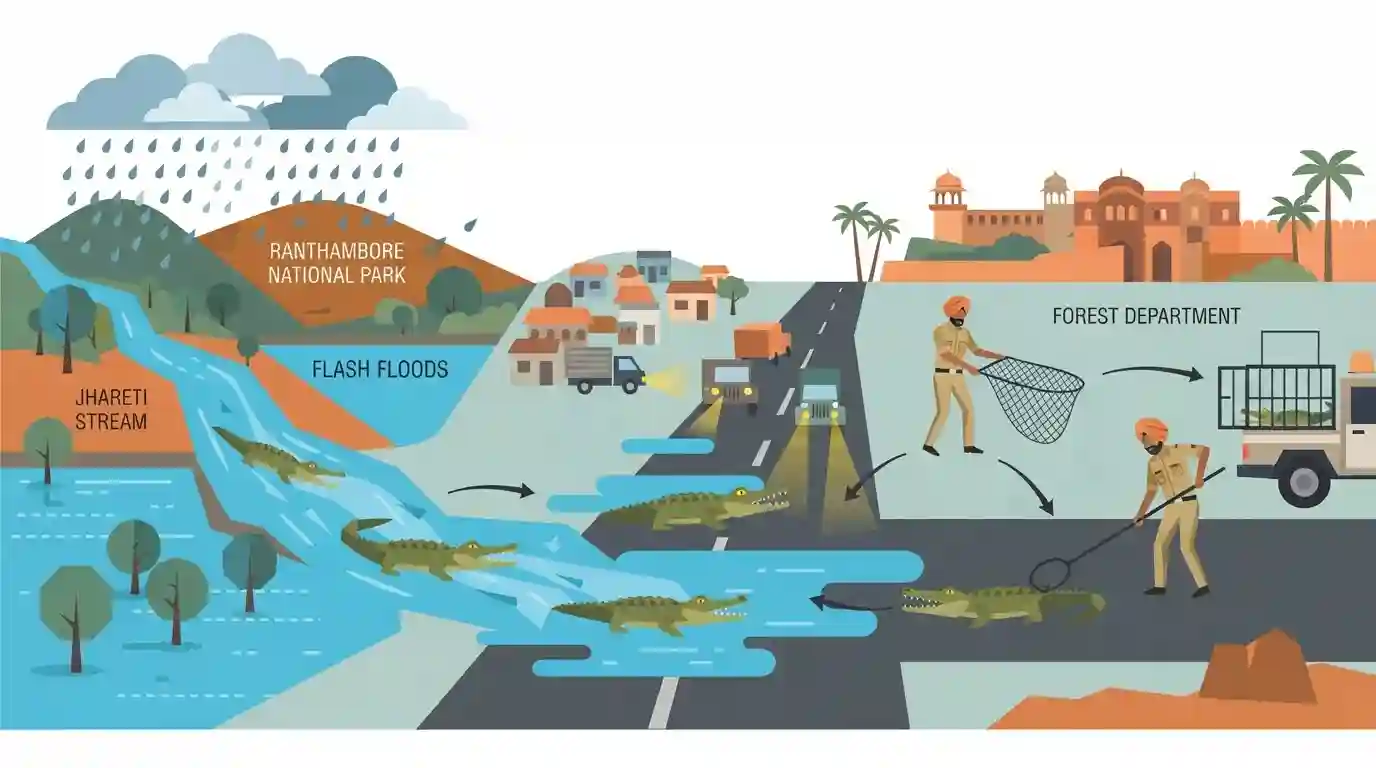
Flash Floods Force Crocodiles onto Roads Near Ranthambore Park
Source:etv-bharat ↗
Why It Matters
Highlights the geography and ecology of Ranthambore (specifically the Jhareti stream and local reservoirs like Atal Sagar) and the vulnerability of human-wildlife interface during extreme weather events like flash floods, which is relevant for Rajasthan Geography and Environment sections in the RAS Prelims.
Summary
Following heavy rainfall in Sawai Madhopur, Rajasthan, flash floods in the Jhareti stream and nearby reservoirs caused crocodiles from Ranthambore National Park to stray onto roads. The incident highlights the impact of extreme monsoon weather on regional wildlife and water bodies, necessitating intervention by the Forest Department to ensure public safety and wildlife rescue.
Key Points
- Heavy monsoon rains triggered flash floods in Sawai Madhopur, leading to overflowing water bodies including the Jhareti stream.
- As water levels rose, several crocodiles from the Ranthambore National Park zone strayed onto local roads, prompting panic among commuters and tourists.
- Reservoirs such as Atal Sagar, Mishra Darra, and Aada Balaji also experienced massive overflow due to the intense downpour.
- The Forest Department was alerted to rescue and relocate the displaced crocodiles back to their natural habitats.
Important Terms
Ranthambore National Park

A renowned national park and tiger reserve in Rajasthan, located at the junction of the Aravalli and Vindhya ranges. Bounded by the Chambal and Banas rivers, it hosts diverse wildlife, including tigers, leopards, and marsh crocodiles.
UPSC context
GS Paper 3 (Environment). Frequently tested on map locations, tiger reserves, and intersecting geographical features like rivers and mountain ranges.
Marsh Crocodile (Mugger)
A freshwater crocodile species native to the Indian subcontinent, commonly found in lakes and rivers. Recognized by its broad snout, it is listed as 'Vulnerable' by the IUCN and protected under India's Wildlife Protection Act.
UPSC context
GS Paper 3 (Biodiversity). Highly relevant for species-in-news questions, focusing on IUCN status, natural habitats, and conservation efforts.
Flash Floods
Highly localized, sudden, and rapid flooding of low-lying areas or streams, typically occurring within six hours of intense rainfall. They carry immense destructive force, overwhelming natural drainage systems.
UPSC context
GS Paper 3 (Disaster Management). Crucial for understanding extreme weather events, climate change impacts, and state mitigation strategies.
Forest Department
The primary state-level administrative authority responsible for forest conservation, wildlife protection, and enforcing environmental laws. It actively manages human-wildlife conflict scenarios, such as animal rescues during natural disasters.
UPSC context
GS Paper 3 (Environment). Relevant for institutional frameworks in biodiversity conservation and human-animal conflict resolution mechanisms.
Prelims Trap
The Mugger crocodile found in Rajasthan is Critically Endangered and restricted primarily to the Chambal river.
Muggers are IUCN Vulnerable and widely distributed across India, unlike the Gharial which is Critically Endangered and highly restricted to clean river systems like the Chambal.
Static Concepts Connected
What are the geographical boundaries and features of Ranthambore Tiger Reserve?
- Hill Ranges: Situated at the crucial geological junction where the Aravalli and Vindhyan hill systems meet.
- River Systems: Bounded by the Banas River to its north and the Chambal River to its south.
- Forest Type: Predominantly tropical dry deciduous forests, with Dhok (Anogeissus pendula) as the most prominent tree species.
What is the conservation status of India's three crocodilian species?
- Mugger (Marsh): IUCN Vulnerable; highly adaptable to freshwater lakes, reservoirs, and rivers across the Indian subcontinent.
- Gharial: IUCN Critically Endangered; a specialized riverine species mostly restricted to the Chambal river sanctuary.
- Saltwater Crocodile: IUCN Least Concern; found in coastal mangroves and estuaries like Bhitarkanika, Sundarbans, and the Andamans.
Cross-Topic Patterns
Climate-induced Wildlife Displacement
Flash floods forcing aquatic wildlife into human habitats highlights how extreme hydro-meteorological events directly escalate human-wildlife conflict beyond traditional forest borders.
Banas-Chambal River System
The Banas River, Rajasthan's longest internal river, flows into the Chambal, making this drainage basin critical for both drought-prone Rajasthan agriculture and riparian ecology.

Ranthambore's specific geography (Aravalli-Vindhya junction, Banas-Chambal rivers) alongside Mugger IUCN status is a high-probability 2026 MCQ.
Linked PYQs · 4
Linked PYQs · 4
- 2018RPSC_PRELIMSGS1
Which of the following does not match?
- 2023RPSC_PRELIMSGS1
The National Tiger Conservation Authority has conferred the status of the fifth tiger sanctuary in Rajasthan, to which of the following sanctuaries?
- 2018RPSC_PRELIMSGS1
Which of the following lakes in Rajasthan does not fall under the ‘National Lake Conservation Program’ (NLCP)?
- 2016RPSC_PRELIMSGS1
Which lake in Rajasthan has been included in the Ramsar Wetlands List?
