Judicial Reforms and Alternative Dispute Resolution Mechanics
Source:The Hindu ↗
Why It Matters
Provides critical judicial perspectives on the balance between adopting technology/AI in justice delivery and retaining human oversight, while underscoring the urgent need to reform arbitration and mediation to genuinely address court pendency.
Summary
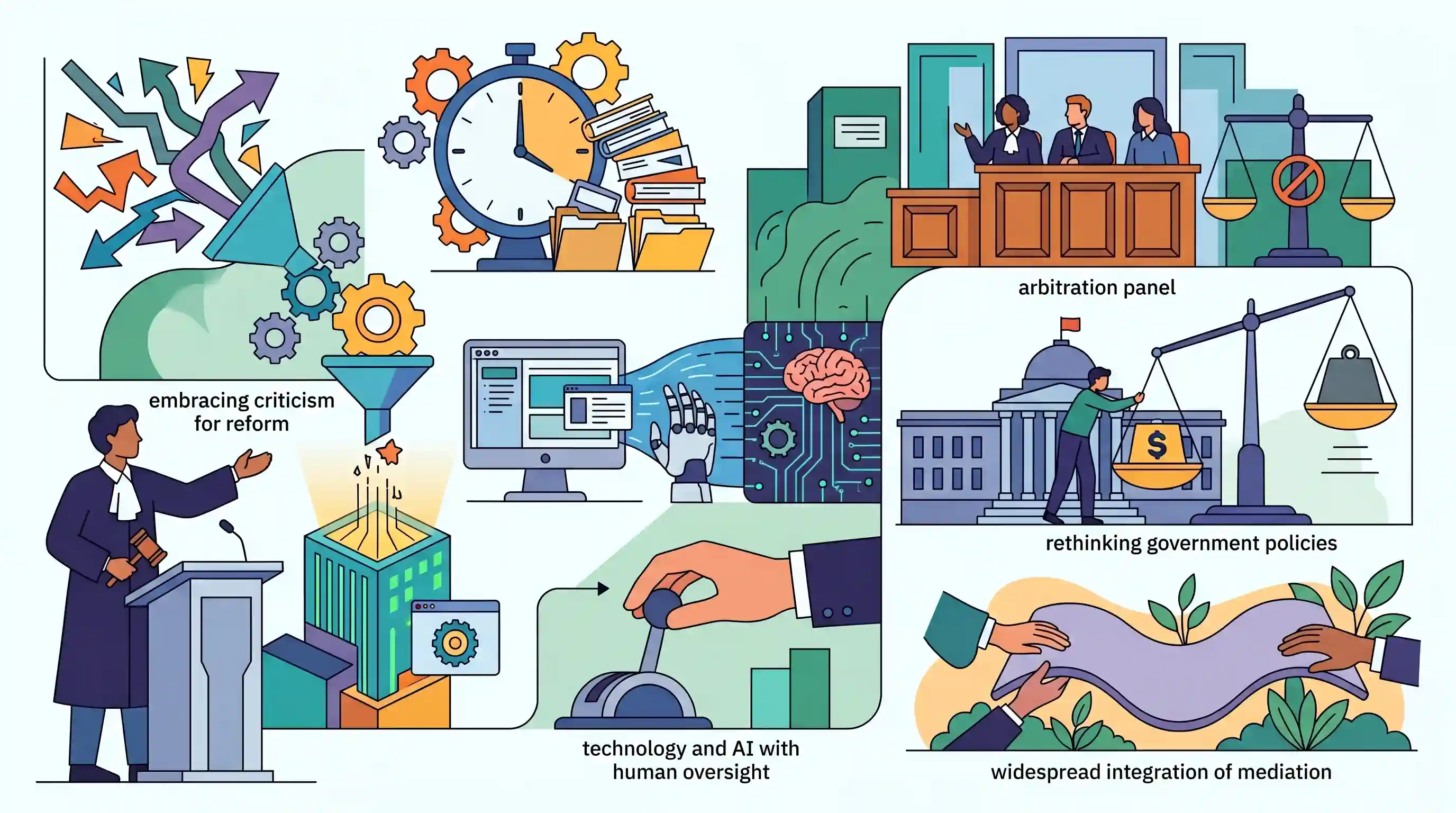
Supreme Court Justice Manmohan, speaking at a legal conclave in New Delhi, emphasized that criticism of the judicial system should be embraced constructively as a catalyst for reform rather than viewed as condemnation. Addressing the integration of technology, he cautioned that while artificial intelligence can be a powerful enabler in decision-making, it must always remain under human oversight. Justice Manmohan also raised concerns about judicial pendency, pointing out that Alternative Dispute Resolution (ADR) processes like arbitration have lost their intended informality and sensitivity, instead mirroring rigid court proceedings. He called for the widespread integration of mediation and urged the government to rethink policies that limit its participation in arbitration based on claim thresholds.
Key Points
- Constructive criticism that highlights systemic shortcomings should be treated as suggestions for judicial reform, rather than condemnation of the system.
- Technology and artificial intelligence serve as double-edged tools in decision-making; they must act as enablers while ensuring the ultimate decision rests with a human mind.
- Alternative Dispute Resolution (ADR) mechanisms, originally intended to be informal and inexpensive solutions to judicial pendency, have increasingly become rigid replicas of formal court proceedings.
- There is a pressing need to integrate mediation at all levels and for the government to reconsider its stance on avoiding arbitration when claims exceed a certain threshold.
Important Terms
Alternative Dispute Resolution (ADR)

Dispute resolution methods, including arbitration, mediation, and conciliation, that resolve legal conflicts outside the traditional court system to ensure speed and cost-effectiveness.
UPSC context
GS Paper 2: Dispute Redressal Mechanisms. Tests knowledge of judicial efficiency, Article 39A (Equal Justice), and ease of doing business.
Mediation Act, 2023
Legislation mandating pre-litigation mediation for civil and commercial disputes, establishing the Mediation Council of India to regulate and institutionalize the mediation process.
UPSC context
GS Paper 2: Statutory/Regulatory Bodies. Evaluates understanding of recent legal reforms to reduce the burden on the formal judiciary.
Judicial Pendency
The massive backlog of unresolved cases across Indian courts (exceeding 5 crore), caused by low judge-to-population ratios, vacancies, and procedural inefficiencies.
UPSC context
GS Paper 2: Structure and Functioning of the Judiciary. Essential for discussing the 'Justice Clock' and systemic judicial delays.
Scheduled Castes and Scheduled Tribes (Prevention of Atrocities) Act
A 1989 law designed to prevent crimes against marginalized communities and ensure their social dignity, legal protection, and rehabilitation through special courts and strict penalties.
UPSC context
GS Paper 2: Social Justice and Vulnerable Sections. Tests knowledge of legal safeguards for historical equity and social inclusion.
Arbitration
A formal ADR procedure where parties submit their dispute to a neutral third party (arbitrator) for a final, legally binding decision called an 'award.'
UPSC context
GS Paper 2 & 3: Governance and Economy. Relevant for international commercial law and India's ambition to become a global arbitration hub.
Supreme Court of India
The highest judicial forum and final court of appeal under the Constitution of India, possessing original, appellate, and advisory jurisdictions.
UPSC context
GS Paper 2: Judiciary. Focuses on its role as the 'Guardian of the Constitution' and its power of judicial review.
Society of Indian Law Firms (SILF)
A representative body of leading law firms in India that provides a collective voice for the legal profession and advocates for judicial and legal reforms.
UPSC context
GS Paper 2: Pressure Groups/Civil Society. Important for understanding professional entities that influence legal policy and corporate governance.
Prelims Trap
"Any public criticism of a judicial order that diminishes the court's authority automatically constitutes criminal contempt."
Section 5 of the Contempt of Courts Act, 1971, explicitly protects "fair criticism" of judicial acts. Constructive criticism does not automatically constitute criminal contempt.
Static Concepts Connected
What are the constitutional and statutory provisions regarding Contempt of Court?
- Constitutional backing: Articles 129 and 215 grant the Supreme Court and High Courts respectively the inherent power to punish for contempt of themselves.
- Statutory exemption: Section 5 of the Contempt of Courts Act, 1971 explicitly exempts "fair criticism" of judicial acts on merits from contempt proceedings.
- Truth as defence: A 2006 amendment to the 1971 Act introduced 'truth' as a valid defence against contempt charges, provided it is bona fide and in public interest.
What are the primary statutory and policy frameworks governing ADR in India?
- Section 89 CPC: Empowers civil courts to refer pending civil disputes to alternative mechanisms like arbitration, conciliation, lok adalat, or mediation.
- Mediation Act 2023: Institutionalizes the mediation process, notably introducing provisions for mandatory pre-litigation mediation in civil and commercial disputes to declog courts.
- MoF 2024 Guidelines: Restricts routine arbitration in domestic public procurement contracts to disputes valued under ₹10 crore, pushing higher-value claims toward mediation.
Cross-Topic Patterns
Judicial AI vs. Algorithmic Bias
The push for strict human oversight in judicial AI connects with India's deployment of SUPACE and SUVAS, balancing the reduction of pendency against the fundamental right to an unbiased trial.
Fiscal Policy & Public Procurement ADR
The Ministry of Finance’s 2024 directive limiting arbitration in public procurement ties judicial reform to fiscal management, attempting to stop prolonged arbitration cases from draining the state exchequer.

Expect a multi-statement prelims question linking the Contempt of Courts Act's 'fair criticism' clause and the Mediation Act 2023.
Linked PYQs · 2
Linked PYQs · 2
- 2024MainsGS2
Explain and distinguish between Lok Adalats and Arbitration Tribunals. Whether they entertain civil as well as criminal cases ?
- 2024MainsGS4
The application of Artificial Intelligence as a dependable source of input for administrative rational decision-making is a debatable issue. Critically examine the statement from the ethical point of view.
