Peacock Tarantula Habitat Survey in Eastern Ghats Tiger Reserve
Source:The Hindu ↗
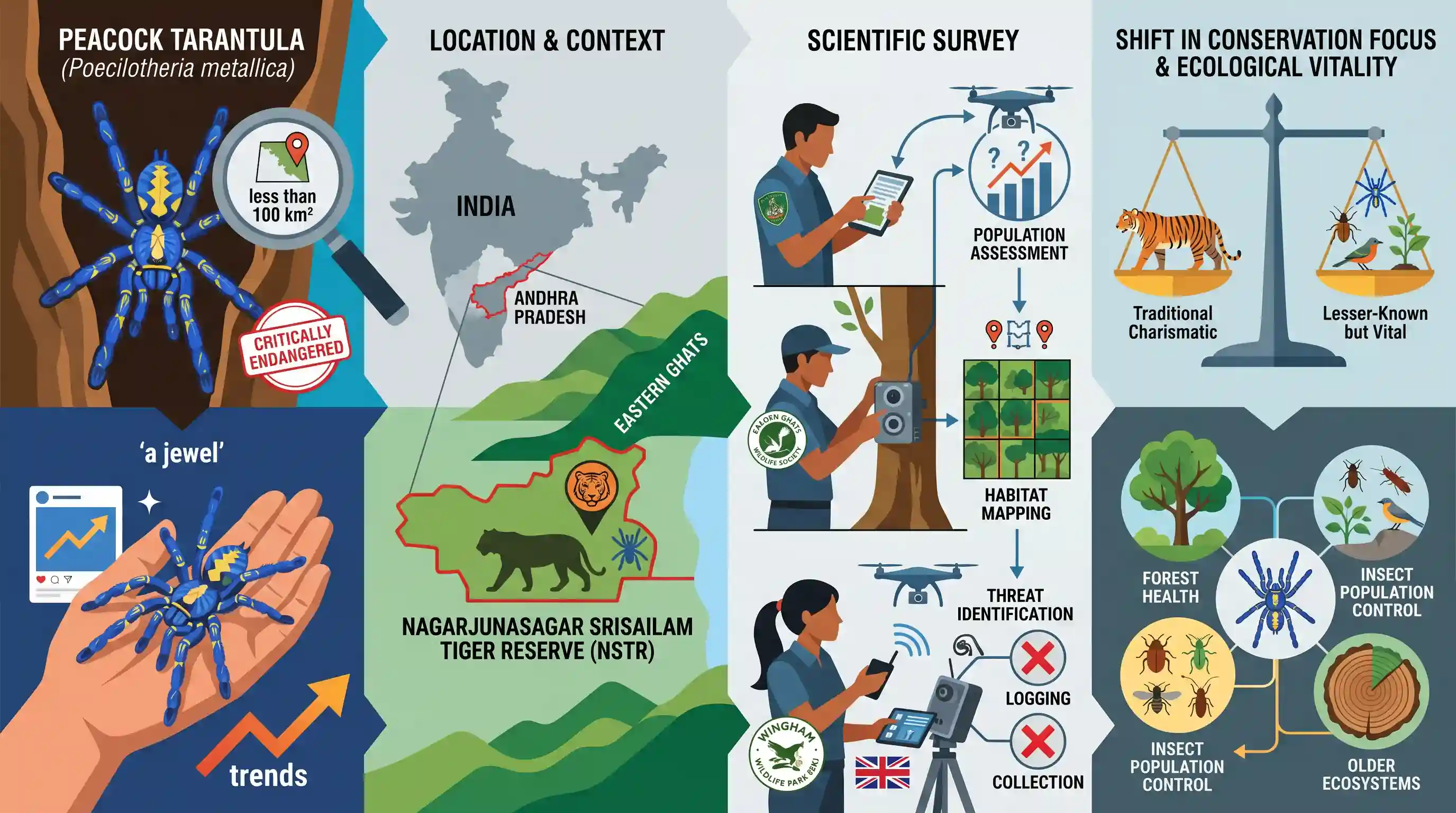
Why It Matters
UPSC frequently tests knowledge of critically endangered species, their natural habitats, and specific protected areas (like the Nagarjunasagar Srisailam Tiger Reserve). The Peacock/Gooty tarantula has already appeared in recent Prelims, underscoring the importance of tracking state-led conservation surveys of highly endemic, non-megafauna species.
Summary
A comprehensive scientific survey has been launched in Andhra Pradesh\'s Nagarjunasagar Srisailam Tiger Reserve to assess the population and habitat of the critically endangered Peacock Tarantula. The electric-blue spider, which is endemic to a tiny patch of the Eastern Ghats, recently gained public attention after a social media post by AP Deputy Chief Minister Pawan Kalyan. Led by the AP Forest Department and the Eastern Ghats Wildlife Society, with UK-based Wingham Wildlife Park as a technical partner, the survey marks a significant shift in conservation focus towards lesser-known but ecologically vital species.
Key Points
- The Peacock Tarantula (Poecilotheria metallica) is an electric-blue spider endemic to the Eastern Ghats in Andhra Pradesh.
- It is classified as \'critically endangered\' by the IUCN due to habitat loss and a highly restricted geographical range.
- First discovered in 1898 near Gooty, the species recently gained public attention following a social media post by AP Deputy CM Pawan Kalyan.
- A conservation status survey is being conducted in the Nagarjunasagar Srisailam Tiger Reserve by the AP Forest Department and the Eastern Ghats Wildlife Society, with UK-based Wingham Wildlife Park as a technical partner.
- The initiative highlights a crucial shift in conservation efforts from charismatic megafauna to lesser-known, ecologically vital species.
Important Terms
Peacock Tarantula

A striking electric-blue, arboreal spider endemic to a tiny forest patch in Andhra Pradesh's Eastern Ghats. Also called the Gooty Sapphire, it is the only blue species of its genus.
UPSC context
GS Paper 3 (Biodiversity); tests knowledge of endemic fauna, habitat requirements, and conservation status of lesser-known Indian species.
Critically Endangered
The highest threat category assigned by the IUCN Red List (excluding extinction), indicating a species faces an extremely high risk of extinction in the wild due to severe decline.
UPSC context
GS Paper 3 (Environment); essential for understanding extinction risk criteria and prioritizing conservation efforts for threatened biodiversity.
Nagarjunasagar Srisailam Tiger Reserve (NSTR)
Spanning the Nallamala Hills in Andhra Pradesh and Telangana, it is India’s largest tiger reserve by area. It serves as a vital corridor for diverse Eastern Ghats flora and fauna.
UPSC context
GS Paper 3 (Protected Areas); significant for its geographic scale, wildlife corridors, and multi-species conservation initiatives.
Eastern Ghats Wildlife Society
A non-profit organization dedicated to community-based conservation and scientific research in the Eastern Ghats. It partners with government bodies to protect regional biodiversity and lesser-known species.
UPSC context
GS Paper 3 (Environment); illustrates NGO-government collaboration in biodiversity protection and the regional ecological focus of the Eastern Ghats.
International Union for Conservation of Nature (IUCN)
An international environmental network that manages the Red List, the world's most comprehensive inventory of the global conservation status of biological species.
UPSC context
GS Paper 3 (Environment); core global authority for species status and international environmental policy frameworks.
Wingham Wildlife Park
A UK-based wildlife park and technical partner for the Peacock Tarantula survey. It contributes scientific expertise and knowledge on captive breeding and documentation of rare arachnids.
UPSC context
GS Paper 3 (Environment); highlights international technical cooperation and ex-situ conservation support for India's threatened biodiversity.
Endemic Species
A species restricted to a specific geographical area and not found naturally elsewhere. Such species are highly vulnerable to local habitat changes and human interference.
UPSC context
GS Paper 3 (Environment); fundamental concept for biodiversity hotspots, niche habitats, and specialized conservation strategies.
Prelims Trap
"The Peacock Tarantula is a critically endangered ground-dwelling spider endemic to the Western Ghats."
UPSC often swaps Eastern and Western Ghats. The Peacock (Gooty) Tarantula is strictly endemic to the Eastern Ghats and is uniquely arboreal (tree-dwelling), not ground-dwelling.
Static Concepts Connected
What are the key ecological features of Nagarjunasagar Srisailam Tiger Reserve (NSTR)?
- Largest CTH: NSTR boasts the largest Critical Tiger Habitat (CTH) area among all tiger reserves in India.
- River System: The River Krishna flows through the reserve, forming the picturesque Srisailam reservoir and carving deep gorges.
- Forest Type: It is dominated by Southern tropical dry mixed deciduous forests and scrublands, making it an ideal habitat for Eastern Ghats endemics.
How are non-megafauna invertebrates protected under India's conservation frameworks?
- WPA Schedules: The WPA 1972 (amended 2022) includes specific schedules (e.g., Schedule I and II) that can grant absolute legal protection to vital invertebrates like endangered spiders and butterflies.
- CITES Implementation: By integrating CITES provisions into the WPA, India enforces strict regulations against the illegal export of exotic invertebrates targeted by the global pet trade.
Cross-Topic Patterns
Umbrella species & micro-habitats
Tiger conservation at Nagarjunasagar Srisailam inadvertently protects the micro-habitats of endemic invertebrates, perfectly illustrating the 'umbrella species' concept in ecological management.
Exotic pet trade & CITES
The Peacock Tarantula's striking colour makes it highly vulnerable to the illegal exotic pet trade, linking regional Eastern Ghats biodiversity loss to international wildlife smuggling networks.

Expect a pair-matching Prelims question linking lesser-known critically endangered endemics (like Peacock Tarantula) to specific habitats.
Linked PYQs · 2
Linked PYQs · 2
- 2020PrelimsGS1
Among the following Tiger Reserves, which one has the largest area under "Critical Tiger Habitat"?
- 2025PrelimsGS1
Regarding Peacock tarantula (Gooty tarantula), consider the following statements : I. It is an omnivorous crustacean. II. Its natural habitat in India is only limited to some forest areas. III. In its natural habitat, it is an arboreal species. Which of the statements given above is/are correct?
