Resource Diplomacy and Critical Mineral Pacts in Geopolitics
Source:Indian Express ↗
Why It Matters
Understanding how geopolitical conflicts (like the Russia-Ukraine war) intersect with the global race for critical minerals is essential for Mains GS2 (International Relations) and GS3 (Economy/Resources). It highlights how transactional diplomacy and strategic resource access are shaping modern foreign policy, which directly affects global supply chains and India's own strategic calculations.
Summary
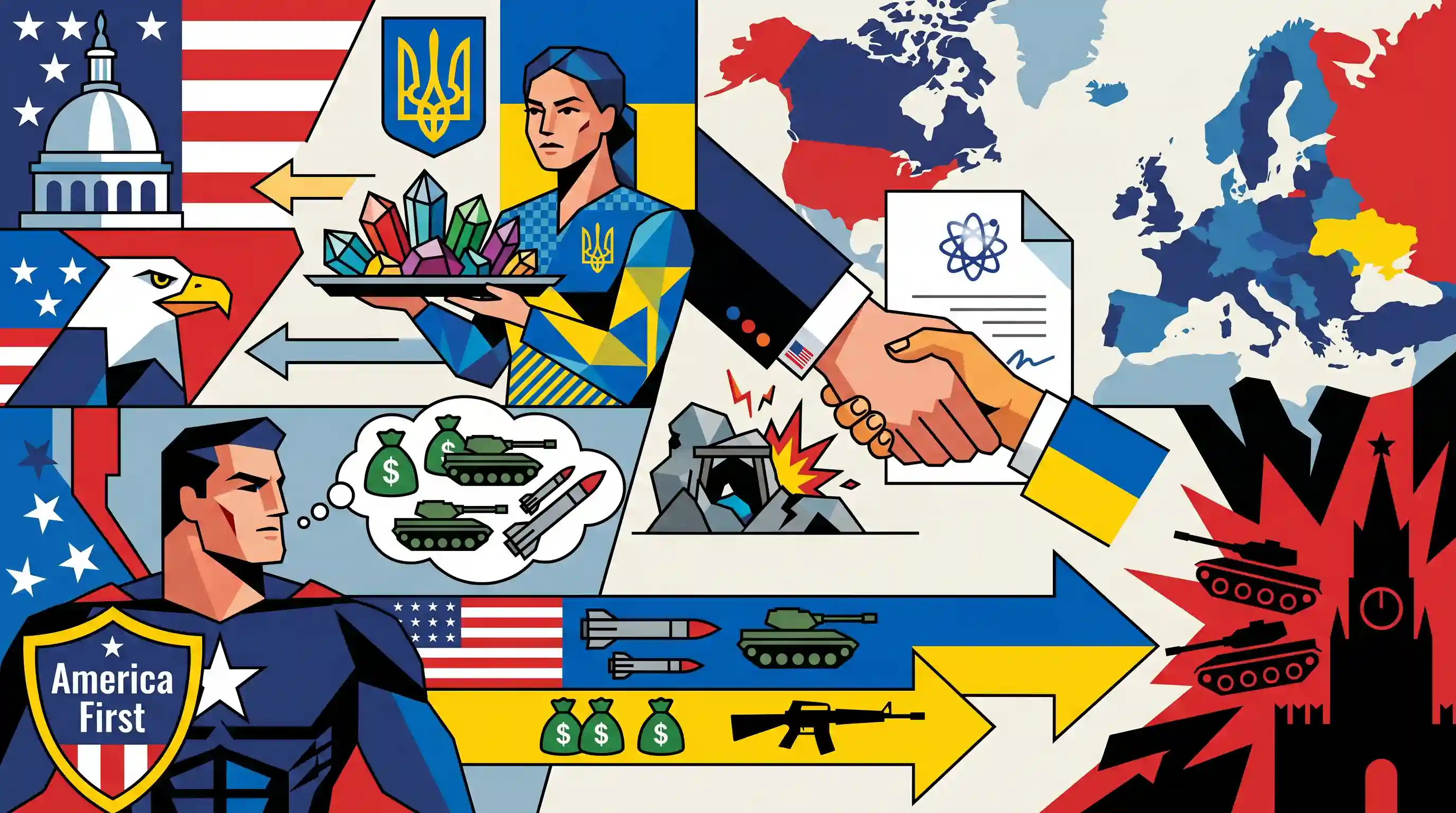
The article analyzes a proposed critical minerals agreement between the United States and Ukraine, framed within the context of the incoming Trump administration and President Zelenskyy's diplomatic efforts. While the economic viability of extracting these minerals in a war-torn region may be weak, the deal serves a vital strategic purpose: it provides a transactional justification for continued US military and economic involvement in Ukraine. By offering access to strategic resources, Ukraine appeals directly to an "America First" foreign policy approach, ensuring that the US remains engaged in countering Russian influence in Eastern Europe.
Key Points
- A proposed critical minerals pact is being utilized by Ukraine to secure continued US support under Donald Trump's transactional foreign policy framework.
- Despite the weak economic rationale—given the costs and risks of operating in a conflict zone—the deal is strategically positioned to align with US interests in securing strategic materials.
- The arrangement highlights a shift toward "resource diplomacy," where geopolitical alliances are increasingly justified through access to critical supply chains rather than purely shared democratic values.
- For the incoming US administration, the deal provides domestic political cover to maintain a strategic footprint in Eastern Europe and counter Russian influence under an "America First" rationale.
Prelims Trap
Ukraine's strategic critical minerals appeal is entirely driven by the clean energy transition and EV batteries.
While lithium is indeed crucial for the EV transition, Ukraine's massive titanium reserves are the primary target for the US aerospace and defense sectors, not the clean energy transition.
Static Concepts Connected
What are India's titanium mineral sources and how are they regulated?
- Primary Sources: Titanium is extracted primarily from ilmenite and rutile, abundantly found in the beach sand coastal tracts of Kerala, Tamil Nadu, and Odisha.
- Atomic Minerals: Ilmenite and rutile are classified as "prescribed substances" (atomic minerals) under the Atomic Energy Act, 1962.
- PSU Monopoly: Since 2019, the government has banned private mining of beach sand minerals, reserving extraction exclusively for Public Sector Undertakings (PSUs) like IREL.
What determines if a mineral is classified as a "Critical Mineral"?
- Economic Impact: The mineral is absolutely essential for modern technologies, defense aerospace, or the clean energy transition (EVs, solar panels, wind turbines).
- Supply Chain Risk: The mineral faces a high vulnerability to supply disruption due to geographic concentration in extraction or processing (e.g., China's dominance).
- Non-substitutability: There is a distinct lack of viable, commercially scalable substitutes for the mineral in its primary industrial or defense applications.
Cross-Topic Patterns
Resource Diplomacy replacing Normative IR
The shift from value-based alliances (democracies) to transactional "America First" resource deals mirrors India's own realpolitik approach to securing energy and critical minerals in a multipolar world.
Global Titanium demand & Indian Beach Sands
Global defense scrambles for titanium directly connect to India's 2019 ban on private beach sand mining, severely restricting India's ilmenite and rutile export potential despite vast reserves.

Expect a multi-statement Prelims question linking Ukraine's Titanium/Lithium reserves to India's domestic Atomic Minerals Concession Rules.
Linked PYQs · 4
Linked PYQs · 4
- 2025MainsGS2
"The reform process in the United Nations remains unresolved, because of the delicate imbalance of East and West and entanglement of the USA vs. Russo-Chinese alliance.” Examine and critically evaluate the East-West policy confrontations in this regard.
- 2021MainsGS2
“The USA is facing an existential threat in the form of a China, that is much more challenging than the erstwhile Soviet Union.” Explain.
- 2025PrelimsGS1
In the context of electric vehicle batteries, consider the following elements : I. Cobalt II. Graphite III. Lithium IV. Nickel How many of the above usually make up battery cathodes?
- 2025PrelimsGS1
Consider the following statements : Statement I: Some rare earth elements are used in the manufacture of flat television screens and computer monitors. Statement II : Some rare earth elements have phosphorescent properties. Which one of the following is correct in respect of the above statements?
