Challenges in Lithium Ion Battery Recycling and Policy Gaps
Source:The Hindu ↗
Why It Matters
Crucial for GS3 (Energy, Environment, and Circular Economy), addressing how regulatory frameworks impact critical mineral supply chains, electric vehicle adoption, and e-waste management in India.
Summary
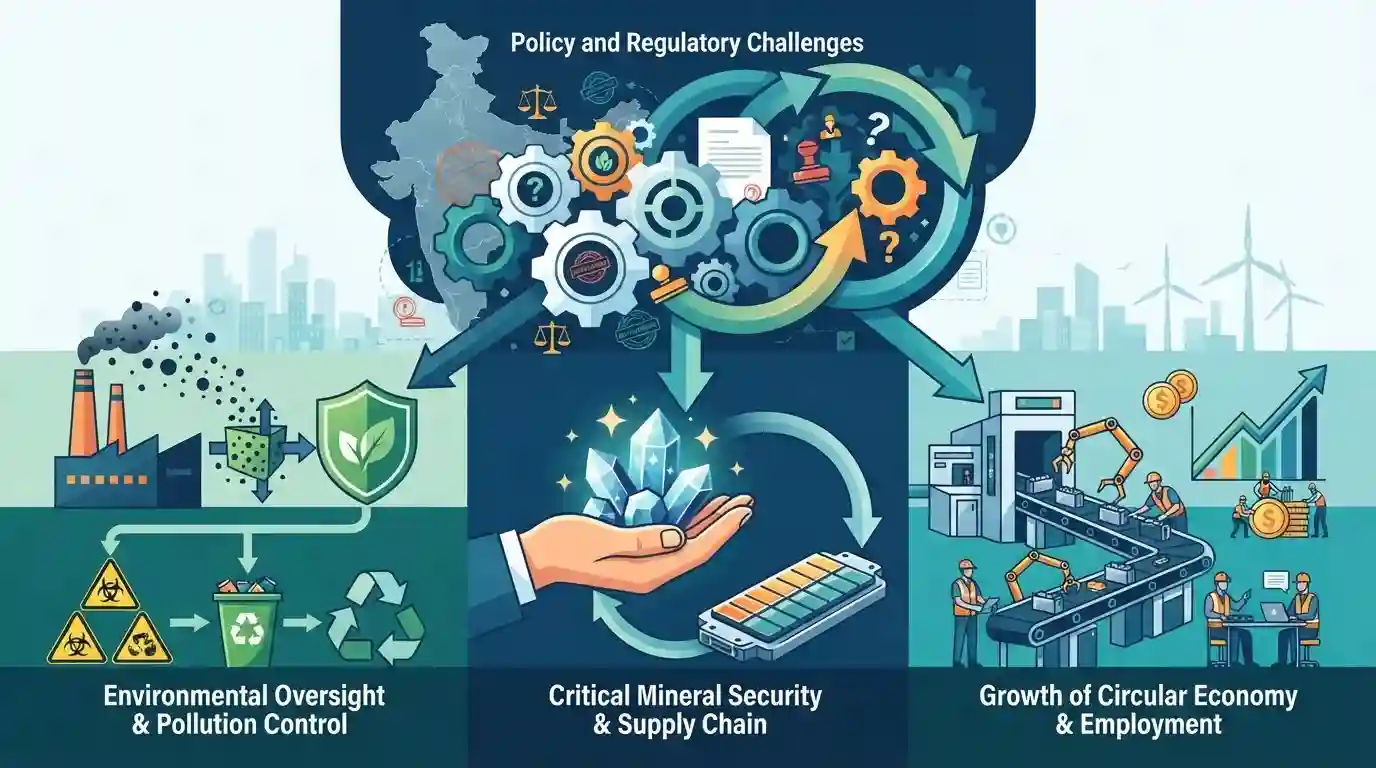
An analysis of the policy and regulatory challenges facing lithium-ion battery recycling in India, highlighting the tension between environmental oversight, critical mineral security, and the growth of a sustainable circular economy.
Key Points
- The article discusses the policy bottlenecks, regulatory confusion, and environmental implications surrounding the recycling and processing of lithium-ion batteries in India.
- Lithium-ion batteries are vital for electric vehicles (EVs) and energy storage systems, making recycling a cornerstone for critical mineral security and circular economy goals.
- Restrictive bans or flawed regulatory frameworks can inadvertently harm the domestic recycling industry, leading to informal processing, hazardous waste handling, and heavy reliance on raw material imports.
- Balancing stringent environmental safeguards with industry-friendly incentives is crucial to foster a formal, sustainable recycling ecosystem in India.
Important Terms
Battery Waste Management Rules

Regulatory framework notified by MoEFCC in 2022 implementing Extended Producer Responsibility (EPR) for all battery types, enforcing strict recovery targets, digital tracking via QR codes, and a ban on landfill disposal to foster a circular economy.
UPSC context
Important for GS Paper III (Environmental Pollution & Degradation, Conservation, and Circular Economy). Tests policy frameworks for waste management.
National Critical Mineral Mission
A government initiative launched to secure India's supply chain for essential minerals like lithium, cobalt, and rare earths by boosting domestic exploration, processing, international asset acquisition, and recycling.
UPSC context
Relevant for GS Paper III (Energy, Infrastructure, and Critical Minerals). Tests strategies for energy security and clean tech manufacturing.
Prelims Trap
Battery Waste Management Rules exempt original equipment manufacturers from physical recycling liabilities if they pay an environmental compensation fee.
The Battery Waste Management Rules apply Extended Producer Responsibility (EPR) to manufacturers and importers, but ultimate physical recycling is largely channeled through authorized recyclers, not just original equipment manufacturers themselves.
Static Concepts Connected
What are the key provisions of the Battery Waste Management Rules (BWMR) in India?
- Legal backing: Statutory basis notified under Environment (Protection) Act, 1986, replacing earlier 2001 battery rules.
- EPR mandate: Mandates Extended Producer Responsibility (EPR) making producers legally responsible for collection, recycling, and refurbishment.
- Recovery targets: Introduces mandatory recovery targets for critical materials like lithium, nickel, cobalt, and manganese from spent batteries.
- Strict prohibition: Prohibits disposal of waste batteries in landfills or incineration and institutes environmental compensation for non-compliance.
Cross-Topic Patterns
Critical Minerals and Resource Nationalism
The ban on black mass export mirrors raw material export restrictions seen in rare earths, protecting strategic value chains under the guise of resource nationalism.
EPR Frameworks across Plastic and Battery Waste
Integrating EPR obligations with mandatory recycling quotas bridges environmental compliance (GS-3 Environment) with industrial manufacturing targets (Make in India).

Expect a statement-based question pairing Battery Waste Management Rules with EPR mechanics and black mass export bans.
Linked PYQs · 4
Linked PYQs · 4
- 2023MainsGS3
The adoption of electric vehicles is rapidly growing worldwide. How do electric vehicles contribute to reducing carbon emissions and what are the key benefits they offer compared to traditional combustion engine vehicles?
- 2026PrelimsGS1
Which of the following statements about Rare Earth Elements (REEs) and Critical Minerals is/are correct ? 1. Modern technological innovations including Artificial Intelligence, robotics and space exploration extensively utilise Rare Earth Elements (REEs). 2. China has the highest share in mining of REEs followed by India. 3. The Government of India launched the National Critical Mineral Mission (NCMM) in 2025 to establish a robust framework for self-reliance in the critical mineral sector. 4. Rare Earth Elements are a set of 13 metallic elements. Select the answer using the code given below :
- 2025PrelimsGS1
Consider the following statements : Statement I: Circular economy reduces the emissions of greenhouse gases. Statement II: Circular economy reduces the use of raw materials as inputs. Statement III : Circular economy reduces wastage in the production process. Which one of the following is correct in respect of the above statements?
- 2019PrelimsGS1
In India, 'extended producer responsibility' was introduced as an important feature in which of the following?
