Supreme Court Directives Address Higher Education Student Distress
Source:The Hindu ↗
Why It Matters
The issue integrates core GS2 themes: the management of social sectors (Education), the functioning of constitutional offices (Governor's role in universities), and the judiciary's proactive role (Article 142). It also touches upon the social and ethical dimensions of student distress, highlighting the gaps between policy intentions and implementation in higher education.
Summary
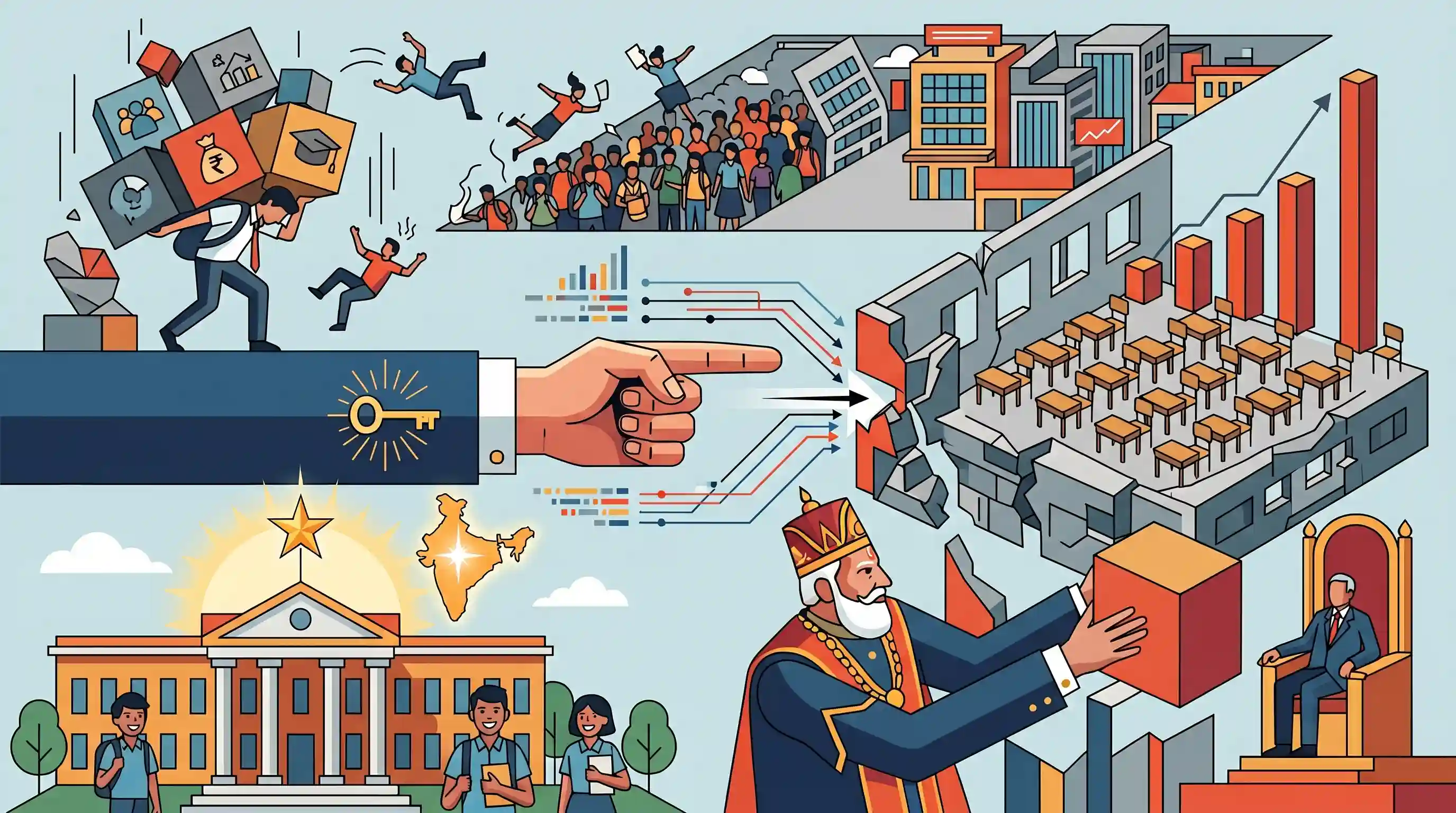
The Supreme Court recently intervened to address the alarming issue of student suicides in higher education institutions (HEIs), linking the crisis to the unregulated massification and privatization of the education sector. Utilizing its extraordinary powers under Article 142, the Court issued directives aimed at both tracking student distress—stemming from social, financial, and academic pressures—and resolving severe administrative paralysis. A critical aspect of this paralysis is the high number of unfilled faculty and administrative vacancies in public HEIs, sometimes reaching 50%. The situation is further complicated by political friction, where recalcitrant Governors have stalled vital appointments, such as Vice-Chancellors, in states like Tamil Nadu. The article argues that overcoming these infrastructural and political hurdles is vital to establishing a robust public education system capable of supporting India's 'Viksit Bharat' aspirations and ensuring student well-being.
Key Points
- The Supreme Court, invoking Article 142 of the Constitution, issued nine directives to the Centre and States regarding the rising rate of student suicides in higher education institutions (HEIs).
- The Court highlighted that the massification of higher education, largely driven by privatization, has lacked corresponding improvements in quality, leading to academic, social, and financial distress among students.
- Seven directives focus on mechanisms for tracking, recording, and reporting student suicides to understand systemic failures, while two mandate the filling of administrative and academic vacancies.
- Many public HEIs suffer from severe faculty shortages, with vacancies reaching up to 50%, undermining the delivery of quality education and increasing the burden on existing staff.
- Administrative paralysis in state universities is exacerbated by political friction, such as Governors stalling the appointment of Vice-Chancellors and faculty members, as witnessed in Tamil Nadu.
- The article stresses that a well-funded, robust public higher education system is essential to support vulnerable students and achieve national goals like 'Viksit Bharat'.
Important Terms
Article 142 of the Constitution

Grants the Supreme Court "plenary powers" to pass any decree or order necessary for doing "complete justice" where existing laws are inadequate.
UPSC context
GS Paper II (Judiciary). Tests understanding of judicial activism and the SC's power to resolve systemic administrative or social crises.
Governor as Chancellor
A statutory role (inherited from colonial legacy) where the Governor acts as the head of state universities, appointing Vice-Chancellors and overseeing administration.
UPSC context
GS Paper II (Polity/Federalism). Critical for analyzing Center-State friction and its impact on the autonomy and functioning of higher education.
University Grants Commission (UGC)
The statutory body responsible for maintaining standards of university education, providing grants, and regulating mental health and safety norms in institutions.
UPSC context
GS Paper II (Education/Governance). Important for tracking the implementation of national education policies and judicial directives on student welfare.
Viksit Bharat
The government’s vision to transform India into a fully developed nation by the centenary of its independence in 2047, focusing on economy and human development.
UPSC context
GS Paper II & III. A recurring theme in governance and economic planning, emphasizing the link between human capital and national prosperity.
Massification of Education
The rapid expansion of higher education enrollment (often via privatization), which risks diluting academic quality and straining infrastructure if not adequately regulated.
UPSC context
GS Paper II (Social Justice). Tests the ability to analyze the challenges of scaling educational access while maintaining student well-being and standards.
Prelims Trap
The Governor acts as the ex-officio Chancellor of state universities under the direct provisions of the Indian Constitution.
Aspirants often confuse the Governor's role as Chancellor as a Constitutional duty. It is purely statutory, derived from individual state university acts, enabling state legislatures to amend laws to remove them.
Static Concepts Connected
What is the scope and limitation of Article 142 of the Constitution?
- Complete Justice: Empowers the Supreme Court to pass any decree or order necessary for doing "complete justice" in any pending matter.
- Pan-India Enforceability: Orders and decrees passed under this article are enforceable throughout the territory of India in a manner prescribed by Parliament.
- Statutory Limits: It is a supplemental equitable power that cannot be used to supplant, ignore, or override express statutory laws.
What is the basis of the Governor's role as Chancellor of state universities?
- Statutory Derivation: The role is not constitutional; it is conferred by specific state university legislations (statutes).
- Independent Discretion: While acting as Chancellor, the Governor is generally not bound by the aid and advice of the State Council of Ministers.
- Punchhi Commission: Recommended that Governors should not be burdened with statutory positions like Chancellor to preserve their constitutional dignity and neutrality.
Cross-Topic Patterns
Article 142 filling executive voids
The SC's directives on student suicides and HEI vacancies reflect a continuous pattern of judicial activism (like the Vishaka Guidelines) acting where executive paralysis or legislative vacuum exists.
Federal friction over University Chancellors
The stalling of Vice-Chancellor appointments connects to recurrent Centre-State disputes, prompting several states to pass bills removing the Governor from the Chancellor post to bypass political gridlock.

Prelims 2026 may test the statutory nature of the Governor's Chancellor role alongside Punchhi Commission recommendations on federalism.
Linked PYQs · 3
Linked PYQs · 3
- 2015MainsGS2
The quality of higher education in India requires major improvements to make it internationally competitive. Do you think that the entry of foreign educational institutions would help improve the quality of higher and technical education in the country? Discuss.
- 2023MainsGS1
Explain why suicide among young women is increasing in Indian society.
- 2014MainsGS2
Should the premier institutes like IITs/IIMs. be allowed to retain premier status, allowed more academic independence in designing courses and also decide mode/criteria of selection of students. Discuss in light of the growing challenges.
