Union Budget 2026-27 Balances Fiscal Consolidation with CapEx Growth
Source:The Hindu ↗
Why It Matters
The Union Budget dictates the macroeconomic direction of the country and is a fundamental topic in GS3. Candidates must understand the nuances of capital versus revenue expenditure, fiscal deficit targeting, and the government's sectoral interventions (like PLI and MSME support) to evaluate India's economic resilience and growth strategies.
Summary
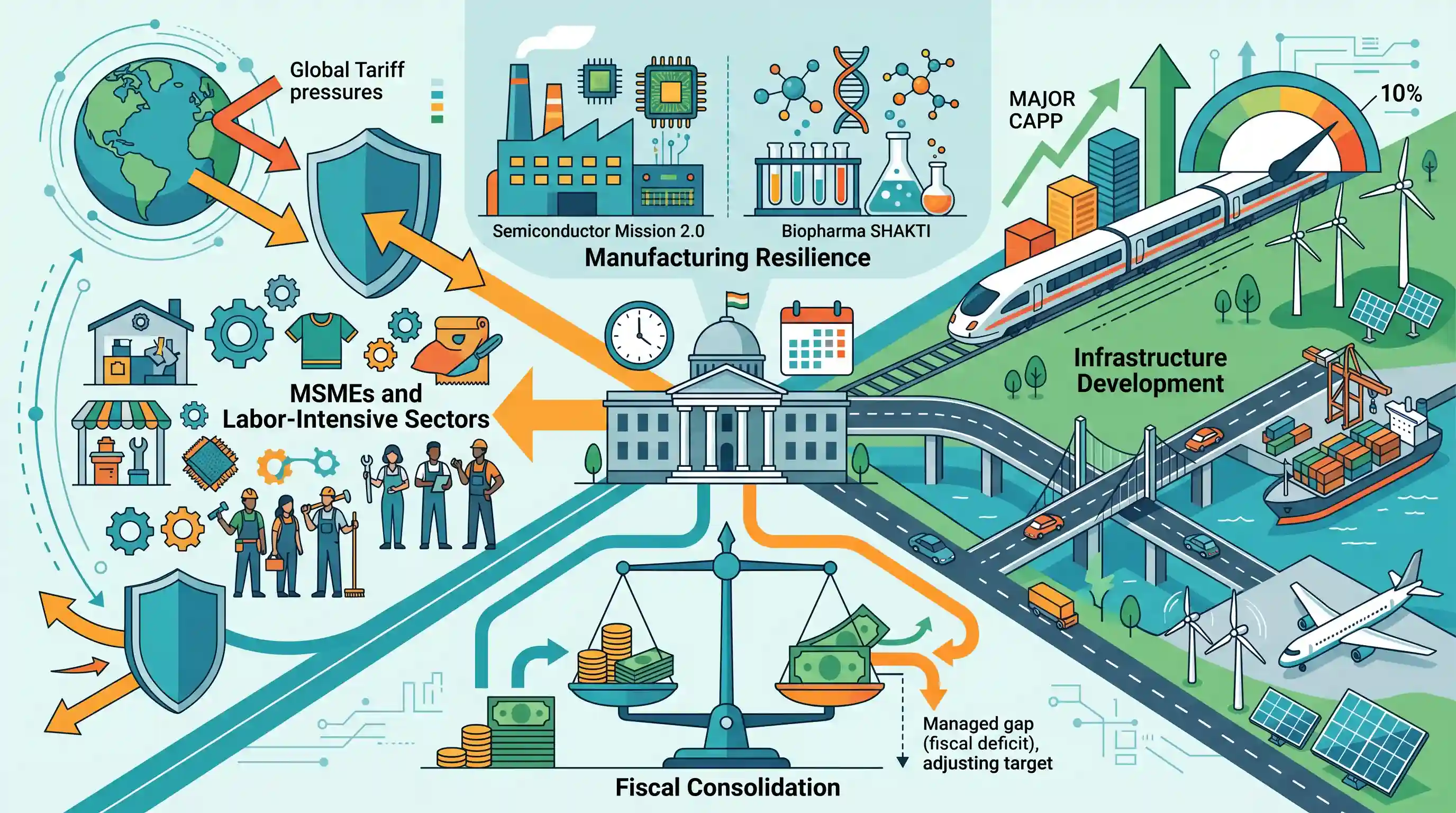
The Union Budget 2026-27 adopts a prudent, sector-specific approach focused on medium-term growth rather than disruptive reforms. It emphasizes manufacturing resilience through schemes like the India Semiconductor Mission 2.0 and Biopharma SHAKTI, alongside targeted support for MSMEs and labor-intensive sectors to counter global tariff pressures. Infrastructure development remains a priority with a record capital expenditure target of 4.4% of GDP. Simultaneously, the government maintains its fiscal consolidation path by projecting a fiscal deficit of 4.3%, balancing expenditure enthusiasm with revenue sobriety.
Key Points
- The Union Budget 2026-27 prioritizes prudence over 'Big Bang' reforms, adopting a sector-specific approach to navigate ongoing geopolitical and geoeconomic uncertainties.
- A strong emphasis is placed on manufacturing and MSMEs through targeted programs like the India Semiconductor Mission 2.0, the Biopharma SHAKTI scheme, and measures to create 'Champion MSMEs' to boost exports.
- Capital expenditure is projected at a record ₹12.2 lakh crore (4.4% of GDP) for 2026-27, focusing on infrastructure creation such as dedicated freight corridors and a Coastal Cargo Promotion Scheme.
- The fiscal deficit target is set at 4.3% of GDP for 2026-27, indicating continued adherence to fiscal consolidation, despite the Economic Survey advocating for greater fiscal flexibility.
- Taxation policy remains sober, avoiding major direct tax cuts while introducing indirect tax relaxations for marine, leather, and textile exports, alongside a projected 13.5% contraction in GST revenue due to rate rationalization.
Important Terms
Biopharma SHAKTI scheme

A ₹10,000 crore flagship initiative (Strategy for Healthcare Advancement through Knowledge, Technology, and Innovation) launched in Budget 2026-27 to transform India into a global hub for high-value biologics and biosimilars manufacturing.
UPSC context
GS Paper III (Economy/S&T); tests pharmaceutical sector reforms, reducing import dependence, and the shift from generics to innovation-led value.
India Semiconductor Mission 2.0
The second phase of India's semiconductor strategy launched in Budget 2026-27, focusing on producing equipment, materials, and indigenous Intellectual Property (IP) to strengthen domestic supply chains and global resilience.
UPSC context
GS Paper III (Industrial Policy/S&T); vital for electronics self-reliance, 'Atmanirbhar Bharat,' and critical technology infrastructure.
National Export Promotion Mission
A digitally driven framework launched to enhance India’s export competitiveness, specifically supporting MSMEs and labor-intensive sectors through affordable trade finance, credit guarantees, and assistance in tackling non-tariff barriers.
UPSC context
GS Paper III (Indian Economy); tests knowledge of export-led growth, trade policy, and MSME support amidst global protectionism.
Coastal Cargo Promotion Scheme
An initiative introduced in Budget 2026-27 to incentivize the shift of freight from road and rail to waterways, targeting a 12% modal share for coastal shipping and inland waterways by 2047.
UPSC context
GS Paper III (Infrastructure); tests understanding of multimodal transport, logistics efficiency, and sustainable maritime development under Amrit Kaal Vision.
Electronics Component Manufacturing Scheme
An industrial incentive scheme whose outlay was increased to ₹40,000 crore in Budget 2026-27 to capitalize on investment momentum and promote domestic production of high-value components like display modules.
UPSC context
GS Paper III (Changes in Industrial Policy); significant for deepening electronics value chains and reducing dependency on component imports.
PLI scheme
A performance-based incentive program providing subsidies to manufacturers based on incremental sales of products made in India, aimed at making domestic manufacturing globally competitive and resilient.
UPSC context
GS Paper III (Economy/Industry); core pillar of industrial policy, testing knowledge of manufacturing resilience and 'Make in India.'
Prelims Trap
Revenue expenditure yields a higher fiscal multiplier than capital expenditure because it directly boosts short-term consumer demand.
Capital expenditure actually has a significantly higher multiplier (~2.45 in India) because it crowds in private investment and builds long-term productive capacity, unlike revenue expenditure.
Static Concepts Connected
What is the Inverted Duty Structure under GST?
- Definition: Occurs when the tax rate on raw materials (inputs) is higher than the tax rate on the finished product.
- Economic impact: Causes input tax credit accumulation, blocking working capital and making domestic manufacturing less competitive compared to imported finished goods.
- Remedy: Addressed through GST rate rationalization, merging or adjusting tax slabs to correct the input-output tax imbalance.
How does Capital Expenditure affect macroeconomic stability?
- Asset creation: Focuses on creating long-term physical assets (like dedicated freight corridors) or reducing liabilities, fundamentally expanding the economy's productive capacity.
- Fiscal multiplier: Has a strong multiplier effect (estimated at ~2.45 in India), meaning every rupee spent generates more than double the economic output.
- Crowding in: Government Capex acts as an anchor that 'crowds in' (attracts) private sector investment by lowering logistical costs and signaling long-term demand.
Cross-Topic Patterns
Semiconductor Mission + Geopolitics
ISM 2.0 links domestic industrial policy directly to geopolitical de-risking and supply chain resilience, paralleling India's strategic stances in the Quad and global critical mineral platforms.
MSMEs + Global Tariff Barriers
Budgetary support for 'Champion MSMEs' to boost exports acts as a macroeconomic shield against rising Western protectionism, such as the EU's Carbon Border Adjustment Mechanism (CBAM).

Expect a multi-statement Prelims question interlinking the Capex fiscal multiplier, GST inverted duty structure, and FRBM glide path.
